
New research examines how polymer blends transition during large format extrusion, a practical issue for anyone mixing materials on pellet-fed systems.
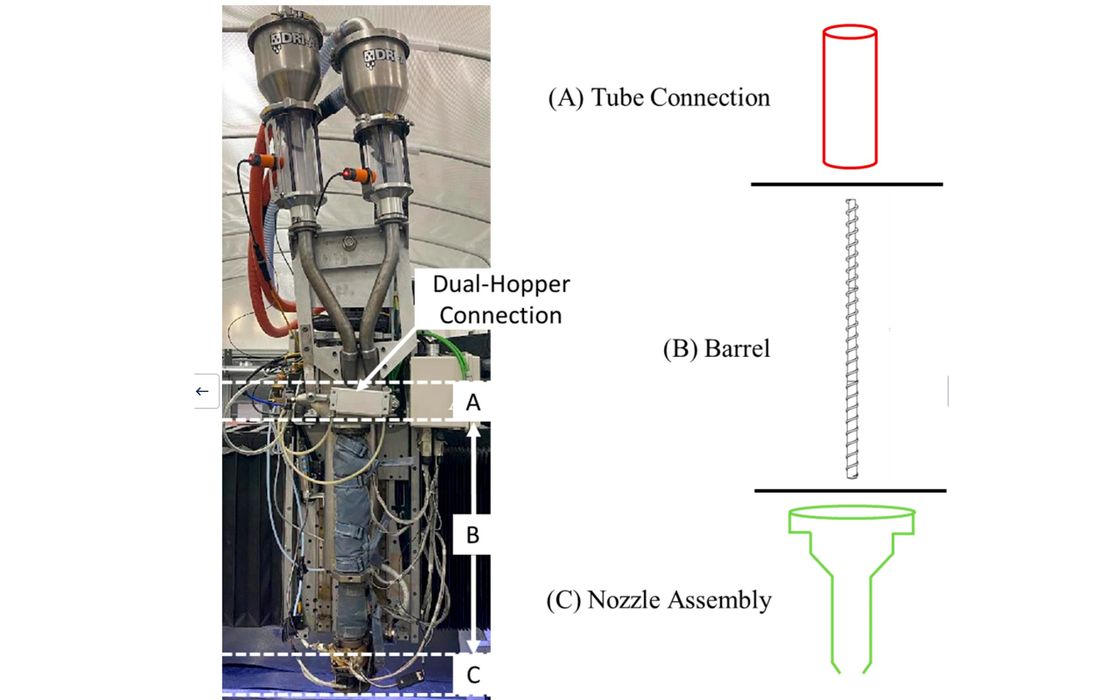
The work focuses on Large Format Additive Manufacturing (LFAM), often called Fused Granulate Fabrication (FGF), where printers feed polymer pellets through a screw extruder to lay very large beads. Systems in this class include industrial platforms like BAAM and LSAM, which are used for patterns, molds, tooling, and oversized parts. Unlike desktop FFF, LFAM commonly relies on compounded pellets and sometimes on-machine blending to manage cost, stiffness, and thermal performance.
When operators switch from one pellet stream to another or alter a blend ratio, the extruder does not change composition instantly. Instead, there is a transition zone in which material properties, color, and flow behavior gradually shift. That seemingly small detail can ripple into dimensional drift, layer bonding issues, surface artifacts, and unexpected mechanical gradients across a part.
Understanding and predicting that transition is central to reliable multi-material jobs, whether the goal is cost reduction with a stiff core and tough skin, faster printing with higher throughput pellets, or color changes for visual indicators. The paper sets out to characterize this behavior and frame it in process terms a production team can use.
Why Transitions Matter In Pellet-Fed Printing
Pellet-fed LFAM moves significant mass through a heated screw and nozzle, which creates residence time and purge volume. When a blend changes from, say, a glass fiber filled grade to an unfilled toughened grade, the extruder holds a buffer of the old composition. The result is a composition ramp that plays out over many toolpath meters and several minutes, depending on bead size, screw geometry, and deposition rate.
In practice, that ramp can shift the melt viscosity and shrinkage behavior mid-layer. The consequence is bead width variation, corner fidelity loss, or local warpage. If the materials are not fully compatible, the transient region may also become the weak link for interlayer adhesion. Even simple color changes reveal this effect as a long gradient rather than a clean boundary.
The authors frame transition behavior in terms of process variables AM teams already track: extruder screw speed, nozzle temperature, melt pressure, toolpath dwell, and commanded blend ratio. While the paper’s abstract signals a focus on transitions in blended materials, it does not list specific machine models, nozzle diameters, or exact purge volumes, which readers should note as an important unknown.
Inside The Transition Zone
Mechanistically, the screw acts as both conveyor and mixer. Material bounces between flights, shears, and partially mixes while temperature gradients collapse. During a ratio change, the screw channels and barrel hold the earlier composition, so the mass fraction of the outgoing melt follows a first order response rather than a step. If an inline static mixer or longer screw is used, the transition may lengthen but smooth out.
Miscalibrated blending can therefore produce zones with unexpected fiber fraction, poor wet-out, or incompatible phase morphology in immiscible pairs. That is especially risky with short carbon fiber or glass fiber pellets, where transient fiber content affects bead sag, anisotropy, and final modulus. The paper’s value is in calling attention to these practical tradeoffs, though it does not provide exhaustive numbers for transition length under defined settings, another gap to keep in mind.
For production, the key economic variable is predictability. If you can model the grams of purge required to reach a new steady state, you can plan toolpaths to hide transitions in sacrificial features, schedule blend shifts at infill rather than perimeters, or print a purge tower analogous to what multi-material desktop machines do. That reduces human touch time by avoiding rework and limits scrap that would otherwise erase the cost advantage of commodity pellets.
Software also needs to catch up. Most slicers for LFAM do not yet let users associate composition with time and path location in a closed loop manner. Gravimetric feeders and melt pressure sensors could enable control logic that hits a target composition within one or two beads, but the paper does not indicate whether such closed loop demonstrations were performed.
Looking forward, adoption will hinge on concrete, auditable data. Service bureaus and in-house tooling cells will want transition length in meters as a function of bead size and flow, mechanical test coupons extracted across a gradient, and microscopy that shows phase morphology or fiber distribution during the transient. That would make it easier to write work instructions that guarantee part performance.
There are risks to watch. Moisture, pellet lot variability, and colorants can all change melt rheology and therefore the transition profile. Material compatibility is another constraint; mixing semicrystalline and amorphous polymers, or different fiber loadings, may require adhesion promoters and temperature profiles that are not trivial to maintain across a large, heated envelope.
Still, putting numbers and mechanisms to LFAM blending is a step toward multi-material production that is deliberate rather than hopeful. If transitions can be predicted and routed as intentionally as infill, large format might finally deliver graded structures on purpose instead of by accident.
Via Polymers
