
Researchers at Nanyang Technological University have 3D printed sacrificial molds to create a self-sensing soft continuum robot that reconstructs its shape with machine learning.
Hold on, what’s a continuum robot? A continuum robot is a robot whose body bends smoothly like an elephant trunk, snake, octopus arm, or flexible endoscope, rather than moving through a small number of rigid joints like an industrial robot arm.
Continuum robots are appealing for constrained or delicate tasks, but shape feedback is their Achilles’ heel.
The premise put forward by the researhers is straightforward: turn the robot’s body into the sensor using a conductive polymer composite (CPC), and let a learning model interpret the messy signals.
Rather than directly printing elastomer composites, the group 3D printed polyvinyl alcohol (PVA) sacrificial molds for a Yoshimura origami lattice, then cast a graphite–PDMS CPC into that architecture. The result is a cylindrical mesh that bends freely and carries an embedded, distributed resistive network, eliminating post-assembly sensors.
How The 3D Printed Lattice Becomes A Sensor
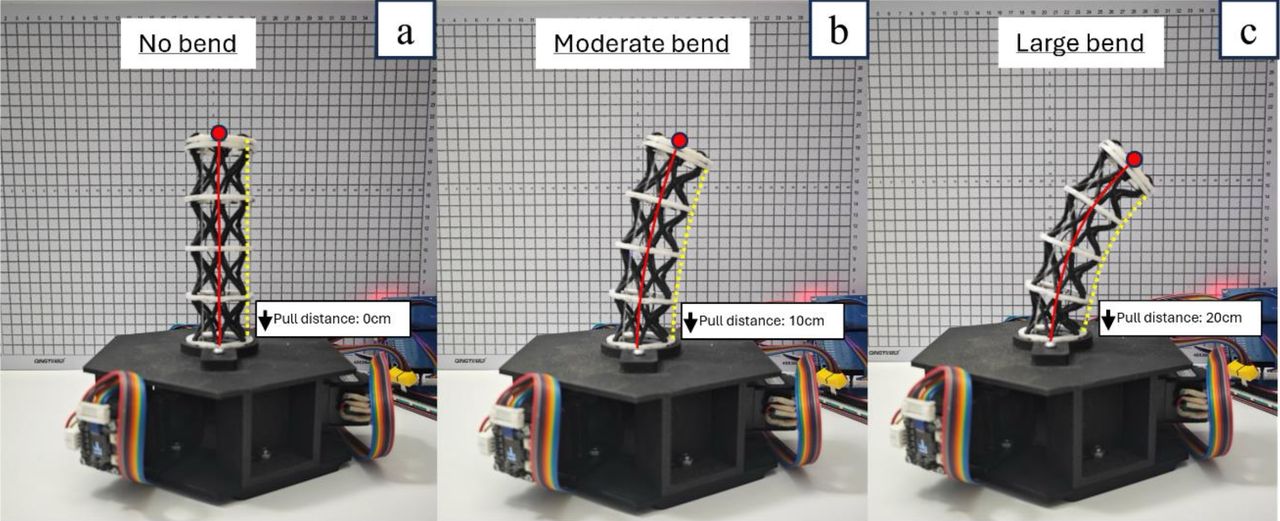
Each segment is about 30 mm long and 40 mm in diameter, with twelve CPC struts in an X-pattern between rigid rings. Four segments stack to form a roughly 120 mm robot with a stiffness gradient — slightly thicker lower struts for stability, thinner upper struts for compliance. Copper mesh electrodes are embedded at each end during casting for low-noise contacts, and three tendons driven by motors in the base provide actuation.
The CPC formulation is: Sylgard 184 PDMS with 33 wt% graphite, cured at 60C for twelve hours. Below about 25 wt% the composite becomes too resistive; above 40 wt% it turns brittle. The team reports stable, repeatable piezoresistive behavior with some hysteresis and drift, which can make calibration annoying and leads to their data-driven model instread.
For electronics, a compact board samples six resistance channels at 100 Hz and fuses them with tendon inputs. In operation, the system reconstructs shape and tip position near real time. Reported accuracy is interesting: a mean tip position error of 3.8 mm and an end-effector RMSE of 6.3 mm, even when the robot is disturbed by external loads that a pure kinematic model would miss.
Machine Learning For Shape And Object Inference
The model is a Conformer — convolution for local features plus a Transformer encoder for temporal dependencies — trained on time windows of the CPC signals plus tendon displacements. Instead of forcing a closed-form map from resistance to curvature, the team pairs learning with a Cosserat rod model to maintain physical consistency in the reconstructed backbone.
There is more. The same self-sensing lattice, extended to six segments as a static gripper, classified grasped-object geometry without cameras. Using only resistance time-series and a simple SoftMax classifier, it reached 85% accuracy distinguishing none, cylinder, square, and triangle rods. In other words, the structure’s own deformation encodes useful context for manipulation.
This is a very interesting move for soft robotics and AM. 3D printed sacrificial molds let you manufacture delicate, repeatable lattices that would be difficult to assemble by hand. Integrating sensing into the architecture reduces wiring, improves durability, and keeps the form factor intact. For labs and service groups prototyping inspection tools or medical manipulators, this approach could cut BOM cost and touch time while boosting reliability.
