
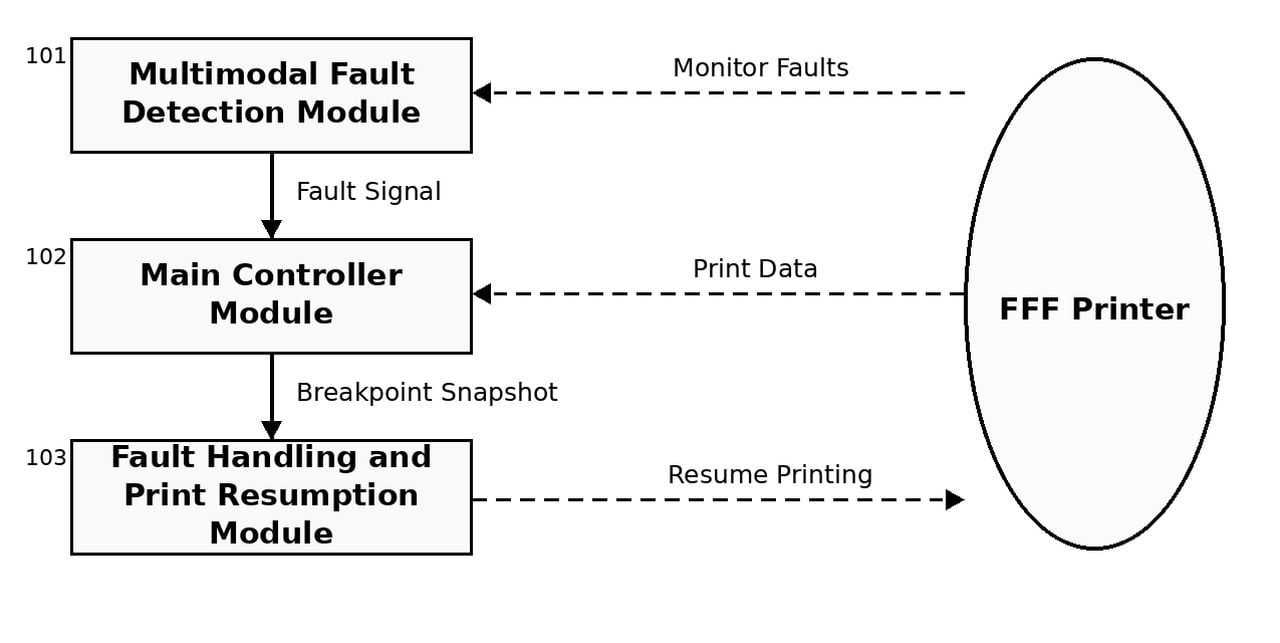
A Chinese patent application describes a way to make FFF printers recover more intelligently from nozzle clogs and filament breaks.
The application, CN122143344A, was filed by Hunan Boxiang New Materials Co., Ltd. and published on 5 June 2026. The title translates roughly to “Fault Detection and Processing System and Method for an FDM Printer.”
The patent proposal is not just another filament runout sensor. It combines several functions that are usually handled separately, or not handled at all: real time fault detection, emergency print stoppage, breakpoint recording, and controlled print recovery.
That combination is what makes this patent interesting.
The patent lists two typical failures. The first is nozzle blockage, caused by material impurities, temperature problems, or carbonized material during long prints. The second is filament breakage in the feed path, which can happen with brittle filament or a sharply bent guide tube.
Most 3D printer operators have seen both of these issues. The result is usually the same: the printer continues moving while little or no material is being deposited, and the operator discovers the problem long after the part has been ruined.
The proposed system watches the filament feed motor. If the nozzle begins clogging, extrusion resistance rises and the feed stepper motor must work harder. That shows up as higher current or torque. If filament breaks or disappears from the feed path, resistance drops, and motor load falls below normal.
In other words, the machine is not merely asking, “Is there filament at the sensor?” It is asking, “Does the extrusion system feel right?”
The patent then adds a secondary confirmation mechanism for breakage detection. A microswitch or photoelectric sensor can be placed near the feeder outlet or feed tube entrance to confirm whether filament is actually present. This is intended to reduce false positives when the motor load suggests a break but filament is still detected.
Motor load monitoring can be sensitive, but it can also be noisy. Different materials, speeds, temperatures, retractions, and spool drag can all change the load profile. A second sensing mode may help, provided the thresholds are tuned properly.
The recovery method may be more important than the detection.
According to the patent, the printer controller continuously records print position and print state, including layer height, X and Y coordinates, executed G code line, extruder status, and speed parameters. When a fault occurs, the controller stops the print and saves a breakpoint snapshot to non volatile memory such as an SD card or mainboard flash.
After the user clears the physical problem, the printer can resume from that snapshot. The recovery sequence moves the print head to a safe start position above the already printed area, performs a timed air extrusion to restore smooth material flow, returns to the failure position, and continues executing the remaining GCODE.
This could reduce waste on long prints, especially large objects where a failure after many hours is painful. It could also be useful for print farms, where operator time and material waste are both real costs.
But there’s one issue: recovery from an extrusion failure is rarely perfect.
If a nozzle clog caused under extrusion for several lines before detection, the part may already have a weak zone. If a filament break occurs during a cosmetic surface, resuming accurately may still leave a visible scar. If the print cooled during fault correction, adhesion between the old and resumed layers may be compromised.
This kind of system lives or dies in firmware tuning. The same concept that works well on PLA at moderate speed may behave differently with TPU, carbon fiber filled nylon, abrasive materials, or high speed printing profiles.
Anyway, this is a pretty sensible approach. Many desktop FFF printers already have increasingly capable controllers, current sensing drivers, and filament sensors. The big commercial question is whether 3D printer manufacturers can turn those ingredients into reliable recovery rather than another ticky box specification.
A patent is obviously not a product, but it does suggest Hunan Boxiang New Materials is thinking forward here. For FFF users, it’s not just detecting failure. It is saving the print after failure without pretending that nothing happened.
Via Espacenet
