
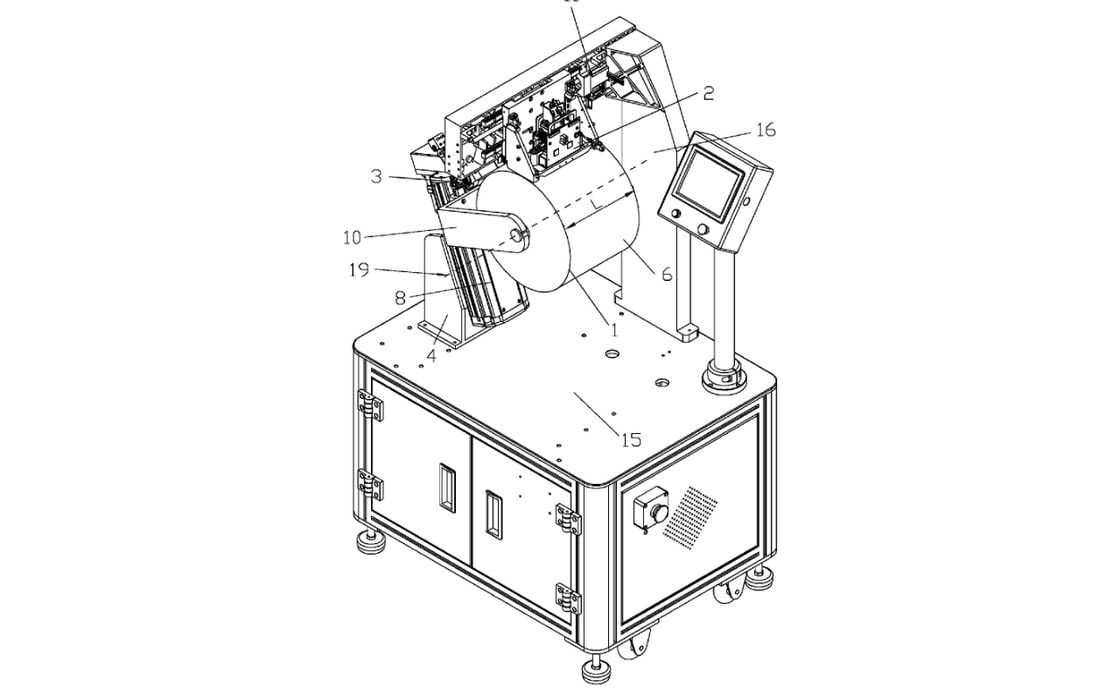
A newly published Chinese patent describes a cylindrical, continuously rotating inkjet 3D printer that aims to boost jet on time and throughput.
The application targets MultiJet Printing (MJP) workflows, where reciprocating planar motion wastes time accelerating and decelerating between jet-on passes. The patent describes current systems, such as 3D Systems’ Projet MJP 2500W, as constrained by low effective jetting duty cycle. Prior proposals improved turnarounds but introduced nonuniform linear speed across the radius, complicating nozzle timing and wasting potential jet frequency.
Here the inventors turn the build surface ninety degrees. Instead of a flat bed, the print surface is the sidewall of a rotating cylindrical platform. A stationary carriage holds the inkjet head opposite the sidewall and moves it linearly along the cylinder’s axis. By eliminating reciprocating XY scans and keeping rotation unidirectional, the concept tries to convert motion time into deposition time.
Rotary Cylinder, Axial Carriage, Spiral Slicing
Mechanically, the cylinder spins at a controlled angular velocity while the printhead moves along the axis, continuously jetting wax or UV-curable resin. A planarization device, such as a leveling roller mounted behind the head, smooths the just-deposited material. A UV curing module can follow for photopolymer builds, or the system can operate warm for phase-change wax. The platform also shifts away from the head along a defined diagonal, so that a full layer is achieved in two passes: half the thickness on the outbound traverse and the remainder on the return.
To feed this motion, the patent proposes generating a spiral, continuous slice rather than conventional discrete layers. The software wraps a spiral surface around a virtual cylinder and intersects it with the model to yield a single continuous toolpath. In a worked example, with a 500 dpi target resolution and a head at 100 dpi nozzle pitch of 0.254 mm, each full rotation advances the head axially by 0.0508 mm, and after five rotations the head has shifted one nozzle pitch.
The inventors note two control strategies as the build grows outward: keep angular speed constant and increase jet frequency as the radius increases, or slow the angular speed so the line speed at the printing surface stays constant and jet frequency remains unchanged. Either approach aims to keep deposition density consistent as geometry expands radially.
Efficiency Claims And Practical Constraints
On paper, the design addresses several known inefficiencies. Continuous rotation removes turnarounds and acceleration ramps, lifting the share of time spent actually jetting. A long leveling roller spanning the effective print length reduces motion complexity and should improve surface uniformity. Radial supports can pack parts more tightly around the cylinder, which could be attractive for jewelry wax trees and other small parts requiring high throughput.
However, there are gaps typical of patents. No build volume, head configuration, or throughput numbers are provided. Synchronizing angular speed, axial feed and platform retreat will require precise closed-loop control, particularly as the printing radius grows with each layer. Wax management (temperature control, viscosity stability) and photopolymer UV dosing across a curved track need validation. Polygonal-cylinder variants reduce rotary complexity but can imprint facet artifacts unless planarization and jet timing are tightly coordinated.
If realized, this could appeal to service bureaus and jewelry manufacturers who already rely on MJP for fine wax patterns, as well as dental labs and design studios seeking reliable small-part runs. The economics hinge on demonstrated parts per hour, material yield, and post-processing simplification — especially support removal for radially generated supports. IP overlap with incumbent MJP portfolios will also influence commercialization paths.
We should watch for a prototype showing continuous spiral jobs, quantified duty cycle gains, dimensional accuracy over long axial lengths, and consistent surface finish. If those arrive with clear software and calibration workflows, expect interest at trade shows later this year; if not, this may remain a compelling idea awaiting the right integrator.
Sometimes the fastest way across a build is around it.
Via Google Patents
