Anthony Palumbo and Charles Goulding examine how emerging carbon-negative construction materials, combined with advances in sustainable additive manufacturing and 3D printing, signal a structural shift toward climate-positive manufacturing and construction ecosystems.
Introduction
Concrete remains the foundational material of modern infrastructure, yet it carries a significant environmental burden. Conventional Portland cement production is responsible for approximately eight percent of global carbon dioxide emissions, largely due to the high-temperature calcination of limestone and the energy-intensive processes required to manufacture and cure cementitious materials at scale. As global construction demand continues to rise, this emissions profile has become increasingly incompatible with climate targets and sustainability mandates. We recently spotlighted this issue in our January piece, Clay: Earth’s Abundant Material and 3D Printing, on Fabbaloo.
Recent research from Worcester Polytechnic Institute (WPI) introduces a fundamentally different materials pathway. Researchers have developed a bioinspired enzymatic structural material (ESM) that actively absorbs carbon dioxide during curing rather than emitting it. The material sets rapidly under ambient conditions, offers tunable mechanical properties, and avoids the high-temperature processing intrinsic to traditional cement. While still at a research stage, this development highlights a broader transition underway in materials science, one in which construction materials are no longer evaluated solely on strength and durability, but also on their carbon behavior across the lifecycle.
Within the additive manufacturing (AM) ecosystem, this shift carries particular significance. AM is increasingly positioned not just as a production method, but as a materials-efficient manufacturing platform capable of supporting carbon-aware design, localized fabrication, and circular material flows. Carbon-negative and low-carbon materials such as ESM point toward a future where additive manufacturing and sustainable construction evolve in parallel rather than as separate domains.
Breaking Down the New Carbon-Negative Material
The enzymatic structural material developed at WPI relies on biologically inspired chemistry rather than conventional cement hydration. Enzymes catalyze reactions that convert atmospheric or captured carbon dioxide into solid mineral components, which then bind into a load-bearing matrix. Unlike Portland cement, which inherently releases CO₂ during limestone decomposition, this process embeds carbon directly into the material structure as it forms.
Quantitatively, the contrast is notable. Traditional concrete production emits on the order of 300 to 330 kilograms of CO₂ per cubic meter. In comparison, the WPI material has been shown to sequester more than 6 kilograms of CO₂ per cubic meter during formation. While this does not offset all emissions associated with construction, it represents a reversal of the traditional emissions profile and establishes carbon capture as a material property rather than an external mitigation step.
Equally important is the material’s processing behavior. ESM cures within hours under mild conditions, enabling rapid fabrication without kilns or prolonged curing chambers. Its mechanical properties can be adjusted through formulation changes, and the material is designed to support repair or recycling at end of life. These characteristics align closely with the requirements of digital fabrication and modular construction, where fast turnaround, material efficiency, and predictable performance are critical.
Sustainability Trends Reshaping AM Materials
The emergence of carbon-negative construction materials is part of a wider sustainability transformation already underway within additive manufacturing. Across polymer, composite, and hybrid material systems, AM researchers and manufacturers are actively rethinking feedstocks, processing energy, and lifecycle impacts.
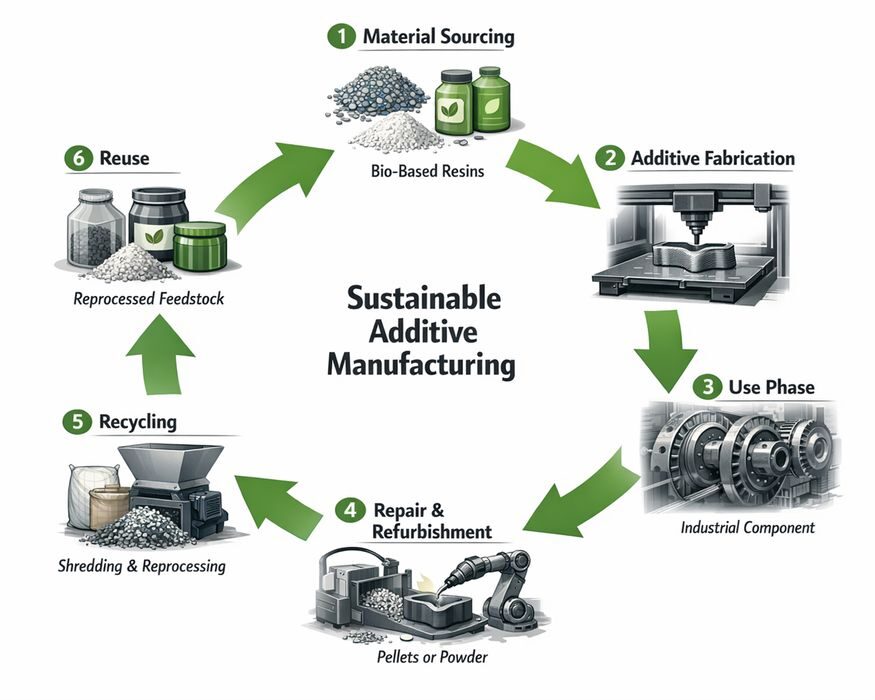
Bio-based composites and biodegradable polymers remain one of the most mature sustainability pathways in 3D printing. Polylactic acid (PLA), derived from renewable plant sugars, has long served as an entry-level example, but current research is pushing beyond simple substitution. New bio-derived resins, engineered monomers, and hybrid polymer systems are being developed to retain mechanical and thermal performance while reducing reliance on fossil-based inputs. These materials are increasingly evaluated not just for printability, but for recyclability, compostability, and compatibility with closed-loop manufacturing systems.
In parallel, recycled feedstocks for AM are gaining industrial traction. Mechanical recycling of post-consumer and post-industrial plastics into usable filaments and pellets is becoming more common, particularly for large-format extrusion systems. Some research efforts extend further by integrating CO₂-derived polymers or mineral fillers into recycled materials, effectively combining waste reduction with carbon utilization. These approaches reduce dependence on virgin materials while extending material lifecycles within AM production environments.
Natural fiber and bio-composite filaments represent another growing category. By reinforcing polymers with cellulose, hemp, or other plant-based fibers, manufacturers can reduce overall plastic content while improving stiffness and strength for certain applications. Such composites are especially relevant for extrusion-based AM processes used in furniture, tooling, and construction-adjacent applications, where part size and material efficiency often outweigh fine surface resolution.
Lifecycle Thinking and Sustainability Metrics in AM
As sustainable materials proliferate, the AM industry is also developing more rigorous methods for evaluating their environmental impact. Life-cycle assessment frameworks tailored specifically to additive manufacturing are increasingly used to quantify energy consumption, material sourcing impacts, waste generation, and end-of-life pathways. These assessments highlight that sustainability gains often arise from system-level decisions rather than material choice alone.
For example, additive manufacturing can reduce waste through near-net-shape fabrication, eliminate tooling, and enable localized production that reduces transportation emissions. When combined with sustainable materials, these process advantages become more pronounced. Lifecycle metrics allow manufacturers to identify where the greatest environmental benefits occur, whether through material substitution, print strategy adjustments, or improved recyclability and reuse.
Additive Manufacturing in Sustainable Construction Systems
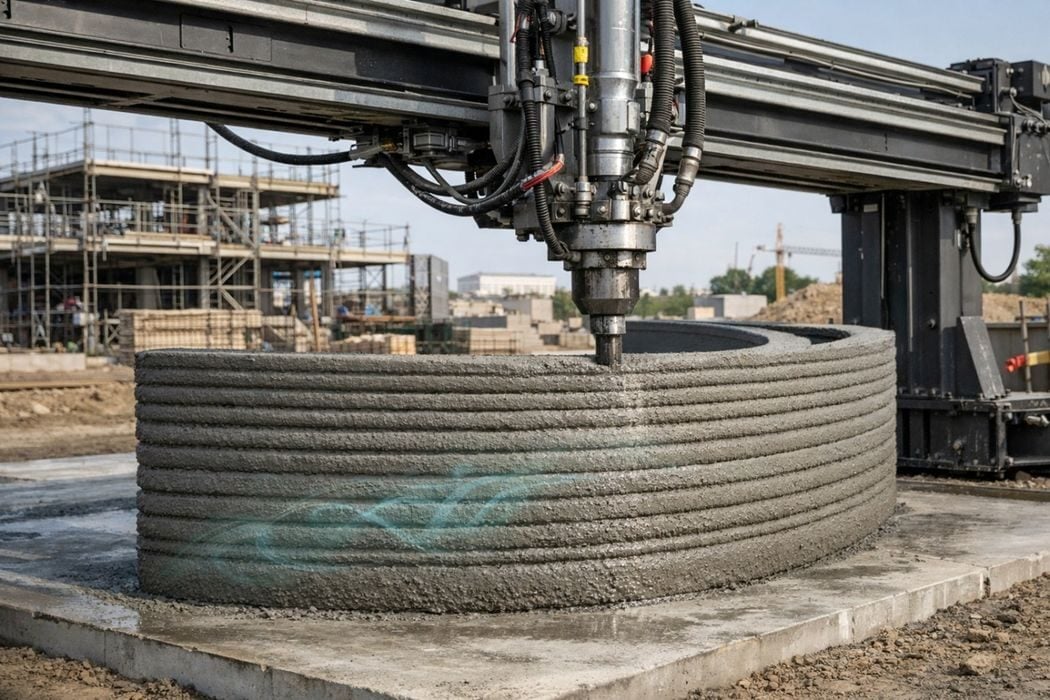
The convergence of additive manufacturing and sustainable construction materials represents one of the most consequential opportunities for emissions reduction in the built environment. Large-scale AM techniques, including binder jetting and gantry-based extrusion systems, are already being deployed to fabricate walls, structural elements, and modular building components. These systems are well suited to materials that cure rapidly, require minimal post-processing, and benefit from precise deposition control.
Materials such as enzymatic structural composites could, in principle, be adapted for additive or hybrid fabrication workflows, either printed directly or formed into prefabricated modules. At the same time, architectural experimentation with clay, mycelium-based composites, and other bio-derived materials demonstrates a growing willingness to rethink construction materials from both environmental and design perspectives.
Additive manufacturing also aligns naturally with lifecycle-oriented construction strategies. Digital design enables modularity, repairability, and material traceability, while AM fabrication supports localized production and reduced material waste. These characteristics complement carbon-aware materials by extending sustainability benefits beyond the curing phase and into long-term building use and maintenance.
Future Directions and Remaining Challenges
Despite rapid progress, sustainable additive manufacturing faces several unresolved challenges. Environmentally favorable materials do not always meet the mechanical, thermal, or durability requirements demanded by industrial and construction applications. Continued research is needed to balance sustainability metrics with performance consistency and regulatory compliance.
Scalability remains another hurdle. Novel materials such as enzymatic structural composites must demonstrate cost competitiveness, supply chain reliability, and repeatable manufacturing performance before they can meaningfully disrupt entrenched industries like concrete production. In parallel, a circular AM ecosystem requires robust recycling infrastructure, standardized material data, and coordinated supply chains capable of supporting recycled and bio-derived feedstocks at scale.
Even with these challenges, the overall trajectory is clear. Materials science innovations that embed carbon capture, recyclability, and energy efficiency directly into material systems are moving from academic research into practical manufacturing pathways.
The Research & Development Tax Credit
The now permanent Research and Development (R&D) Tax Credit is available for companies developing new or improved products, processes, and/or software. 3D printing can help boost a company’s R&D Tax Credits. Wages for technical employees creating, evaluating, and revising 3D printed prototypes are typically eligible expenses toward the R&D Tax Credit. Similarly, when used as a method of improving a process, time spent integrating 3D printing hardware and software can also be an eligible R&D expense. Lastly, when used for modeling and preproduction, the costs of filaments consumed during the development process may also be recovered.
Whether it is used for creating and testing prototypes or for final production, 3D printing is a great indicator that R&D Credit-eligible activities are taking place. Companies implementing this technology at any point should consider taking advantage of R&D Tax Credits.
Conclusion
The development of rapid-setting, carbon-negative construction materials illustrates how materials innovation can directly support global sustainability objectives. Within additive manufacturing, parallel advances in bio-based polymers, recycled feedstocks, and lifecycle-aware production are reinforcing the same trajectory. When combined with digital fabrication strategies and large-scale AM systems, these materials point toward a future in which manufacturing and construction contribute not only to reduced emissions, but to climate-positive outcomes. Additive manufacturing is increasingly positioned not as a niche technology, but as a central platform for realizing carbon-aware, resilient, and sustainable built environments.