
A new patent filing describes an AI driven 3D printer that could automate patient specific implant production with minimal human touch time.
Custom implant workflows are still manual in many hospitals. Imaging data goes out, CAD happens elsewhere, and a service bureau runs validated builds before shipping parts back for surgery.
The patent puts a number on the problem: it claims the end to end cycle from identifying a defect site to receiving an implant can take about seven days, which is a long wait when a patient is in a surgical queue.
The proposed system uses a familiar additive manufacturing (AM) method: fused filament fabrication (FFF). Most “hospital adjacent” implant situations today default to using LBPF, powered bed fusion, binder jet, or machining for metals, while polymers and resorbables often live in smaller, more distributed toolchains. The patent provides examples include cheekbone, skull reconstruction material, and knee joint components, framed as implantable Class IV medical devices.
What makes the filing interesting is not the extrusion hardware itself, but the formal definition of a closed loop from patient inputs to print code, then back again through inspection and machine learning.
The core architecture proposed is a set of modules: an input stage takes patient defect location, geometry, and dimensions, plus raw material information; a modeling stage uses a deep learning model to generate or adapt 3D modeling data; a slicing stage derives production conditions and converts them into GCODE; and a code modifying stage edits that GCODE based on “print environment conditions” intended to keep quality above a threshold.
The patent proposes that the system does not stop at selecting temperature and speed. It also tries to predict and then enforce path level choices that influence quality, especially extruder travel routes. The patent provides a very FFF specific example: even if temperature and other parameters stay the same, the order and path of nozzle movement can degrade quality if the toolpath crosses sensitive regions. The code modifying module can flag commands that violate the chosen environment conditions and rewrite them, with nozzle travel path called out as a primary variable.
Materials are also clearly scoped to thermoplastics suitable for medical use, naming polycaprolactone (PCL), polydioxanone (PDO), and polylactic acid (PLLA). Those are not generic hobby filaments, and each brings a different melt behavior, shrink profile, and handling constraints. The patent’s slicing software step ties parameter selection to material properties, which is the right direction for any serious attempt at repeatability.
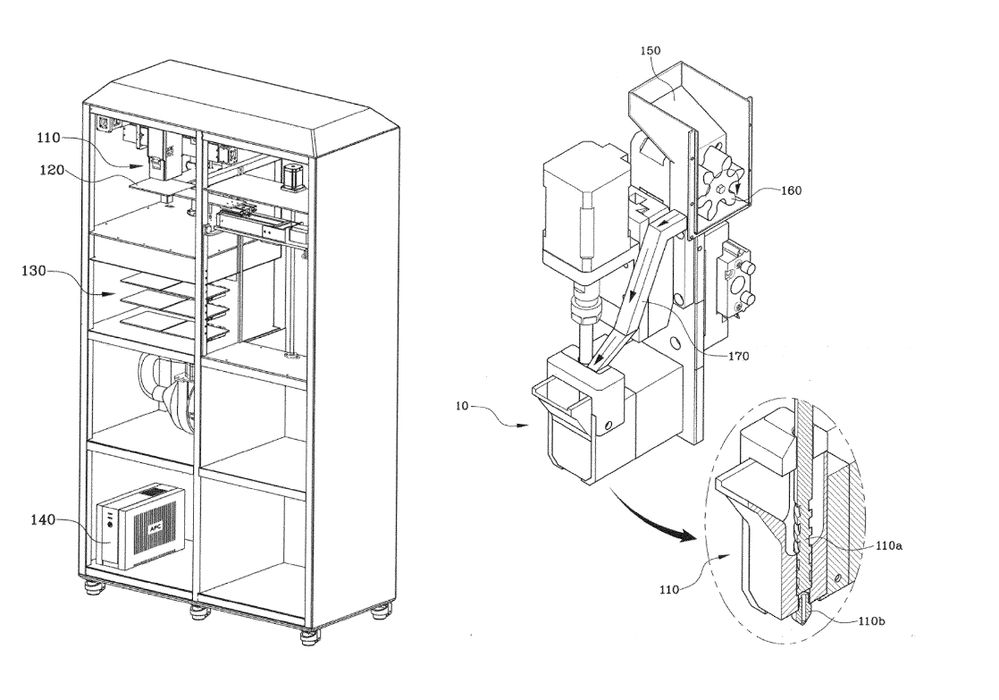
The mechanical description adds a few practical features intended to facilitate unattended operations. There is a storage bin for raw material and a rotating member inside it; by controlling rotation speed, the system controls feed rate into the extruder. There is also a plate transport mechanism to move completed builds along a defined path, implying some level of automated plate swapping or staging for the next job.
The feedback loop is where the “AI” claim smartens up the system. Quality inspection results can be collected via vision camera image analysis or manual inspection, and only “good” results above a threshold are fed back into the deep learning model along with the production conditions and generated command code. That is a pretty conservative choice: it intends on preventing the model from learning from failed prints, but it also means the system may miss valuable failure data unless a parallel “negative learning” pipeline exists outside the patent’s scope.
There is even a voice command module, with examples like “increase output” or “increase printing speed,” where the deep learning model determines a quantitative adjustment, such as a ten percent change, based on prior successful cases with similar patient and material inputs.
As a patent, this is an idea and definitely not a proven product. It does not provide throughput numbers, accuracy, mechanical testing, sterilization compatibility, or regulatory pathway details. For implantable Class IV devices, there would be multiple certifications required. A closed loop that edits GCODE automatically could be a strength for consistency, but it could also become a compliance headache unless every change is logged and requires justification. How do you certify something that changes when used?
The direction here is still quite interesting. A closed loop system for implants could provide a competitive advantage in medical AM with auditable workflows that reduce labor and compress lead time. If a vendor using this approach can genuinely turn patient data into a validated build with minimal human intervention, then the “seven day” cycle could disappear.
Via WIPO Patentscope
