
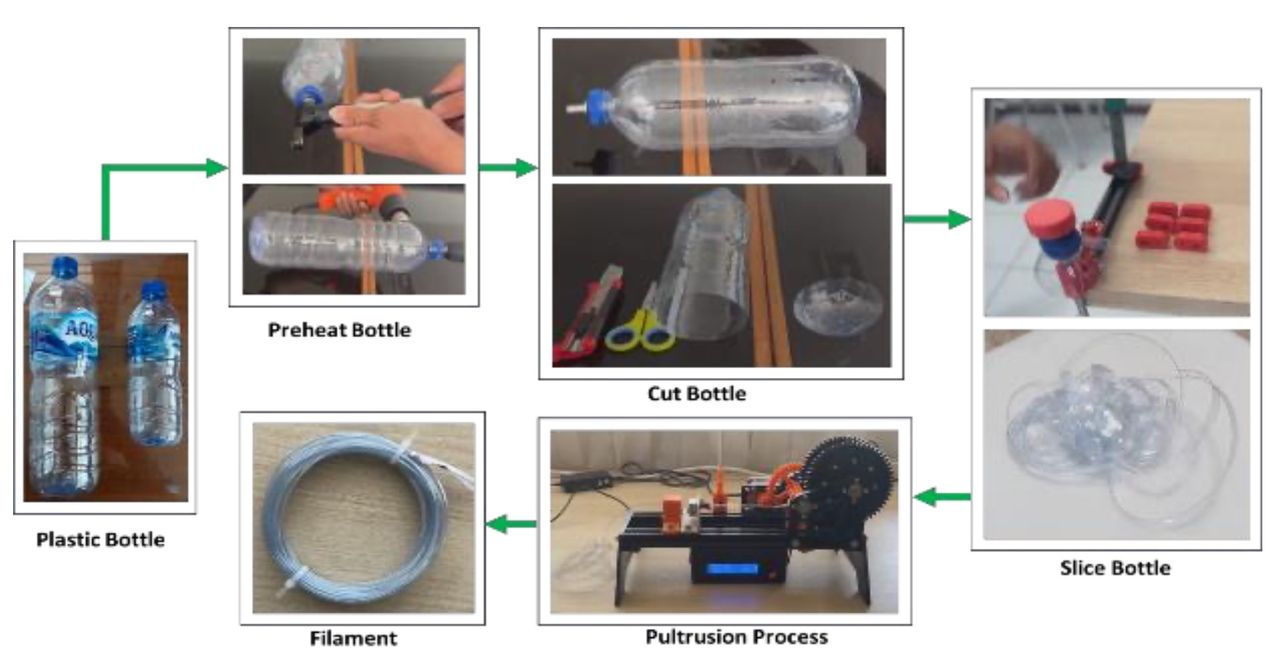
Turning an old PET bottle into 3D printer filament sounds almost absurdly simple.
Cut the bottle into a long strip, pull that strip through a heated forming zone, wind the result onto a spool, and you’ve got recycled filament.
Except, of course, the bottle itself can make the whole process unpredictable.
That’s the focus of a recent study titled Pultrusion-Based Recycling of PET Bottle Waste into FDM Filaments: Effects of Feedstock Geometry on Filament Quality. Rather than concentrating only on heater temperature or pulling speed, the researchers looked farther upstream at something much more basic: the shape and consistency of the PET strip going into the machine.
That turns out to matter quite a bit.
A PET bottle is not a nice, standardized feedstock. Its walls curve. Thickness can change. There are shoulders, a shaped base, labels, adhesives and whatever contamination remains from its previous life.
So before any recycling machine even starts heating the plastic, variation has already entered the process.
The Bottle Strip Is Really a Process Parameter
In this type of system, a long strip cut from the bottle is pulled through a heated forming section and reshaped into filament.
The clever part is that this avoids first grinding the bottle into flakes or pellets.
But it also means the dimensions of the strip directly determine how much plastic is entering the forming zone at any moment.
If the strip suddenly gets wider or thicker, more material arrives. If it gets narrower, less arrives. Even with perfectly stable heater temperature and pulling speed, the resulting filament diameter can wander, and that can cause problems.
FFF printers assume filament is reasonably consistent. If its diameter changes along the spool, the printer can effectively be fed too much or too little material, producing overextrusion or underextrusion.
Now the bottle-cutting step looks a lot more important.
For low-cost recycling setups, this suggests that improving the cutting fixture could be just as useful as improving the heater. Controlling strip width, choosing bottles with suitable wall geometry and measuring filament diameter could all have a major effect on the final result.
Waste preparation isn’t just something you do before the real manufacturing process. It is part of the manufacturing process.
Making a Strand Is the Easy Part
There is another catch: Even if the system produces beautifully consistent filament diameter, that does not automatically make it good printing material.
PET can absorb moisture, and heating wet PET can degrade it. Bottles can also contain colorants, coatings, residues and differences in resin formulation.
Then there’s the question of what repeated thermal processing has done to the polymer.
So a working bottle-to-filament machine still has to deal with drying, contamination, quality control and actual print testing. Mechanical properties and surface quality would need to be checked before the resulting material could reasonably be treated as dependable engineering filament.
This almost always gets lost in recycling demonstrations.
Making something that looks like filament is one achievement. Making a spool that can be loaded into a printer and used predictably from beginning to end is quite another.
Commercial filament producers already spend a great deal of effort on diameter control, drying, material consistency and spooling. Starting with free waste plastic does not make those requirements disappear. They are still there!
The study’s emphasis on feedstock geometry is especially useful because it points toward a relatively simple part of the process that may have been underestimated.
Via Journal of Jordanian Mechanical and Industrial Engineering
