
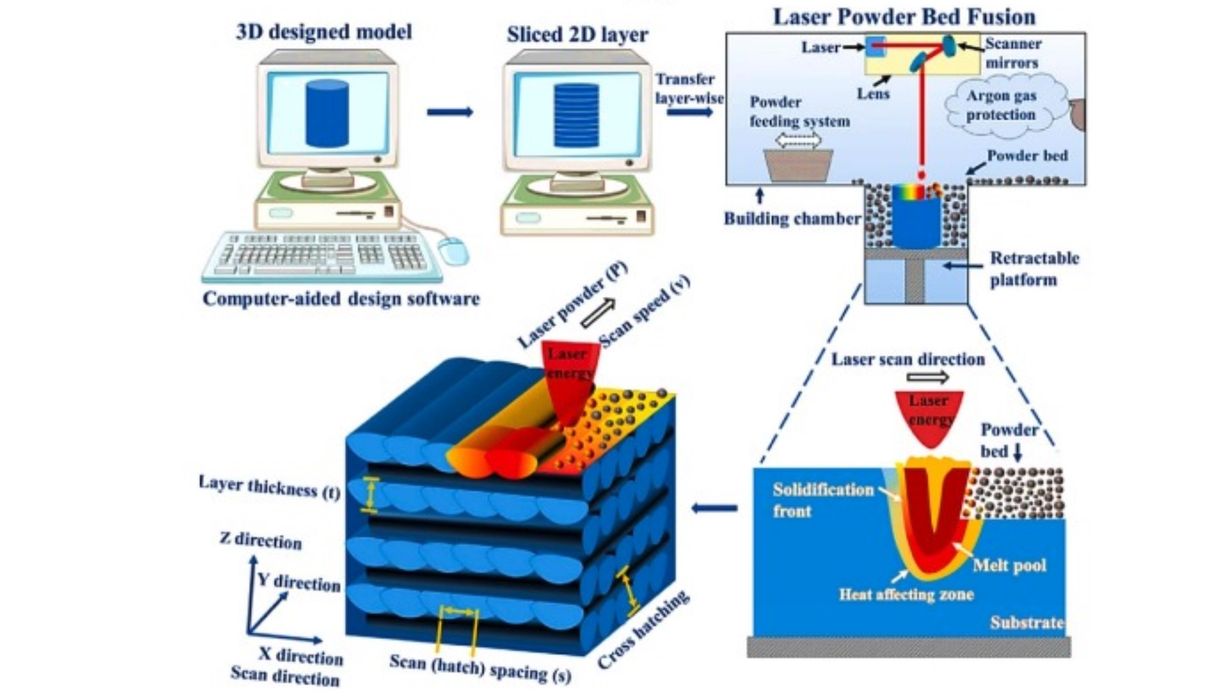
What if an LPBF system could predict what its melt pool was about to do in less than 50 milliseconds?
That’s the idea behind doctoral work by Dexiang Zha, who has been experimenting with physics-informed neural networks, or PINNs, for laser processing.
That prediction time is the story here. Full Computational Fluid Dynamics simulations can provide extremely detailed information about a melt pool, but they’re far too computationally expensive to run inside a real-time printer control loop.
A PINN offers a shortcut.
The neural network is trained with some physics built into the process. In this case, the network has to follow a heat-conduction equation along with appropriate initial and thermal boundary conditions. When its predicted temperature field violates those rules, the training process penalizes it.
That means the network doesn’t have to discover the entire thermal world by staring at mountains of experimental data. It already knows some of the rules.
Zha used a double-conical heat source extending into the material. You can picture this as two joined cones describing how laser energy is distributed below the surface.
That shape is intended to better represent keyhole-mode processing, where the melt pool can extend quite deeply into the material. A purely surface-based heat source would have trouble describing that geometry.
The model accepts spatial position, time, laser power, scan speed and the heat-source geometry as inputs. The final neural network used eight hidden layers containing 32 neurons each. The researchers also concentrated their calculation points around the moving laser beam.
The interesting thermal activity is happening around the laser, while much of the surrounding substrate is doing very little. Spending equal computing effort everywhere would waste computation resources.
Of course, the model still had to be connected to reality.
The team produced five laser tracks on aluminum sheet using powers ranging from 750W to 1400W and scan speeds between 0.1 and 0.3 m/s. Three polished cross-sections were examined for each condition to measure melt-pool width and depth.
The experiments helped calibrate the virtual heat source. A sensitivity analysis showed that the height of the lower cone had the greatest influence on melt-pool depth, while the upper radius mostly affected width.
For each condition, the researchers then ran 200 independent inverse-optimization trials, adjusting those virtual dimensions until the predicted melt pool lined up with the measured one.
The resulting mean relative errors were 3.39% for melt-pool width and 4.47% for depth.
The PINN was also compared against a considerably more sophisticated FLOW-3D WELD simulation that included fluid flow, phase changes, surface tension and laser reflections.
Temperature trends at virtual probe locations lined up reasonably well. However, the PINN couldn’t reproduce all the details because melt flow and free-surface behaviour weren’t included in its physics.
And there’s an even bigger limitation if we’re thinking about actual LPBF: These experiments were performed on bare aluminum rather than a powder bed. That was intentional, as it removed powder-related noise and made the calibration cleaner.
Unfortunately, powder can be the source of many issues.
A real LPBF system has to deal with particle absorption, powder spreading, spatter, unstable vapor cavities and all the other weird stuff that happens once a laser fires.
So there’s still quite a bridge between this controlled experiment and something you could drop into a production LPBF machine. Nevertheless, these experiments suggests an intriguing approach.
Detailed multiphysics simulations and a relatively small number of experiments could be used to build and calibrate a fast model. The PINN could then perform the rapid calculations needed during actual processing.
In one welding overlap example, the model screened 30 combinations of laser power and speed almost instantly and identified conditions capable of achieving a required 1.6 mm penetration depth.
The next challenge is to feed it data from a real LPBF machine. If that can be done, an LPBF system might eventually predict the thermal consequences of what it is doing while there is still time to change something during a print job.
