

Polymaker just released an extremely interesting new FFF material: HT-PLA PRO.
Why is it so interesting? It’s because it is designed to answer a rather bizarre question: if you were stranded on a desert island and could keep only one type of filament, which would it be?
While that’s a ridiculous and unlikely scenario, the question is quite valid. That’s because every filament material has some constraints. PLA is too brittle and melts at higher temperatures; ABS creates emissions when printing; Nylon absorbs water; ASA warps when printing; etc. You always have to pick the right tool/material for the job.
Polymaker’s question implies you have to get around all of those constraints somehow.
They came close last year when they released HT-PLA. This was a PLA material that was as easy to print as normal PLA, but offered higher thermal resistance. However, it was still pretty brittle and tended to break under repeated impacts.
Enter HT-PLA PRO, their latest material. It’s designed to be easy to print like PLA, offer higher thermal resistance like HT-PLA, and provide much higher impact resistance.
Could this be the answer to the desert island question?
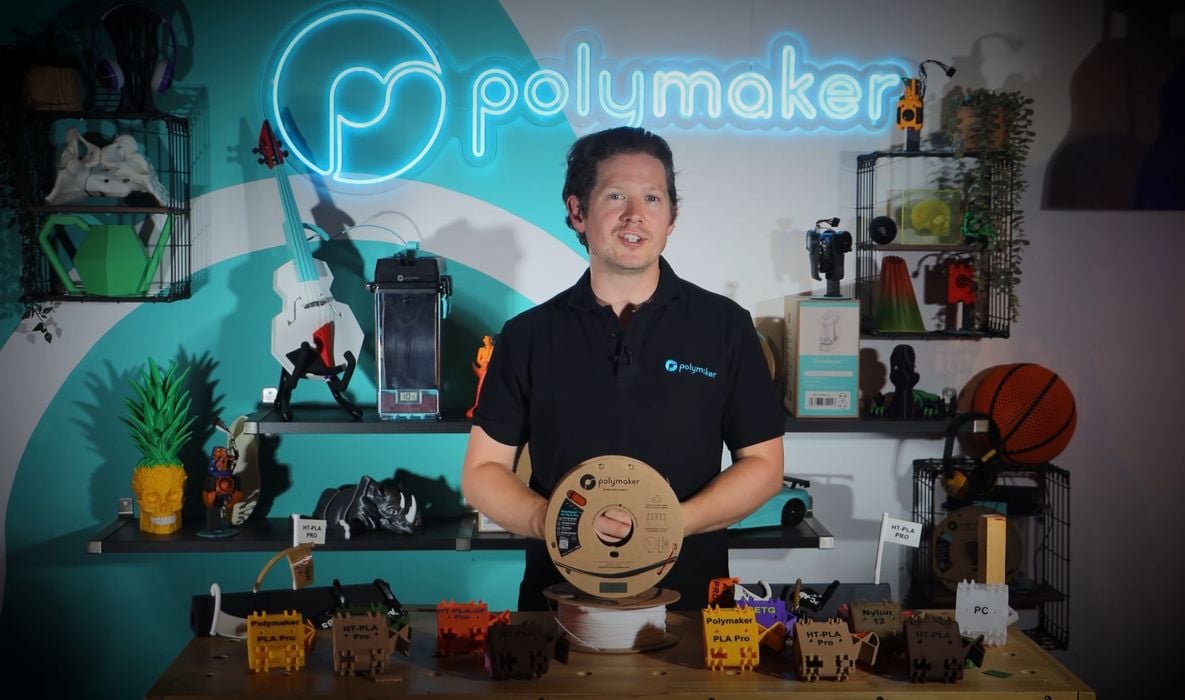
Polymaker’s Luke Taylor designed a rather complex test to see whether the new material could withstand impacts, especially in a high-temperature environment.
In the video, you’ll see the experiment’s design, which involved a carriage repeatedly impacting a steel target until the “bumper” broke away. The experiment design also provided very significant heat through some circulating water pipes.
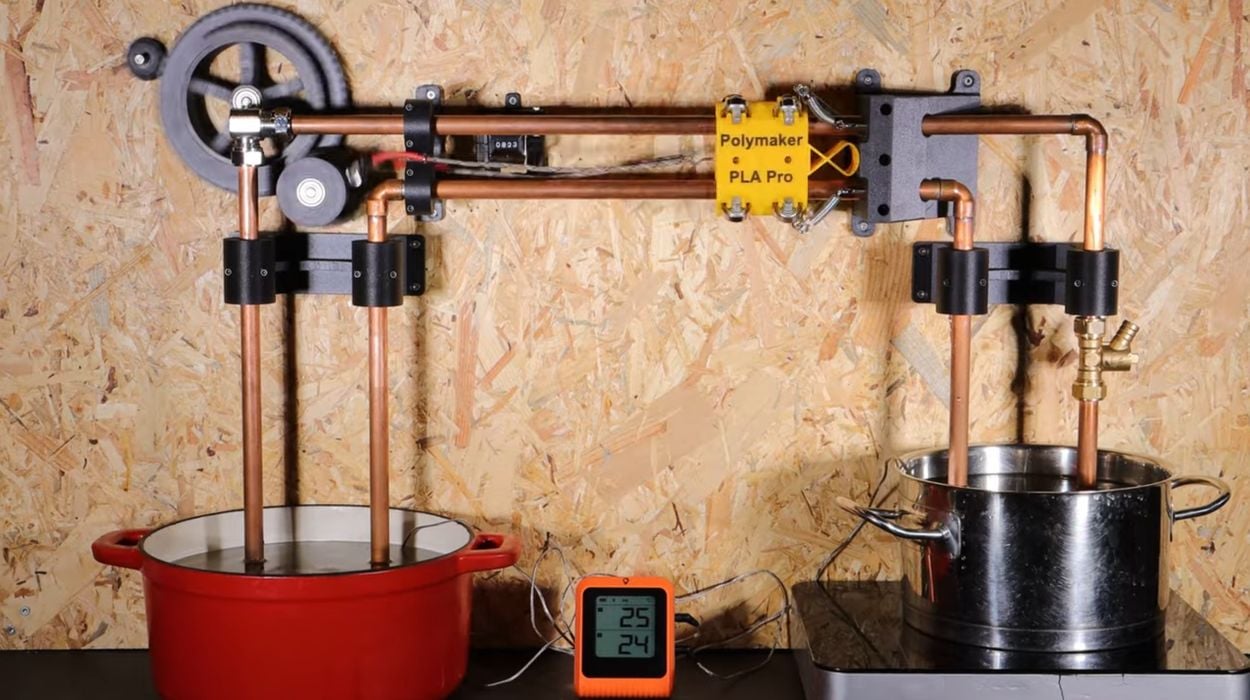
Taylor ran two test sets, one with common materials at room temperature and a second set at high temperature. The results were extremely interesting.
Room temperature results, in “number of impacts before breaking”:
- HT-PLA-GF: 35
- PLA: 432
- PLA PRO: 1709
- HT-PLA: 810
- HT-PLA PRO: 3157 (2 hrs)
This is quite interesting. It shows that their HT-PLA is indeed stronger than regular PLA, but nowhere near HT-PLA PRO. Note that the GF version is extraordinarily weak on this test, breaking literally 100X faster than the new material.
The results were quite different from the engineering specifications. Those test a single impact strength, while the Polymaker test involved repeated impacts, which is actually a more realistic simulation of an application.
The test then switched to “hot mode”, where boiling water was circulated through the pipes. This heat would then transfer into the 3D printed parts, much like it would on a typical application.
The results were quite interesting:
- HT-PLA-GF: 28
- PLA: 162
- PLA PRO: 232
- HT-PLA: 98
- HT-PLA PRO: 864
In addition, other non-PLA materials were tested, just for fun:
- ABS: 161
- PETG: 261
- PC: 456
- PA12: 6000 (test stopped)
These results show that ABS isn’t as good as plain PLA for impacts at high temperatures, which defies common assumptions. HT-PLA PRO beat all these non-PLA materials, with the exception of the nylon PA12 material. However, the PA12 sample did deform during the test, actually losing several bearings that fell out!
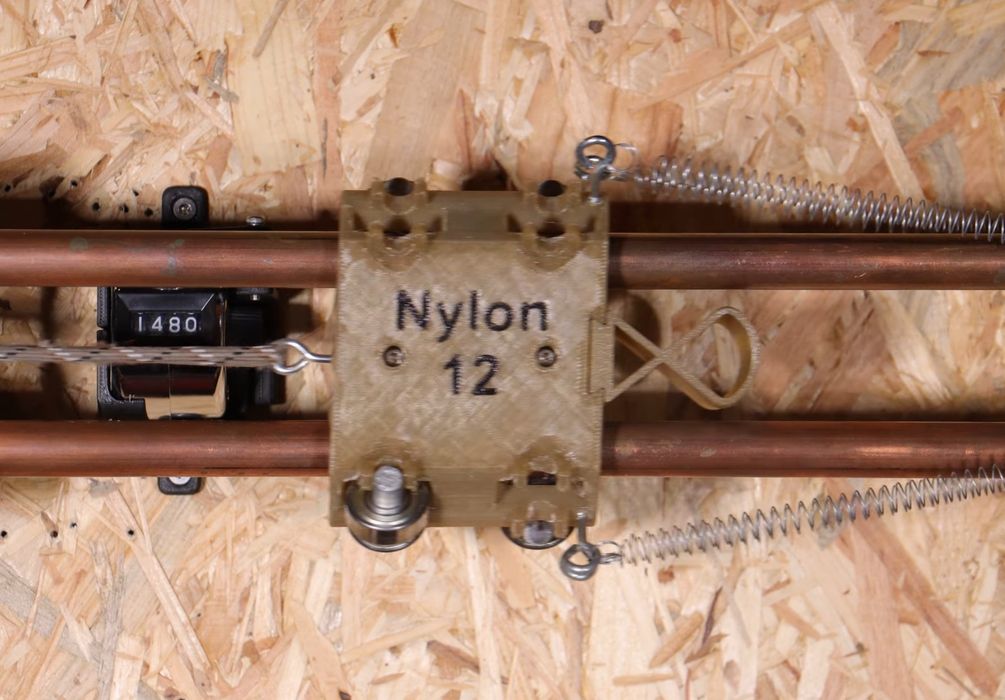
The results of this test show that HT-PLA PRO is a very impressive material, and perhaps could be the one true material you’d actually want to have on that desert island.
Via Polymaker
