
A new volumetric 3D printing process has been patented by Quadratic 3D.
Hold on, what is Quadratic 3D?
They are a Boston-based startup that seems to have formed in 2019, so not that long ago. They have been quietly developing a new 3D printing process that is volumetric, quite unlike today’s popular 3D print processes. They’ve been funded, at least publicly, to the tune of almost US$8M, and appear to have a team of around twenty people.
Volumetric 3D printing is quite different as it attempts to print an entire object at once. The typical approach is to blast light patterns at a rotating cylinder of photopolymer. As energy accumulates in spots within the 3D space of the cylinder, polymerization occurs and the object solidifies.
This process can be quite a bit faster than today’s common 3D printing processes, and sometimes can be done in only minutes or even seconds.
We haven’t heard much, or anything, really, from Quadratic 3D. But this week I noticed a patent they had recently been awarded that describes some of what is presumably their take on volumetric 3D printing.
The patent, WO2025227153A1, is titled “Methods and Systems for Forming an Object by Volumetric 3D Printing” and is quite lengthy: 80 pages. To save you a long read, I can summarize what I get out of the document.
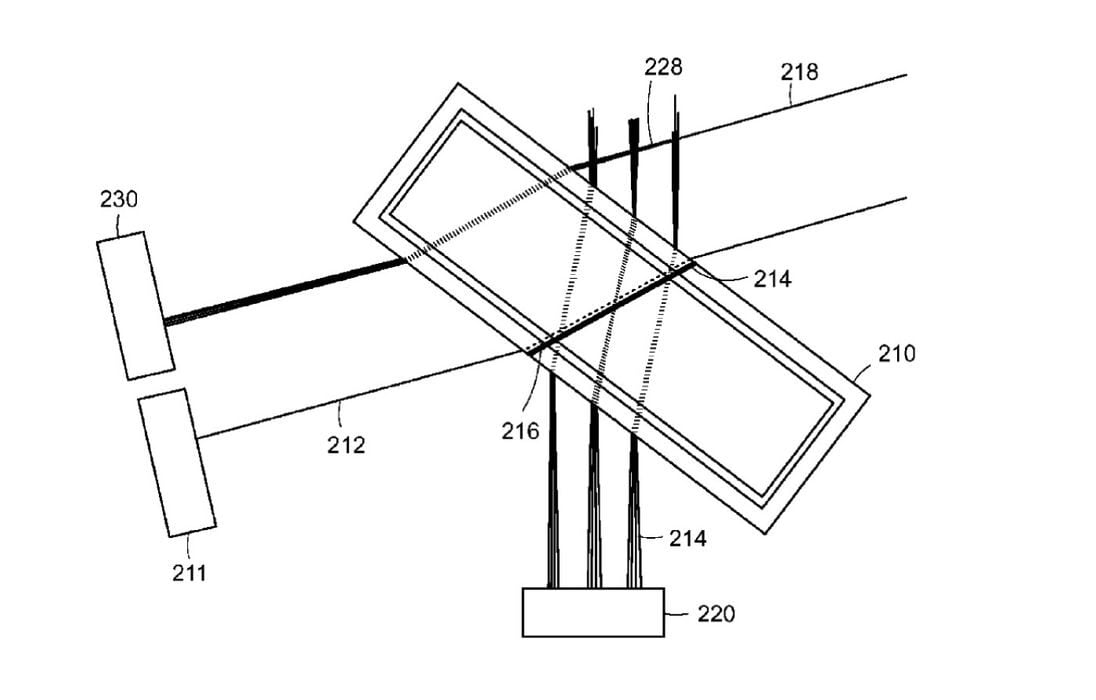
The Quadratic 3D process differs in several ways from the “typical” volumetric process. Usually there is a rotating cylinder of resin, but here there is not. Instead of one light exposure (or two), they use three.
The concept is to cure a virtual “sheet” that passes through the build volume. The virtual sheet is created by the intersection of the first two light sources. One source is a specific wavelength, while the other is an optical image of, presumably, a slice of the object.
This provides enough energy for the molecules in selected regions to take on altered properties. Later, a third light exposure occurs, and this causes those altered regions to properly solidify. All of these exposures involve different wavelengths of light. This process repeats as required to complete the object.
Quadratic 3D must have some interesting chemistry in their resin.
It seems they’ve done a ton of research and testing on this approach, as the patent talks about ways to tweak the second image in different ways. This likely assists in maintaining quality and consistency of the resulting print.
In addition, the third exposure is made without interfering with the first two, so perhaps this all takes place simultaneously. The printhead design apparently includes all of these features, with the “sheets” being parallel.
One interesting angle is that their build chamber includes special coatings to reduce back-reflections that would obviously mess up the process.
How is this different from other volumetric approaches? First, there’s no rotation, which offers resin stability. Second, it seems to use 2D slicing, rather than a full 3D exposure, and finally they use a “develop” phase to complete the solidification.
One thought I had was that this process might be more scalable than other volumetric processes, which tend to be only able to handle relatively small volumes.
How big can you print with this mystery process? How fast can you print? We have no idea, as this is just a patent for a method. This process will have to be built into a machine using advanced engineering and optical systems, and only then would you know the process’s true performance.
Of course, Quadratic 3D is doing all that in their secret labs, but hopefully we will hear something more soon. After all, the patent is public and they are now protected.
Via Espacenet and Quadratic 3D
