
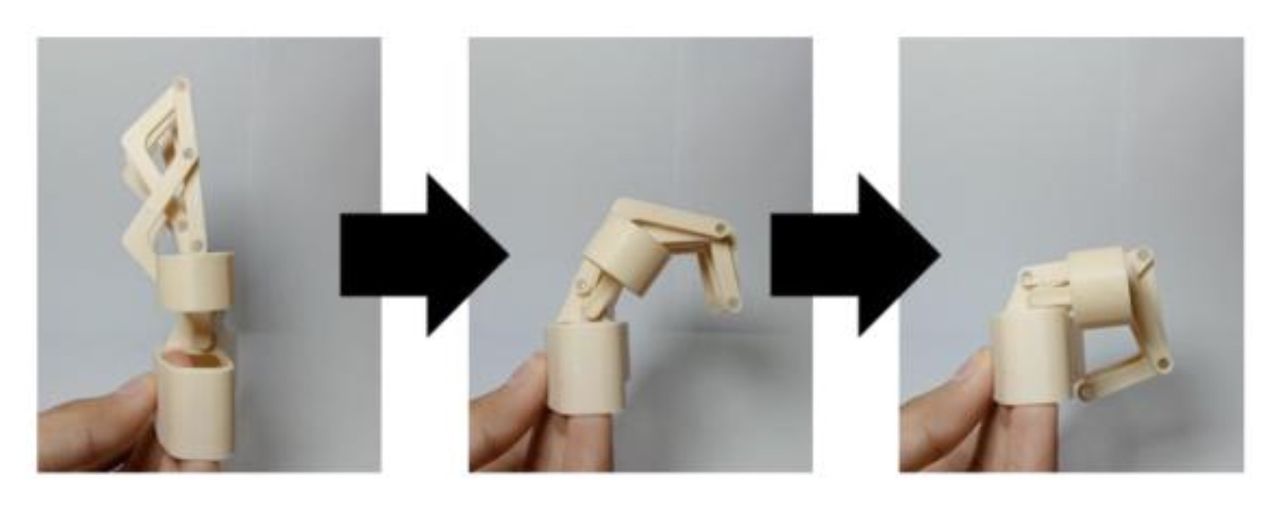
A new paper details a low-cost, body powered 3D printed finger prosthesis for trans-phalangeal amputees, signaling fresh momentum for practical, customizable partial-digit solutions.
Most readers know the 3D printed prosthetics story through community projects and clinic collaborations that deliver wrist-driven hands and cosmetic covers. Partial finger loss, however, is a different design space. There is less room for linkages, higher demand for comfort under shear, and a constant trade-off between cosmetic shape and functional leverage. Commercial devices exist, but custom fabrication often drives up cost and lead time.
That is why a focused, body powered finger design matters. By avoiding motors, batteries and complex sensors, body powered systems lean on cables, linkages and elastic returns to produce repeatable motion. Additive manufacturing then brings fast iteration, individualized geometry and the ability to align part strength with load paths during printing. For clinics and labs working with constrained budgets, that combination is appealing.
Why A Printed Finger Matters
Partial-digit prostheses are typically judged on four axes: comfort, durability, controllability and appearance. Additive helps with all four. A patient-specific socket can distribute pressure over viable tissue and avoid sensitive scars. CAD models can be parametrized to match residual phalanx length and width, improving suspension without excessive straps. Surface textures and thin TPU pads can add grip without bulk, and if something breaks, a replacement can be printed overnight.
Economically, distributed fabrication is the most interesting angle. A small lab or makerspace with a reliable FFF system can produce test fittings, trial different hinge geometries, and adapt tendon routing with minimal material outlay. That can shorten the loop from evaluation to a working device, particularly in regions where access to traditional prosthetics is limited or shipping delays are long. Service bureaus can also step in with tougher materials or higher-precision processes once a design stabilizes.
Inside The Body Powered Mechanism
While the paper’s full technical details are not summarized here, the phrase “body powered” strongly suggests a cable-driven or linkage-based mechanism that translates motion from a proximal joint into distal flexion, with an elastic or spring return for extension. A likely explanation is that the team targeted FFF polymers for cost and availability, employing simple pinned joints, bushings or printed living hinges where appropriate, plus off-the-shelf screws and cord for actuation. That approach keeps tooling simple and enables field repairs with basic hand tools.
Constraints will dictate real-world value. Polymers creep under load, so hinge sizing, print orientation and infill strategy must balance weight against longevity. Cables introduce friction and wear; careful sheath routing and low-bend radii matter. Heat and water exposure could soften or swell parts unless materials and clearances are selected accordingly. Hygiene and skin interface are critical as well, meaning smooth internal surfaces and breathable liners are more than nice-to-haves — they are prerequisites for daily wear.
If the design proves robust, the most immediate beneficiaries are rehabilitation clinics, university labs, and NGOs that already operate small fleets of printers. Automotive and industrial workers who need task-specific reinforcement for a single digit could also benefit from quick-turn, job-tailored devices. On the software side, a parametric workflow — even a simple sizing script — would lower clinician touch time and reduce CAD bottlenecks.
What should readers watch next? Hard data. Reported grip force versus cable input, range of motion across common amputation levels, wear testing over thousands of cycles, and user comfort scores over multi-week trials will separate a clever prototype from a clinic-ready device. Material comparisons — PETG, nylon, reinforced nylon, and perhaps resin or SLS variants — would clarify the durability envelope and cleaning protocols. If the authors release models under a clear license, adoption could be rapid; without that, replication may stall.
As always in medical applications, collaboration with certified prosthetists and attention to local regulatory requirements will determine where and how fast the concept reaches patients. But if a printed hinge and a cable can help someone hold a mug again, that is the kind of incremental AM win that adds up.
