
Charles R. Goulding and Preeti Sulibhavi connect the hit TV drama’s emergency room realism to how Pittsburgh hospitals are already using 3D printing to plan surgeries and improve patient care.
The extremely popular and realistic Warner Bros. Pitt Emergency Room (ER) TV series has now started its second season. The fast-paced program presents the challenges and treatment protocols of a busy urban hospital emergency room. Each season comprises 15 one-hour episodes presenting a day’s activity in the ER. Physicians, nurses, and support staff juggle large patient volumes, diagnose medical problems with complex equipment, and rely on a variety of lab tests to treat patients. The wide diversity of patients — ranging from drug and alcohol abusers to homeless individuals, average citizens, and elderly nursing home residents — gives viewers a vivid snapshot of modern urban medicine.
Popular TV series can have a major impact on society, just as the long-running sitcom Friends encouraged young people to migrate to cities. The original ER series helped inspire a generation of health care workers, and even Noah Wyle — the actor who played Dr. John Carter — has spoken about how many real clinicians credit that show with influencing their career choice.
The Pitt is produced on a Hollywood set but is modeled loosely after real hospitals in Pittsburgh, including Allegheny Health Network facilities and the nearby University of Pittsburgh Medical Center (UPMC). One of the things that distinguishes modern medicine — and that the next generation of clinicians will need to understand — is how digital technologies like 3D printing are moving from research labs into everyday clinical practice.
3D printing (also called additive manufacturing) is increasingly important in medicine because it lets clinicians and engineers turn digital scans into physical objects that can help care for patients in new ways. These range from anatomical models used in surgical planning to custom tools and even, in research labs, bioprinted tissues. The medical sector is one of 3D printing’s most important vertical markets, and The Pitt could help educate viewers not only about emergencies but also about the cutting-edge technologies shaping the future of patient care.
Allegheny Health Network and 3D Printing (Context and Local Innovation)
Allegheny Health Network (AHN) is a major nonprofit academic medical system serving Western Pennsylvania with 14 hospitals and more than 250 clinical locations. While AHN does not prominently advertise a centralized hospital-based 3D printing program like UPMC’s, it does embrace advanced diagnostic technologies that use three-dimensional imaging — a foundational component of 3D printing workflows.
For example, AHN offers 3D digital tomosynthesis mammography, an advanced breast imaging technique that creates detailed layered images of breast tissue. This technology helps clinicians detect early cancer more accurately than traditional 2D mammography.
3D imaging — like tomosynthesis or CT scans — is critical in 3D printing because it provides the base digital data (slices of anatomy) that engineers convert into printable 3D models. A CT scan, MRI, or ultrasound scan is segmented into a digital mesh to make a printable file. Without these 3D imaging technologies, many 3D printing applications would not be possible.
AHN also publicly emphasizes innovation in clinical care and research, noting that exploring and developing advanced medical technologies is part of its mission to offer exceptional care close to home.
Even though AHN doesn’t highlight hospital-level 3D printing labs in the same way as some other systems, Allegheny’s adoption of sophisticated imaging demonstrates how the data side of 3D technologies has already taken root in its practice — meaning the underlying foundation for future 3D printed surgical planning, models, and customized tools exists in the same workflows that clinicians rely on every day. This is a narrative link that The Pitt could explore if writers want to tie Pittsburgh’s real-world hospital tech into the show’s fiction.
University of Pittsburgh Medical Center (UPMC) 3D Printing in Medicine
By contrast, the University of Pittsburgh Medical Center (UPMC) is a documented leader in 3D printing within clinical care.
UPMC launched its 3D printing program in 2016, and it continues to expand its applications across surgical specialties, including orthopaedics, plastic surgery, neurosurgery, cardiology, urology, and cancer care.
Anatomical Models and Surgical Planning
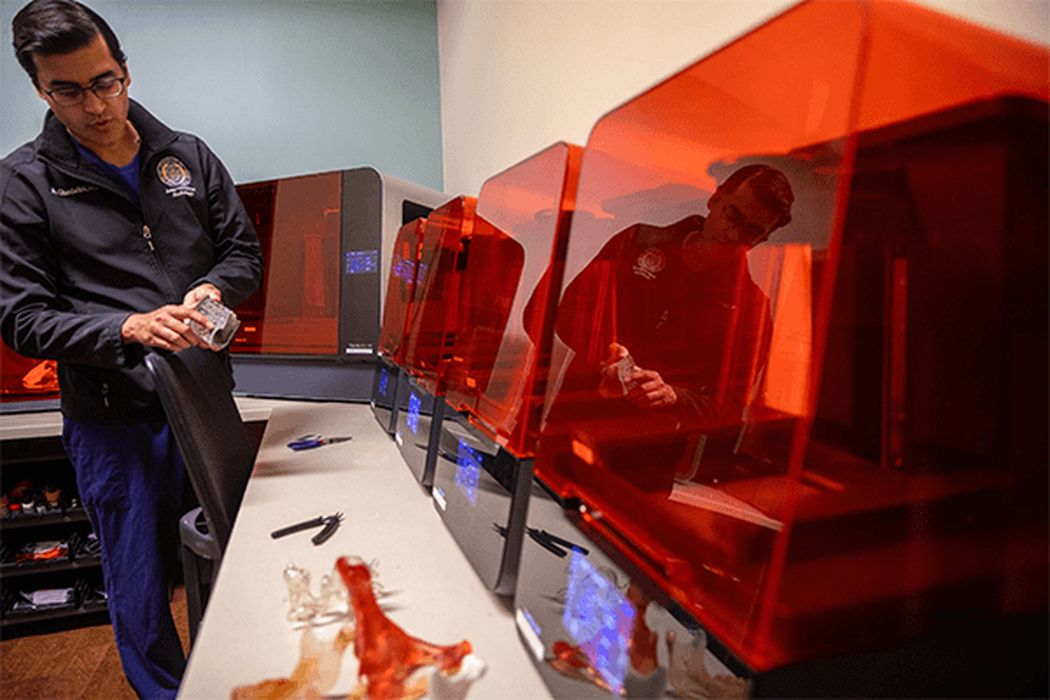
At the heart of UPMC’s program are anatomical models — physical replicas of a patient’s actual anatomy, created from that patient’s CT or MRI scans. Surgeons use these models to plan and sometimes practice surgeries before they go into the operating room. They help improve surgical accuracy, reduce operating time, and can even serve as guides during surgery.
Models like these are especially valuable in complex cases — for example, where tumors sit near critical structures like major blood vessels or intricate bone geometry. Being able to hold a physical replica of a heart or a section of skull gives the surgical team a more intuitive understanding of the anatomy than viewing 2D scans alone.
An example from UPMC’s own reporting involved a young patient named Harper who needed a left ventricular assist device (LVAD) while waiting for a heart transplant. Surgeons used a 3D printed model of her heart to determine which of two device options would fit and how it should be positioned, enabling a lifesaving surgical plan.
Customized Surgical Tools
UPMC also prints custom surgical tools matched to the patient’s specific anatomy. These include cutting guides or drill guides that help surgeons make precise maneuvers during operations.
Training, Patient Communication, and Research
In addition to planning and tools, 3D printing supports surgeon training — residents and trainees can practice on accurate models of real patients’ anatomies — and patient education, where showing a family a physical model can help them understand the planned procedure. Research teams also prototype new devices on printed models.
Impact and Scale
UPMC’s team has grown from printing one or two models per month to producing around 50 models every month because of increased demand across departments. Its facilities include multiple printers and engineering staff who handle the complex digital back-end, converting imaging data into printable files.
UPMC’s 3D printing lab was also designed into its infrastructure — architected with dedicated space to house printers, engineering staff, storage, and support for expanding the program.
3D Printing Beyond “Plastic Models” — Academic and Research Horizons
The University of Pittsburgh also plays a role in research-oriented 3D printing and bioprinting. Researchers at Pitt have developed innovative 3D bioprinting platforms that use bioinks to create functional tissue structures such as organoids inside supportive hydrogel constructs. These early-stage technologies have applications in disease modeling, drug discovery, and potentially personalized cellular therapies in the future.
In engineering labs, Pitt researchers are also using 3D printing to create high-resolution biological scaffolds that guide cells to grow into organized structures reminiscent of living organs — a foundational step toward printing truly functional tissue.
Beyond the hospital setting, the University library and open lab spaces provide access to a range of 3D printers for students and faculty — democratizing access to additive manufacturing tools that can feed innovation across disciplines.
The Research & Development Tax Credit
The now permanent Research & Development Tax Credit (R&D) Tax Credit is available for companies developing new or improved products, processes and/or software.
3D printing can help boost a company’s R&D Tax Credits. Wages for technical employees creating, testing and revising 3D printed prototypes can be included as a percentage of the eligible time spent for the R&D Tax Credit. Similarly, when used as a method of improving a process, time spent integrating 3D printing hardware and software counts as an eligible activity. Lastly, when used for modeling and preproduction, the costs of filaments consumed during the development process may also be recovered.
Whether it is used for creating and testing prototypes or for final production, 3D printing is a strong indicator that R&D-eligible activities are taking place. Companies implementing this technology at any point should consider taking advantage of R&D Tax Credits.
Relatable, Reality TV…
The Pitt should inform an entire generation about the challenges and opportunities related to modern medicine — not just emergencies, but also how technological advances change how medicine is practiced. Modern clinical care is constantly improving, and technologies like 3D printing are becoming part of the standard toolkit in leading hospitals.
For Allegheny Health Network, the use of advanced 3D imaging holds promise as a precursor to deeper additive manufacturing integration. For UPMC, 3D printing is already a clinical reality that improves surgical planning, custom tools, education, and patient outcomes. Altogether, 3D printing illustrates how digital tools are reshaping patient care, offering rich content that could make The Pitt both more realistic and more inspiring to viewers interested in the future of medicine.