
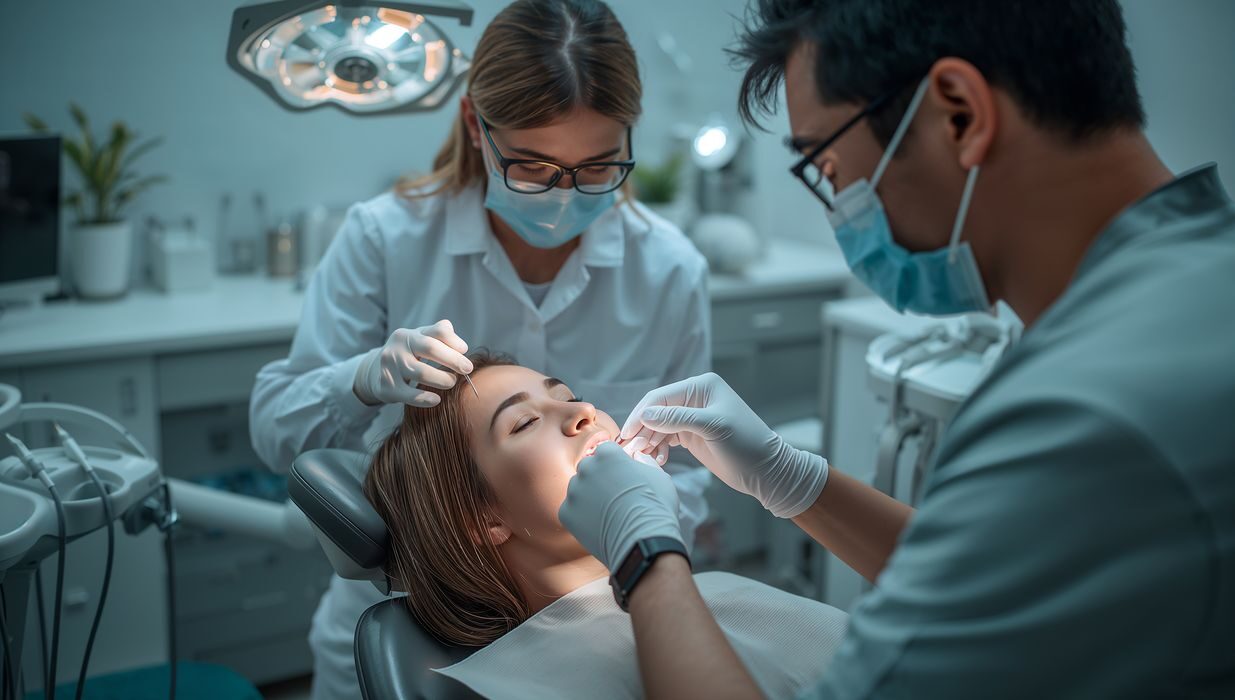
Researchers have developed a way to enable chairside dental crowns.
“Chairside” dental 3D printing has been a dream for many years. Traditionally dental offices send patient data to a centralized service, where, days or weeks later, they receive back the custom-made appliances for the patient. Two visits are required: data collection and subsequent installation.
The chairside concept is different, and it’s all about how fast the printing can take place. If a dental 3D printing process was sufficiently fast, the appliance could be produced while the patient was still in the dentist’s chair: chairside.
This concept has actually taken place with certain dental appliances. Certain types of appliances can now be made fast enough for near-chairside turnaround. However, that hasn’t included crowns.
Crowns are the ultra-hard tops of teeth that are installed during root canals or major replacement procedures. The problem is that none of the hard materials required for crowns can be printed very fast.
Until now. Researchers have developed a new process (UFTD) that is able to 3D print zirconia, an ultra-hard ceramic, in record time. They developed a single-step ultrafast thermal debinding process using a vacuum, plus porous graphite felt that heats very fast and vents pyrolysis products efficiently.
In their process all of the binder is removed in less than 30 minutes, which is up to 200X faster than conventional approaches. The resulting ceramic has comparable engineering properties, and the speed up dramatically reduces the amount of energy required to debind the prints.
The researchers believe this technology could lead to same-day, single-visit crown restorations if sintering were combined in the same cycle. The sequence would be print, UFTD (<30 min), sinter, finish/glaze in hours instead of overnight cycles or days-long lab services.
The technology would also be extremely useful in emergency situations where crowns could be produced rapidly.
While I’ve been discussing use of this technology for dental offices, dental labs could also make use of this tech if commercialized. The production throughput of a lab could be dramatically increased because the machine cycles would be shorter. In addition the amount of energy required per unit produced would drop substantially.
What’s the catch here? The main issue seems to be that the UFTD process requires a peculiar type of dental furnace that is vacuum-capable and equipped with graphite felt fixtures. Today most dental furnaces are air sintering units.
There’s lots of issues yet to be tamed, such as discolouration, cracking, etc. However, this tech seems so promising that it is clear it will eventually make its way into your local dentist’s office.
Via ScienceDirect
