
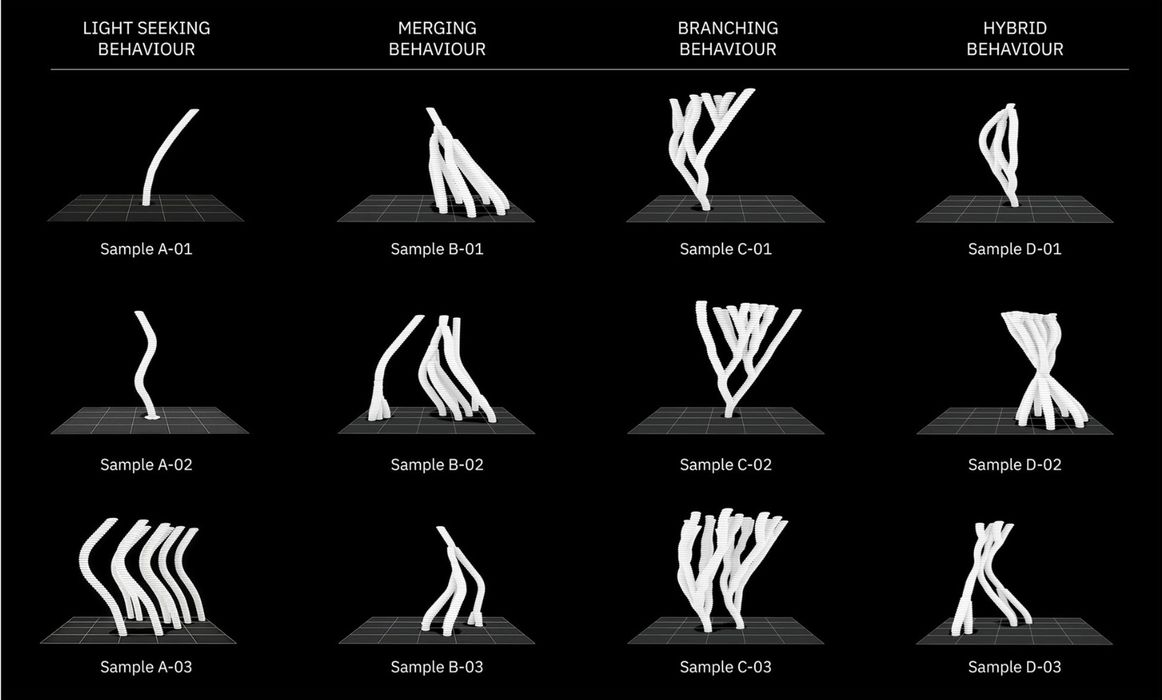
A research team has demonstrated an extrusion 3D printing workflow that changes its growth direction in response to live light sensing.
The system, called Responsive Discrete Deposition Modelling, or R-DDM, comes from Lucas Helle, Joseph Naguib and Roberto Naboni at the University of Southern Denmark. Their idea is a significant departure from the usual model, slice, and toolpath workflow: instead of correcting a print back toward a predefined shape, it lets environmental input influence the emerging shape itself.
Most closed loop AM systems use cameras and sensors to detect errors such as poor extrusion width, layer height drift, or warping, then adjust parameters to preserve the intended geometry. R-DDM has no final geometry or continuous toolpath to preserve.
Instead, it deposits one calibrated plastic extrusion at a time. Before every placement, the system senses conditions, computes a new local direction, and streams a short GCODE segment to the printer. The resulting structure is therefore assembled through many small, situated decisions.
Light As A Fabrication Input
The researchers used phototropism, the way plants orient growth toward light, as their demonstration behaviour. A 220 lumen LED lamp was moved around the printer during fabrication, while an Intel RealSense D455C depth camera observed the build area. Image processing detected shadows and estimated the light direction relative to the growing print.
A Raspberry Pi 4 running ROS2 coordinated sensing, computation and printer actuation. An agent based model implemented in Grasshopper combined attraction toward the light with familiar flocking style rules for cohesion and separation. Those rules allowed individual deposition trajectories to converge, diverge, branch, or merge.
The physical platform for testing was a Prusa i3 MK3 FFF machine with a 0.4 mm nozzle. This is not exotic hardware, which is encouraging: this process might be used on almost any device.
Behaviour Rather Than Geometric Accuracy
Calibration was essential because discrete deposition only works if each commanded extrusion event produces a reasonably consistent bead. The team tested target bead heights from 0.5 mm to 8.0 mm and found a usable calibrated range from 0.5 mm to 4.8 mm. Outside that range, material rheology, nozzle geometry and cooling effects produced increasing deviation.
In light seeking trials, the printed trajectory began responding within one deposition cycle after the lamp moved. Across three runs, the printed structures followed the same general turning behaviour as simulation, although their absolute positions varied by roughly 10 to 20 mm. The light detection pipeline itself showed a mean positional deviation of 19.70 mm, so this is clearly direction sensing rather than precision metrology.
Branching and merging tests also produced repeatable behavioural trends across three physical runs. Separation dominant settings yielded diverging paths, while stronger cohesion produced convergence. A hybrid test changed the interaction weights during one uninterrupted build, producing a compact merged section followed by diverging branches.
Conventional toolpaths are excellent when the workpiece and environment are predictable. They become far less natural when printing onto irregular terrain, working around changing conditions, or constructing forms whose geometry should respond to the site.
