
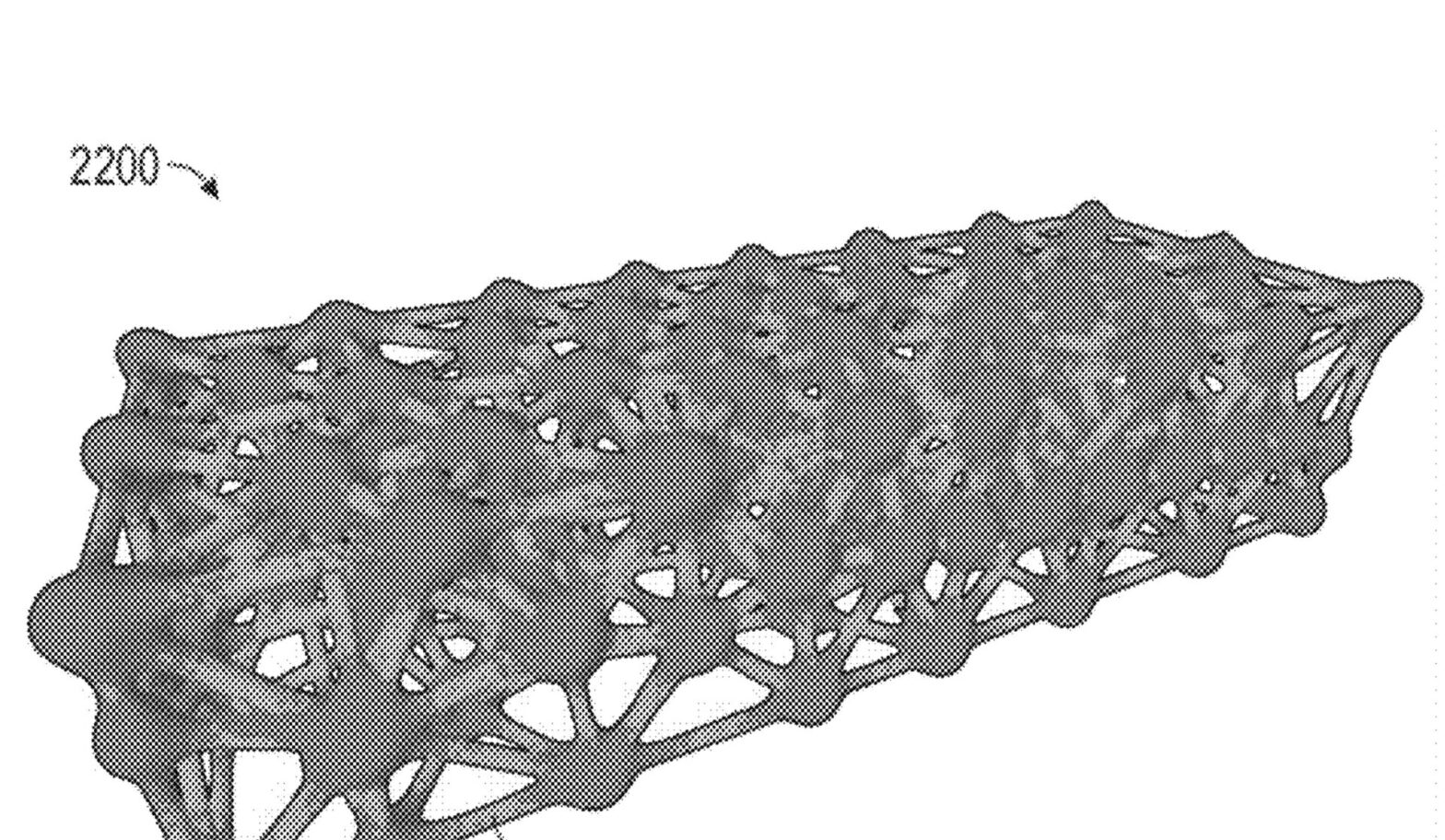
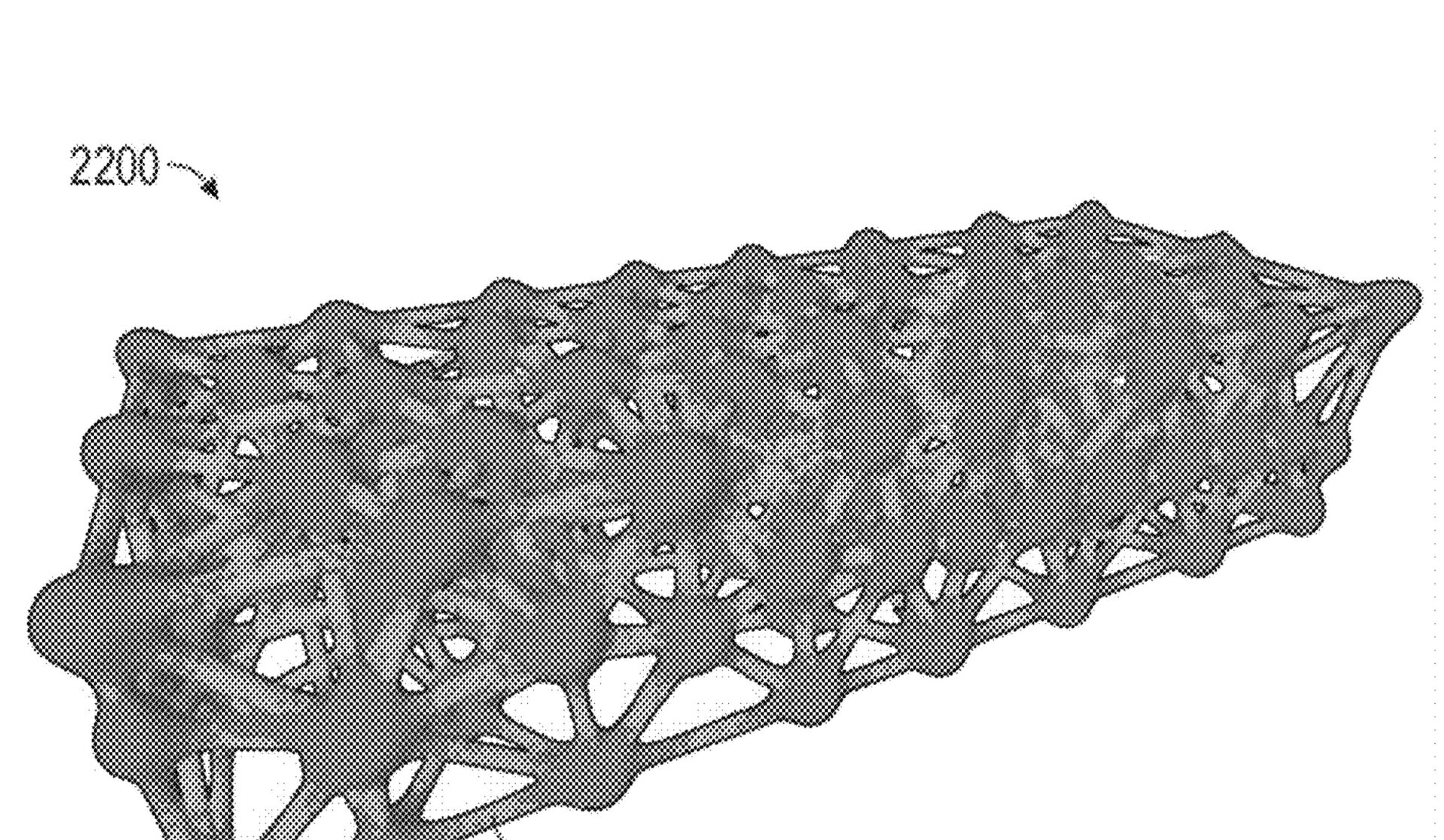
Most 3D design software knows the surfaces of an object, but it doesn’t usually know what the object is made of at every point inside.
That is the reason multi-material 3D printing often feels more tricky than it should. A designer builds several solid bodies, assigns each a material, exports them, and leaves the slicing software to sort out the result. It works for a colored part or a hard shell around a soft core. It is way more difficult when the material is supposed to change gradually through the volume.
An application from The Regents of the University of Colorado proposes a different approach. In US20260320903A1, titled “Multi-Material Volumetric Modeling Systems and Methods,” they describes “OpenVCAD”: a scripted design environment and compiler that treats material distribution as something that can be calculated, transformed and combined just like geometry.
The useful mental model of this is like a tree. Leaf nodes describe primitives such as spheres, meshes or implicit surfaces. Composite nodes translate, rotate, scale, unite or intersect those shapes. A separate class of multi-material nodes then changes the composition inside the resulting volume.
So a designer could define a soft actuator as a shape, apply a function that makes one material more concentrated in one region, and then compile the result into voxels or another volumetric format. The geometry and the material recipe remain connected instead of being split into unrelated files.
The most interesting node is probably functional grading. It uses spatial functions to assign volume fractions to materials. Those functions can produce a smooth transition, a sharp threshold, or something more complicated. The patent shows a tensile dogbone coupon in which a stronger material is in the thinner central region, while another configurartion grades a wing from heavier and stiffer material to lighter and more flexible material along its length.
There is also a convolution node, a term borrowed from image processing. Instead of writing a complicated formula for every boundary, a designer can apply a three-dimensional kernel to neighboring voxels and blur or sharpen the material transition. That is a really interesting idea. If you have ever tried to make several imported solids blend cleanly, you can see why a volumetric equivalent of an image filter would be quite desireable.
The output is not necessarily a giant voxel file. The compiler can export stacked PNG images for voxel-based machines, voxel grids for rendering or simulation, and mesh-based representations for conventional additive manufacturing workflows. The application says its exporters can also drive finite element analysis, which creates a path from material recipe to predicted mechanical behavior.
The performance figures are worth a look. In one of their benchmarks, a soft actuator containing about 1.8 billion voxels took 251 seconds to evaluate and 41 seconds to slice on a computer using an eight-core AMD Ryzen 7 7700X with 16 threads. That is not instantaneous, but it is a reasonable time for processing a volume that large. The filing also reports a 140 x 7 x 28 mm OpenVCAD text example taking seven seconds to slice.
The application looks at material-jetted systems first, including a Stratasys J750 example, but the proposed data model is bigger. The text discusses FFF with multiple hot ends, directed energy deposition with multiple wire feeders, and even laser powder bed fusion where process parameters could be graded instead of the material itself.
That last possibility is intriguing, although it is clearly a future extension rather than demonstrated capability. The immediate challenge is not describing a beautifully complex part. It is proving that every requested material combination can actually be printed, bonded, cured or sintered reliably.
The basic idea here is to let engineers program the inside of a part directly, then compile that description for the machine. The patent is really about closing the software gap that has been holding back much of multi-material additive manufacturing. Finally, this might start working properly.
Via Espacenet