
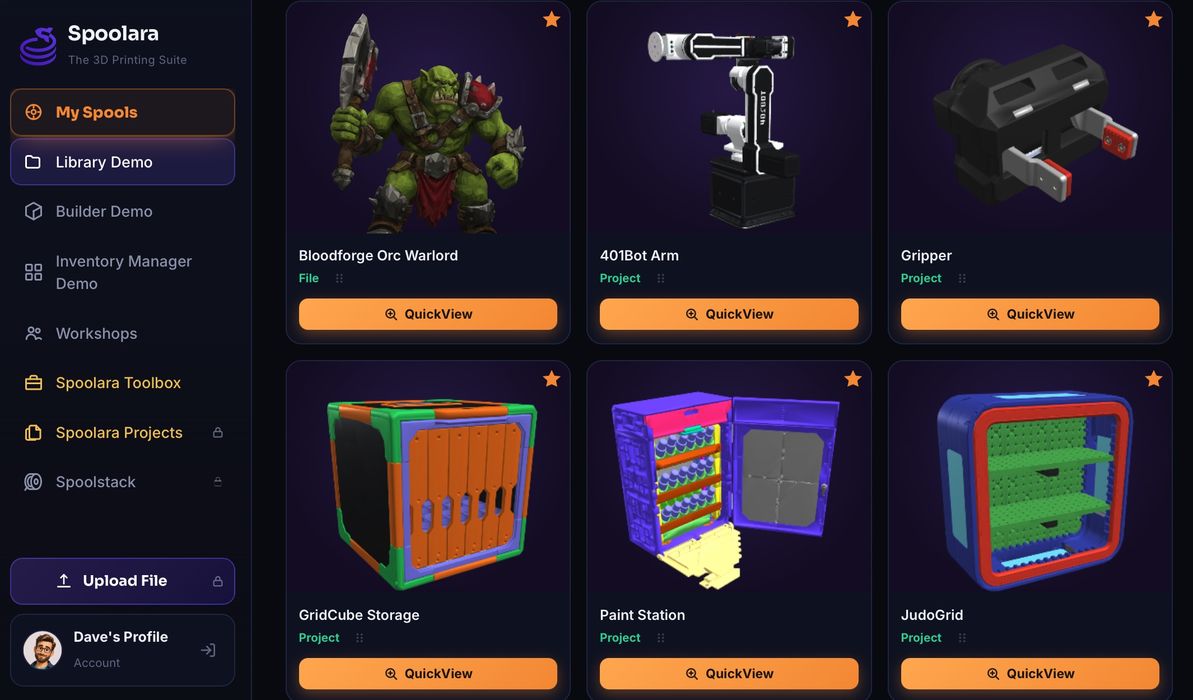
Spoolara has bundled a bunch of small 3D printing utilities together.
It’s a new software suite from FantasyDesigns that recently completed a successful Kickstarter campaign. The project raised US$150,652 from 849 backers, so it is fairly successful so far.
Spoolara is an interesting concept because it doesn’t really do anything particularly revolutionary. Instead, it combines a collection of smaller utilities that 3D printer operators might occasionally find useful.
Their collection of utilities is fairly extensive.
At the center is the Spoolara Library, a system for organizing 3D model files. It supports tagging, filtering, previews, project organization, bulk imports and synchronization with local storage, cloud services and network attached storage.
Then there’s Spoolara Builder, a virtual assembly environment where multiple STL files can be arranged into a project. Operators can assign colors, materials and hardware, then generate a package containing the required files and assembly information.
An inventory manager keeps track of filament, resin, hardware, fasteners and completed prints. It can also provide low inventory alerts. However, it’s not clear where the input data comes from for the inventory. Does the user have to manually input the amount remaining on each spool?
The Spoolara Toolbox contains several specialized utilities, including a Paint Suite for coloring 3D models, a Texture Suite for modifying surface appearances, and Armory, a tool for scaling cosplay and prop components.
There’s even a virtual Workshop feature, where projects can be visually arranged in themed 3D “rooms”, including some for tabletop gaming and cosplay.
For designers distributing their own models, Spoolara also offers creator management functions, including file distribution, licensing, membership identification and customer support tools.
It’s quite a collection.
But here’s my thought: virtually every one of these functions seems like something that would make a nice extra in another software package. Few seem substantial enough to justify purchasing on their own.
But Spoolara has assembled an entire product made of extras. That might actually work.
Consider someone who regularly designs and prints tabletop gaming models. They could be dealing with hundreds of STL files, multiple assemblies, different scales, a substantial inventory of materials and a large number of people downloading their designs.
For that type of 3D printer operator, the effort to switch between different tools to manage things could become a problem. Having all these minor functions available in one environment might be surprisingly useful, particularly if they share information automatically.
There’s one aspect I’m puzzled about, however.
Spoolara encourages operators to move their 3D model libraries into its environment. But many designers deliberately publish their models on services like Printables, MakerWorld and MyMiniFactory, where downloads, community participation and exposure can have considerable value. You don’t collect MakerWorld points if your models aren’t on MakerWorld.
Why would they move their files away from those platforms?
Presumably, files could exist in both places, with Spoolara serving as the operator’s private tracking workspace while the public model repositories handle distribution and discovery. That would make sense, although it’s unclear how much automatic synchronization Spoolara offers with those services.
If maintaining both locations requires a lot of effort, it may not be a good idea at all.
There’s also the subscription question. Spoolara is a subscription service, meaning operators must continue paying for access to its collection of utilities. That’s a very different proposition from occasionally using free utilities or purchasing a specialized application once. Would you risk losing access to your library of 3D models if you stopped subscribing? Could you export them first?
I’m also not entirely convinced there’s a sufficiently large audience willing to pay for this particular combination of utilities.
On the other hand, Spoolara has one significant advantage over many 3D printing Kickstarter projects: there’s no hardware involved.
There are no parts suppliers to manage, no unexpected component shortages, no shipping containers, and no mechanical assemblies that might fail after delivery. Software certainly has development and maintenance challenges, but the usual Kickstarter complications are basically not active here.
Their successful campaign demonstrates that at least several hundred people find the concept to be a good idea. Whether that translates into a sustainable business remains to be seen.
Spoolara certainly isn’t for every 3D printer operator. Someone occasionally downloading a model and printing it would probably find no reason to subscribe.
But for the dedicated maker who regularly creates, modifies, organizes and distributes gaming models, all those little extras might add up to something worthwhile.
Perhaps a collection of small conveniences is itself a substantial product.
Via Kickstarter and Spoolara