
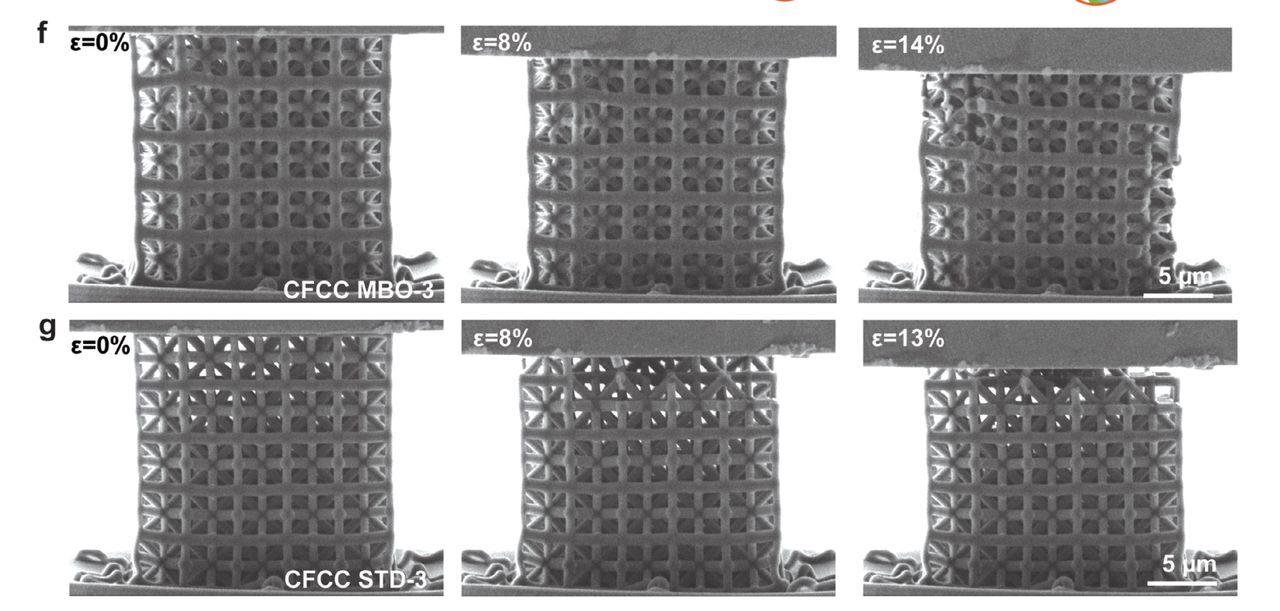
Researchers have used AI to develop a metamaterial that is stronger than steel, but lighter than foam.
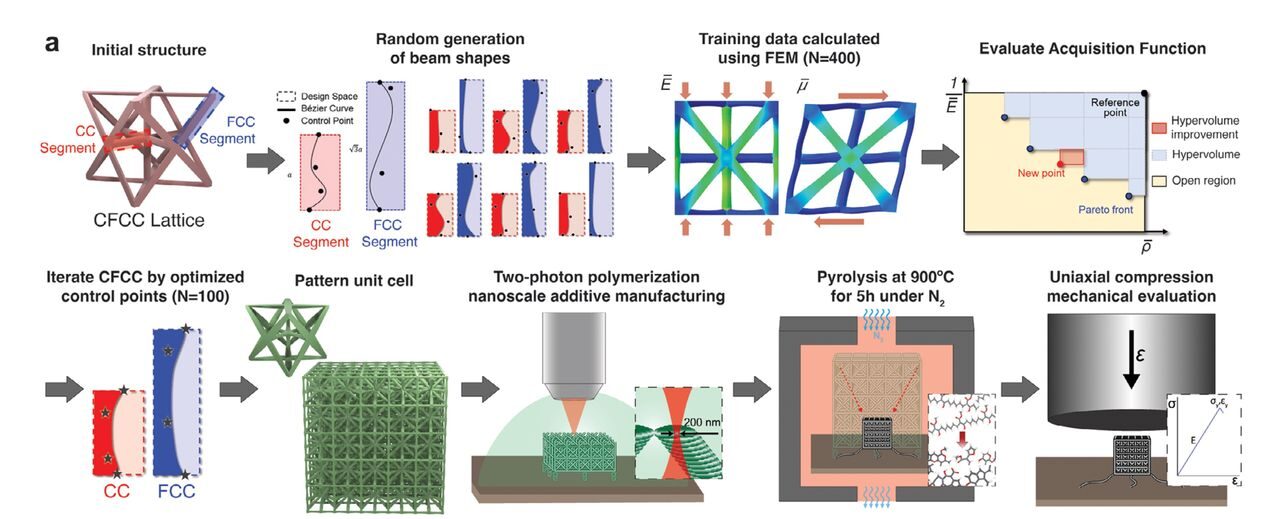
The study demonstrated an entirely new technique for discovering new, ultra-strong materials. The approach used was to use bayesian optimization to discover previously unknown nano lattice geometries that had extremely strong properties.
They sought a new metamaterial that had extreme strength, believing that there were lattice designs that were yet unexplored. Metamaterials are geometries that offer properties different than the base material.
They explored an astonishing 500 billion unit-cell geometries automatically. FEA simulations identified the best candidates from the set, which where then fabricated in real life using two-photon lithography (TPP). The result was prints made of complex carbon nano lattices.
Incredibly, the metamaterial strengths were extremely high, comparable to carbon steel. However, the density of these metamaterials were quite low – as low as 215 kg per cubic meter. This is actually lighter than many foams.
Such strong and lightweight materials would be clearly of great interest in the aerospace, automotive and robotics markets, where weight carries a big penalty.
The research team was able to fabricate a single piece containing 18.75 million unit cells, showing that it was possible to build relatively large structures. Large prints are not a strong point of TPP, which may limit the possibilities for this technique in the future.
Nevertheless, this is the first time a “supermaterial” has been developed with AI tools. While this project focused on pyrolyzed carbon, it should be possible to extend the concept into the worlds of polymers, ceramics, or even metals. The application would be dependent on the resolution of the 3D printers used, but the structures should still function at larger scales.
Materials are what drives 3D printing, and this research certainly opens up a massive number of possibilities for the future.
Via Wiley
