
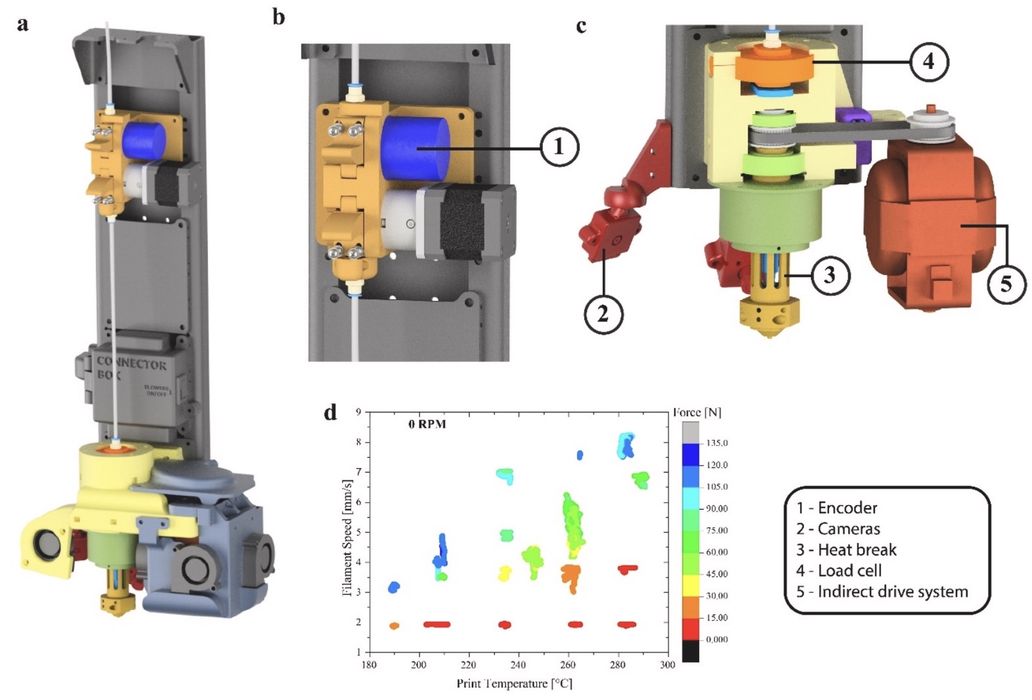
A new study examines a rotating nozzle FFF system for short fiber polymer composite manufacturing.
The paper, published in Materials & Design, focuses on an unusually important limitation in composite fused filament fabrication (FFF): extrusions do not just define the part’s shape. They also influence how short reinforcing fibers align, and that orientation strongly affects the final part’s strength.
Typical FFF systems move a fixed nozzle along a toolpath. The softened polymer experiences shear as it passes through the nozzle and is laid down, tending to orient short fibers in preferred directions. That can be useful, but it also means the printer has only limited control over the reinforcement architecture inside a complex part.
A rotating nozzle adds another controllable motion at the deposition point. Rather than relying solely on travel direction and filament flow to influence the composite, the process could potentially alter the local flow conditions before material reaches the build surface.
Fiber Orientation Is The Real Objective
Why pursue this at all? Short fiber filled thermoplastics are already widely available for desktop and industrial FFF equipment. Carbon fiber, glass fiber, and mineral filled filaments can boost stiffness, reduce warpage, or improve dimensional stability. They are attractive because they avoid the extensive handling and impregnation requirements of continuous fiber systems.
But short fiber reinforcement comes with a catch: it is not isotropic. A printed coupon can look impressive in a tensile test along the extrusion direction yet perform quite differently across layers or around a stress concentration. For load bearing applications, 3D printer operators and designers need more than a nominal material data sheet.
In other words, a rotating nozzle could turn fiber alignment from an incidental result of extrusion into an actual process variable. If that can be controlled repeatably, slicing software might eventually specify nozzle rotation alongside speed, layer height, temperature, extrusion rate, and extrusion direction.
It would require a confirmed relationship between nozzle rotation, polymer rheology, fiber length, fiber loading, cooling behavior, and actual fiber orientation in the extrusion.
Continuous fiber platforms from companies such as Markforged have demonstrated the commercial demand for controlled reinforcement, while short fiber FFF remains cheaper and materially simpler. A credible rotating nozzle approach could give short fiber composites a more sophisticated middle ground.
