
Researchers developed a rotational 3D printing method that builds lattices with programmable shape morphing, an advance that could quickly advance 4D printing.
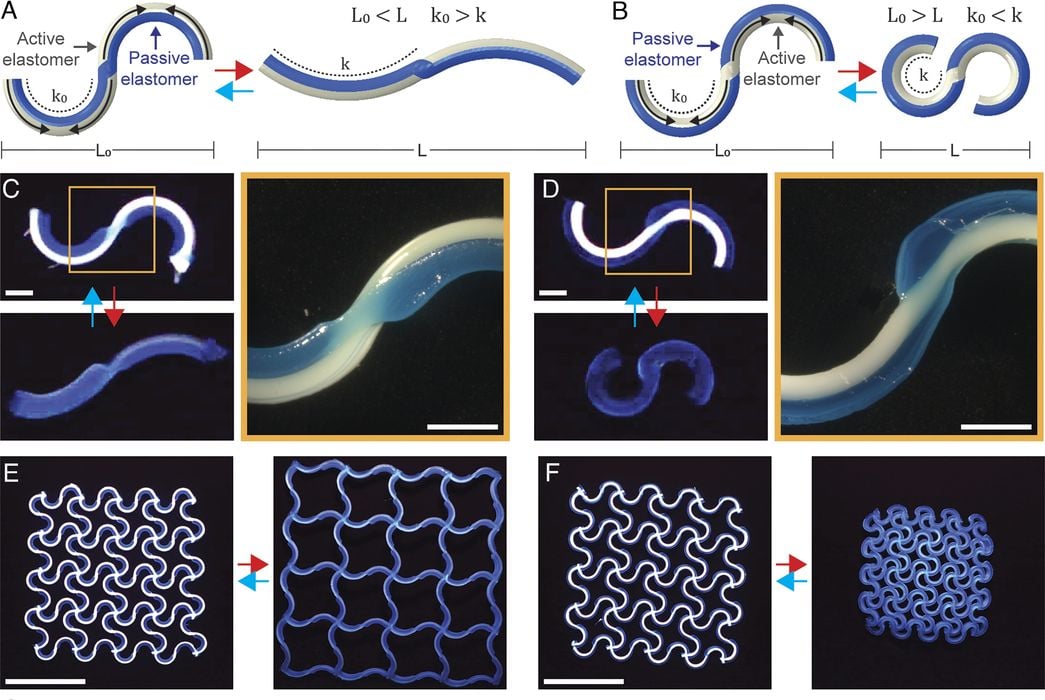
4D printing is the science of printing a geometry that can change shape afterwards when triggered by a stimulus. The stimulus could be anything, like electrical current, but in this study they focused on heat. They designed a lattice that could expand or contract when exposed to heat and cold.
Shape morphing with 3D printed parts is not new, but most demonstrations rely on simple bilayers or planar hinges that swell, shrink, or soften under a stimulus. Direct ink writing (DIW) and multi-material extrusion have enabled some complex behaviors, yet their deformation modes are often constrained to the layer plane. Instead, this research describes how adding controlled rotation during filament deposition creates three dimensional bending and twisting responses directly into each extruded strand.
The work focuses on pairing an “active” ink that changes dimension or modulus under a stimulus with a “passive” companion that does not. Arranged within a single filament, the active–passive mismatch creates internal moments on command, similar to a bimetal strip. What is different here is the rotational degree of freedom: by spinning the print nozzle or filament during extrusion, the researchers tune the orientation of that mismatch to steer how, where, and how much the structure will morph.
From Flat Bilayers To Twisting Filaments
Today’s 4D printing toolkits tend to deliver programmable bending in one direction. Commercial multi-material FFF and DIW can place active and passive regions side by side, but without a means to set the internal angle of anisotropy, designers are limited to standard curls and folds. Photopolymer routes like DLP with liquid crystal elastomers (LCEs) can pattern director fields, but they require specialized chemistries and optics. The rotational approach tries to generalize that control using extrusion hardware and inks.
The method co extrudes or co deposits inks so the cross section of each filament contains distinct active and passive domains. Rotating the nozzle during deposition winds that internal interface helically along the filament’s axis. When the active phase is stimulated — for example by heat, moisture, light, or solvent depending on the chemistry — the filament bends or twists along the programmed helix. By varying rotation rate, filament diameter, and the relative position of the phases, the team demonstrates lattices that deploy, curl, and lock into target shapes.
Mechanism, Limits, And Who Benefits
The mechanism is straightforward mechanics: differential strain between bonded phases generates curvature; a helical orientation introduces coupled bending and torsion. The novelty is in controlling that orientation on the fly during printing to achieve spatially varying morphing across a lattice without post assembly. That reduces human effort, simplifies bill of materials, and enables repeatable actuation patterns embedded at the filament scale.
The process appears feasible only with the DIW process and multi material dispensing, which narrows material choices significantly. Throughput is likely modest because rotation, multi channel deposition, and the very careful curing required by the process all slow the print speed. Software is another gap: mainstream slicers do not include synchronized nozzle rotation, toolpath, and multi material mixing, so custom toolchains are going to be required.
Even with those issues, several sectors should still be interested in this tech. Soft robotics and grippers could benefit from lattice scale actuators that deploy on command. Biomedical devices and morphing scaffolds might exploit gentle, distributed motion and solvent based triggers. Consumer products that need compact shipping and on site deployment — think stents, wearables, or packaging — could use encoded shape change to reduce parts and assembly.
If extrusion can set not just where material goes, but how it will move tomorrow, designers just might start treating filaments as actuators rather than merely structure.
Via PNAS / OpenAlex
