
Charles R. Goulding and Preeti Sulibhavi unpack how Ametek’s massive acquisition of FARO Technologies marks a turning point in scanning’s influence on 3D printing and industrial innovation.
Ametek’s Strategic Leap: Faro Acquisition in Focus
In May 2025, Ametek—a diversified industrial powerhouse with nearly US$7 billion in annual sales—announced its intention to acquire Faro Technologies for approximately US$920 million, paying US$44per share in cash, a premium of roughly 40% over Faro’s closing price on May 5, 2025.
The acquisition received unanimous board approval from both sides and, after clearing regulatory hurdles, officially closed on July 21, 2025. Faro’s stock was subsequently delisted from NASDAQ.This represents Ametek’s largest acquisition in precision scanning since its earlier US$120 million purchase of Quebec-based Creaform in 2013. With Faro added to Creaform and Virtek under Ametek’s Ultra Precision Technologies division, the company now commands an expansive and deep 3D metrology portfolio.
From Scans to Prints: Bridging Digital Reality and Additive Manufacturing
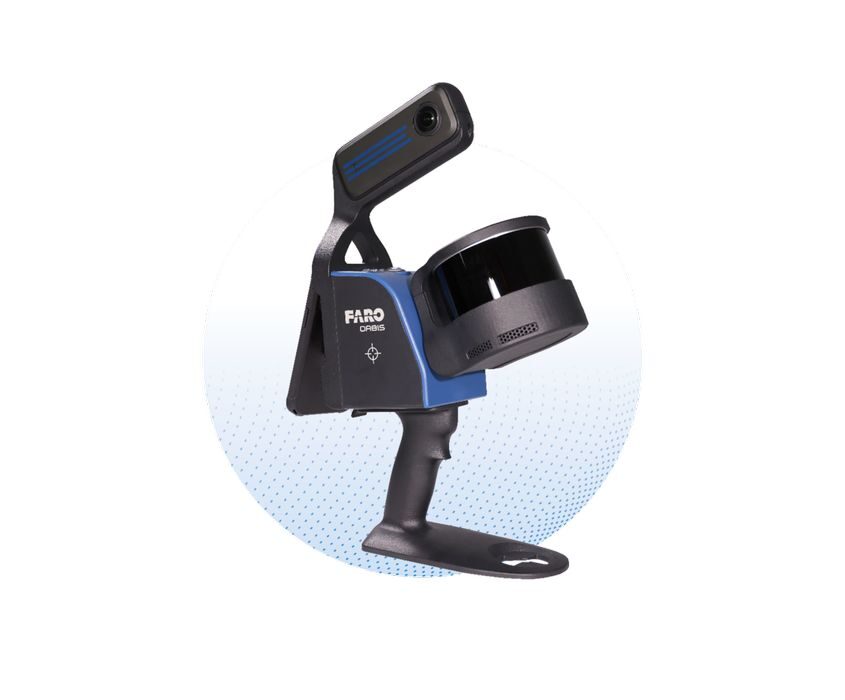
Faro’s product suite includes a broad array of precision tools—hand‑held measurement arms, laser trackers, large‑format terrestrial scanners like the Focus, and photogrammetry systems—backed by software such as RevEng, CAM2, BuildIT, and FARO Sphere XG.
These tools are widely used across industries:
- Architecture, Engineering & Construction (AEC): for BIM integration, as‑built capture, construction progress monitoring, and digital twins.
- Incident investigation and public safety: forensics, reconstruction, and crime scene scanning.
- Reverse engineering and quality control: capturing existing parts and producing CAD‑ready data for replication or 3D printing.
By delivering mesh or CAD‑ready models, Faro scanning seamlessly feeds into 3D printing workflows—from plastic prototype prints to metal additive manufacturing. The combination of scan‑to‑CAD to print has become a major workflow, greatly accelerated by Faro’s hardware and software stack.
Why the US$920M Price Tag Matters
The hefty valuation illustrates the value of leading scanning technology. Faro reported roughly US$340 million in 2024 revenue, but its strategic importance extends far beyond top-line figures—it underpins numerous additive manufacturing applications.
Our 2020 Fabbaloo prediction—calling Ametek a “stealth giant”—has proven prescient: a company once worth ~US$20 billion in 2020 has since doubled to over US$40 billion in market value. The Faro acquisition underscores Ametek’s intention to integrate scanning into core industrial offerings, reinforcing its growth across adjacent sectors.
Additionally, Sandvik’s 2024 acquisition of scanning integrator Cimquest (covered in our “Scanning Success” article) underscores a broader trend of major industrial firms buying scanning businesses to support 3D printing and digital manufacturing expansion.
Additive Enhancements: Recent 3D Printing Examples
Several recent developments in 2025 highlight the synergy between scanning and additive manufacturing:
- HDPE workboat hull printed by Damen & CEAD was made possible by large‑scale scanning data feeding into a massive metal/plastic print process for marine infrastructure.
- ÖBB‑TS’s digital spare‑parts strategy, in partnership with 3D Spark, uses scanning of legacy parts to enable on‑demand 3D printed spare parts for rail vehicles.
- Nano Dimension’s full acquisition of Markforged and Japanese Sodick’s acquisition of Prima Additive show consolidation in metal 3D printing—many applications rely on scan‑driven reverse engineering for part reproduction.
These examples illustrate the emergent loop: scan → design → print, a closed loop of digital reality enabling additive production.
R&D & Per Capita Metrics
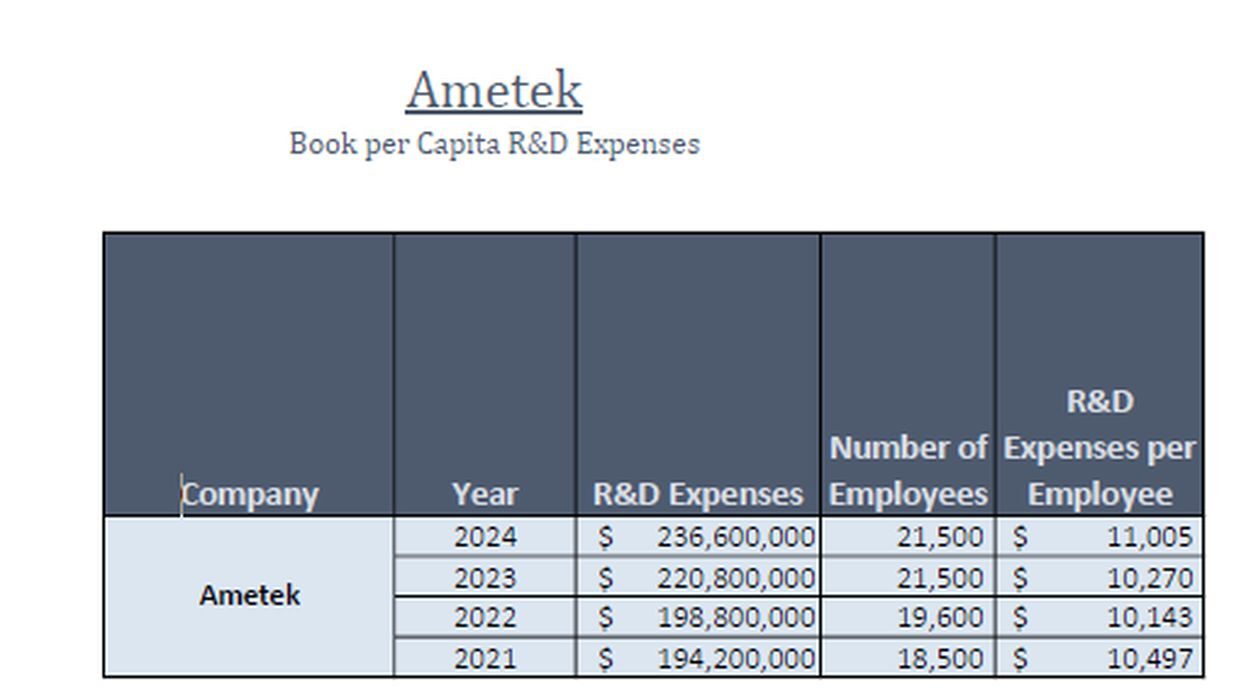
Below is a table presenting the most recent research and development spending by Ametek. Including 2025, this is a company that has invested approximately US$1 billion in R&D, which is impressive.
Implications & Predictions
A version of the scanning‑driven additive economy is now mainstream:
- With Ametek, Sandvik, Hexagon, Trimble, and others owning scanning assets, digital capture is no longer niche—it’s central to industrial strategy.
- These corporate acquisitions enable scaling of support, integration with existing machinery, and bundling with software, bringing scanning‑powered printing workflows within reach of more end‑users.
- Cross‑division collaboration among Faro, Creaform, and Virtek positions Ametek to offer end‑to‑end solutions—from scan capture to inspection projection to printed parts.
Industry feedback is mixed: some on forums warn that consolidation reduces competition and innovation. Others observe that Ametek tends to let its acquisitions operate semi‑autonomously—unlike Autodesk’s absorption strategy—and may allow Faro to maintain brand identity and momentum while benefiting from Ametek’s scale.
Scanning Growth as a Force Multiplier for 3D Printing
To drive 3D printing expansion, scanning growth is the lever:
- Increased scanning capabilities allow more parts, environments, or legacy assets to be digitized.
- Once digitized, those files become the starting point for additive manufacturing, enabling repairs, reproduction, or rapid prototyping.
- With each new use case—be it rail spare parts, marine hulls, forensic replicas, or architectural restoration—scan‑captured models feed printers, expanding the additive market.
By acquiring both Faro and Creaform, Ametek is consolidating critical pieces of this scan‑to‑print pipeline. Their combined growth should catalyze printing volume, not just scanning usage.
The Research & Development Tax Credit
The now permanent Research and Development (R&D) Tax Credit is available for companies developing new or improved products, processes and/or software.
3D printing can help boost a company’s R&D Tax Credits. Wages for technical employees creating, testing and revising 3D printed prototypes are typically eligible expenses toward the R&D Tax Credit. Similarly, when used as a method of improving a process, time spent integrating 3D printing hardware and software can also be an eligible R&D expense. Lastly, when used for modeling and preproduction, the costs of filaments consumed during the development process may also be recovered.
Whether it is used for creating and testing prototypes or for final production, 3D printing is a great indicator that R&D Credit-eligible activities are taking place. Companies implementing this technology at any point should consider taking advantage of R&D Tax Credits.
Conclusion
When giants like Ametek and Sandvik buy established scanning firms, the scanning industry matures—and in doing so, becomes an accelerator for 3D printing growth. With Ametek’s resources and strategic focus, Faro’s deep scanning capabilities can now reach far more verticals and support more print workflows. This acquisition is a milestone: it’s not just about measurement—it’s about enabling design freedom and manufacturing agility via digitization.
Faro’s meshes, Creaform’s portable arms, and Virtek’s projection systems are converging in a future where every scan can be a printed part—and where scanning isn’t just complementary to additive manufacturing, it’s a core enabler.