
A patent application proposes a more selective way to post-cure stereolithography parts.
The invention, patented by SprintRay, describes a system for selectively post-curing SLA 3D printed objects so that different regions of the same part can end up with different properties. Those properties could include colour shade, opacity, flexural strength, modulus, elasticity, or other characteristics affected by curing energy.
In most SLA workflows, the part is printed, washed, and then placed in a curing chamber where it receives a more or less uniform dose of light and heat. That works well enough for many parts, but it assumes the desired final part should have uniform properties throughout.
Dentistry is the obvious target market here. A dental crown or bridge may need different colour shades or opacity levels to better match natural teeth. An aligner, retainer, occlusal guard, or splint might benefit from different mechanical behaviour in different regions.
In other words, the patent is trying to move some material control from the printer into the post-processing step.
The core concept is a curing toolpath. The system would receive data about the 3D printed object, either from the model database used to print it or from a 3D scanner. A processing module would then determine how different regions of the part should be exposed to curing light.
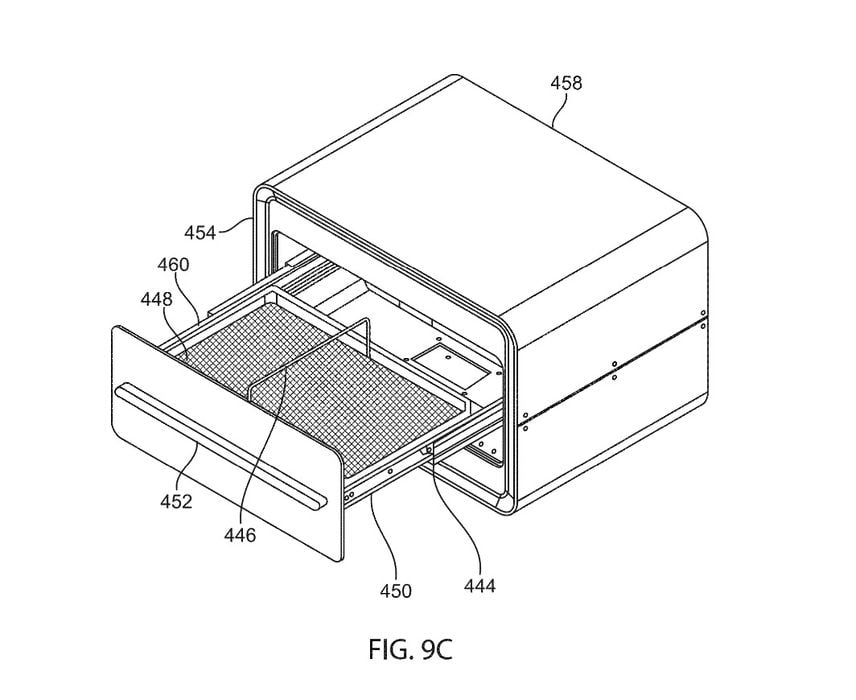
The curing chamber would include a movable light source assembly, a moving platform, or both. The light source could move along a linear track, revolve around the part, tilt, or work with a lens system to change coverage. The patent also describes top and bottom light sources to improve exposure and reduce shadowing.
That is not just about hitting the part with more ultraviolet light. The disclosure repeatedly mentions multiple wavelengths, including UVA and UVC, and combinations such as 365nm, 385nm, and 405nm. Those wavelength choices are important because resin photoinitiators respond differently depending on the chemistry.
There is also a separate disinfection thread in the patent. UVC LEDs are described for sterilizing printed parts, with attention to undercut regions and surface dosage. That would again fit dental and medical workflows, where a post-curing box that also supports sterilization could be commercially attractive.
This could become a very interesting category of resin post-processing. Today, many resin printers compete on exposure systems, speed, automation, and material libraries. Post-curing, by comparison, is often treated as a necessary but simple accessory. If selective curing can reliably tune optical or mechanical properties, the curing chamber becomes part of the material system rather than a simple finishing box.
Via Espacenet
