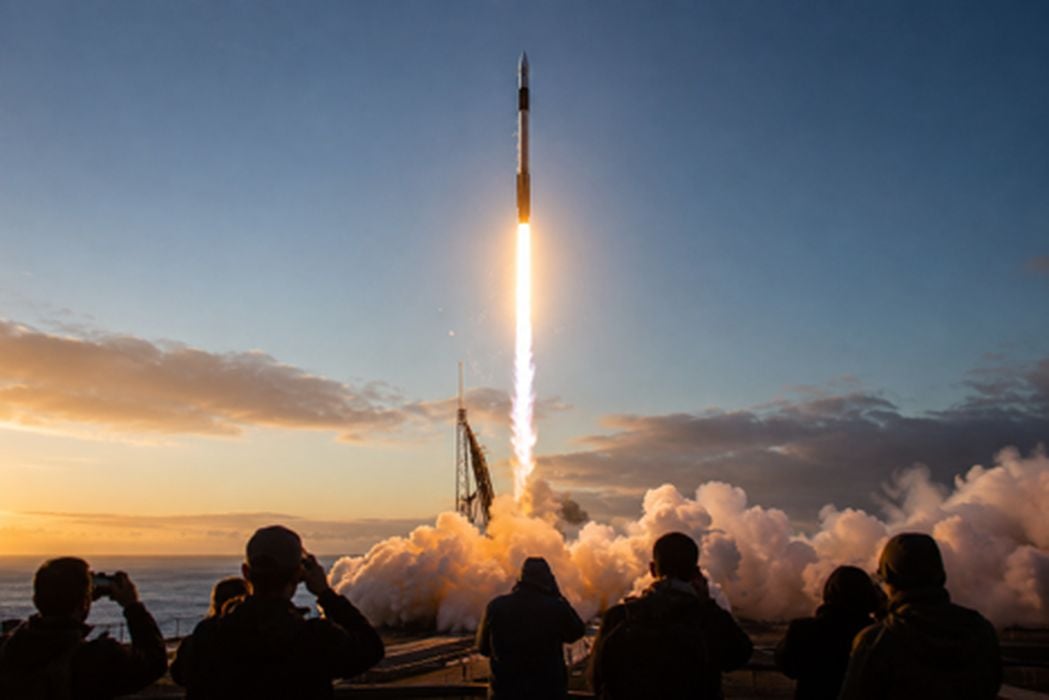
Charles G. Goulding explores how Rocket Lab has emerged as one of the few commercial space companies to successfully scale from innovative rocket development to a diversified aerospace manufacturing powerhouse.
More than 140 launch startups have been founded during the modern commercial space race. Most never reach orbit. Others reach orbit but fail to achieve meaningful launch cadence. Still others produce impressive demonstrations yet never transform engineering accomplishments into repeatable industrial operations. The commercial launch industry is littered with technically capable companies that never crossed the divide between building rockets and manufacturing them.
Rocket Lab is having the kind of year that separates survivors from participants. The company entered 2026 after a record 21 successful launches in 2025, more than any previous year in its history. By May, CEO Peter Beck disclosed that Rocket Lab had already booked more launches in the first few months of 2026 than it secured during all of 2025. The company signed its largest launch agreement to date, including five Neutron launches and three Electron launches, expanded its backlog to more than US$2.2 billion, and continued growing a space systems business that now extends far beyond rockets.
Much attention remains focused on Neutron’s upcoming debut. Designed to carry substantially larger payloads than Electron, the rocket will give Rocket Lab access to a broader range of commercial, civil, and national security missions. If successful, Neutron will mark another step in the company’s evolution from a specialized launch provider into a broader aerospace manufacturer.
The significance of Rocket Lab’s recent success extends beyond its own balance sheet. The commercial launch sector has spent two decades attracting ambitious entrepreneurs and billions of dollars in investment capital. Very few companies have survived long enough to develop a second-generation launch vehicle. Fewer still have done so while maintaining a growing launch schedule and expanding into adjacent aerospace markets.
Manufacturing and 3D Printing Advantages
Peter Beck recently noted that of the 142 launch companies being tracked when Rocket Lab was founded, only two ultimately achieved reliable launch scale: SpaceX and Rocket Lab. Whether one accepts that assessment in full or not, it highlights a broader reality. Access to additive manufacturing, advanced software, and venture capital proved far easier than building a production system capable of delivering rockets to the launch pad repeatedly and reliably.
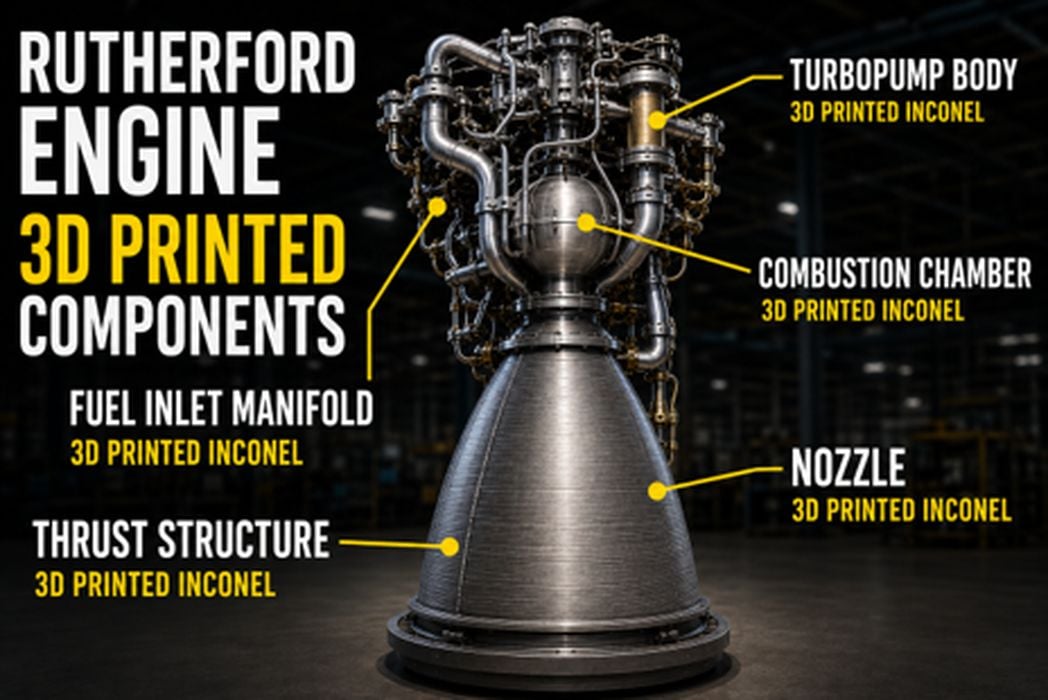
Rocket Lab’s advantage has not simply been additive manufacturing. Plenty of competitors embraced additive manufacturing. Some made it a centerpiece of their marketing. Rocket Lab treated it as a manufacturing tool. The company built production systems around the technology and then focused relentlessly on cadence, reliability, and execution. Today, Rocket Lab has produced more than 1,000 Rutherford engines, with more than 800 having already flown in space. The company operates dedicated engine development and production facilities in California and has spent years refining a process capable of supporting a steadily increasing launch rate.
The Rutherford engine remains one of the clearest demonstrations of that philosophy. When it reached orbit in 2018, it became the first 3D printed rocket engine to do so. Rocket Lab adopted additive manufacturing because rocket engines reward complexity. Cooling channels, injector geometries, turbopump components, and valve housings benefit from shapes that conventional manufacturing struggles to produce efficiently. The result was an engine that could move rapidly from redesign to flight hardware while reducing the number of manufacturing steps required to produce critical components. Over time, those advantages compounded. What began as a technological novelty became a production system.
The next test for Rocket Lab is Neutron. Standing roughly 43 meters tall and designed to carry up to 13 metric tons to low Earth orbit, Neutron moves Rocket Lab into a market currently dominated by much larger launch vehicles. Its first stage will be powered by nine methane-fueled Archimedes engines generating nearly 1.5 million pounds of thrust at liftoff. Like Rutherford, Archimedes incorporates significant additive manufacturing, including printed thrust chambers, turbopump housings, and valve assemblies.
Rocket Lab has already completed full-scale Archimedes engine testing, built dedicated production capacity, and secured multi-launch Neutron contracts before the vehicle’s first flight. The company is not merely building a bigger rocket. It is attempting to scale the manufacturing system that allowed Electron and Rutherford to survive while so many competitors disappeared.
Why Rockets? From Communications to Computing
The first wave of the modern space economy focused on satellites. Communications satellites extended internet access into remote regions. Earth observation satellites monitored crops, shipping lanes, weather systems, infrastructure projects, and military activity. Navigation networks became essential to transportation, logistics, agriculture, finance, and countless smartphone applications. Thousands of satellites now orbit Earth performing tasks that once required aircraft, ground stations, or extensive terrestrial networks. Every launch places another piece of that orbital system into service.
Demand accelerated with the rise of large satellite constellations. Instead of deploying a handful of large satellites designed to operate for decades, companies increasingly launch fleets consisting of hundreds or thousands of smaller spacecraft. These constellations provide broadband connectivity, real-time imaging, environmental monitoring, and persistent surveillance. The result is a growing need for launch capacity. Rocket Lab’s customers are not simply purchasing rides to orbit. They are purchasing access to a growing network of services that increasingly surrounds the planet.
What Satellites Replace
| In Orbit | On the Ground |
| Satellite broadband | Fiber networks and cell towers |
| GPS navigation | Ground-based navigation networks |
| Earth imaging | Aircraft surveys and inspection crews |
| Weather monitoring | Radar stations and weather balloons |
| Missile detection | Distributed radar systems |
| Maritime tracking | Coastal monitoring networks |
The next phase may involve computation itself. Artificial intelligence has triggered an unprecedented race to build data centers. Those facilities require enormous amounts of electricity, cooling capacity, water, land, and permitting approvals. Utilities across the United States are struggling to accommodate rapidly rising power demand. At the same time, communities have pushed back against large industrial developments, while transmission upgrades and permitting processes often stretch for years. These constraints have led companies and governments to explore a possibility that once seemed far-fetched: moving portions of future computing capacity into space.
Orbital data centers remain largely experimental, but the logic behind them is straightforward. Solar energy in space is abundant and uninterrupted. Waste heat can be radiated into the vacuum of space. Computing systems can operate without competing for scarce land, water, and grid capacity. Organizations in Europe, Asia, and the United States have announced studies, prototypes, and long-term plans aimed at evaluating space-based computing platforms. Significant engineering challenges remain. Yet the concept illustrates how rapidly the purpose of launch is expanding.
Additionally, K2 Space and Rocket Lab have been awarded key supplier contracts with the U.S. Space Force’s next-generation military communications network. K2 Space will provide the satellite platform for SES’s entry in the Protected Tactical Satcom-Global program (known as PTS-G) while Rocket Lab will supply the spacecraft bus for Viasat’s PTS-G satellite.
Rocket Lab’s future may ultimately depend less on rockets than on what those rockets carry. The industry’s early growth was driven by communications, navigation, and imaging satellites. The next wave could include increasingly sophisticated sensing systems, autonomous spacecraft, in-space manufacturing facilities, and perhaps even computing platforms. Every one of those ambitions begins with the same requirement: reliable access to orbit.
The Case for Coordination
For most of the Space Age, the problem was access. Launches were rare. Satellites were expensive. Space remained the domain of governments and a handful of large contractors. Companies such as SpaceX and Rocket Lab have spent the past decade attacking that constraint. Launches have become more frequent. Costs have fallen. New entrants have emerged. The result is one of the great industrial successes of the twenty-first century. It has also created a new challenge. More than 11,000 active satellites now orbit Earth. Thousands belong to SpaceX’s Starlink constellation alone. China’s state-backed Guowang project plans a rival network consisting of thousands of satellites. Amazon’s Project Kuiper is deploying its own constellation. European governments, commercial imaging companies, weather services, defense organizations, and scientific institutions are all seeking greater access to orbit. The modern space economy is no longer defined by a handful of flagship missions

Scale changes the nature of the problem. A rocket launch is a national event. Ten thousand satellites become a traffic-management issue. Every spacecraft occupies a finite orbital environment. Every satellite transmits through limited radio frequencies. Every launch adds objects that must be tracked, monitored, and eventually removed. The same technologies making space more accessible are also making it more crowded.
The consequences are not theoretical. In 2009, the inactive Russian satellite Cosmos 2251 collided with the operational Iridium 33 communications satellite, generating thousands of debris fragments that continue to orbit Earth today. Since then, satellite operators have conducted growing numbers of collision-avoidance maneuvers. SpaceX alone reportedly performs tens of thousands of such maneuvers annually across its Starlink fleet. The challenge is no longer placing satellites into orbit. The challenge is ensuring they can coexist once they arrive.
That reality has elevated discussions that once seemed secondary. The United Nations has developed long-term sustainability guidelines for outer space activities. National regulators increasingly require debris-mitigation plans. Industry groups continue developing standards governing spacecraft tracking, data sharing, frequency coordination, and end-of-life disposal. These efforts lack the drama of a rocket launch, yet they may prove equally important. A successful space economy depends upon cooperation as much as competition.
Rocket Lab’s future Neutron launches and SpaceX’s Falcon 9 missions will carry different payloads for different customers. Once those satellites reach orbit, however, they enter a shared environment. Weather satellites, communications networks, Earth observation platforms, navigation systems, and scientific spacecraft all depend upon the same orbital commons. Orbital debris does not recognize national borders. Neither do radio signals. Neither do collision risks.
The next chapter of the space economy may be shaped less by who reaches orbit first and more by how effectively participants work together after they arrive. Launch providers have spent decades expanding access. The challenge now is preserving it. Success has opened the door to a more connected and capable world. Keeping that door open may require an unprecedented level of international coordination.
How Do Aerospace Manufacturers Claim the Section 41 R&D Tax Credit for Additive Manufacturing?
Aerospace manufacturers like Rocket Lab qualify for the Section 41 Credit for Increasing Research Activities (R&D Tax Credit) by incurring Qualified Research Expenses (QREs) during the design, development, and testing of advanced aerospace components. Aerospace companies must qualify for this credit with eligible projects such as those listed in the tale below. This makes the Section 41 R&D tax credit a critical mechanism for offsetting cash-flow pressures.
Aerospace Engineering Matrix: Innovation to Eligible Impact
| Sub-Sector | R&D Innovation / Technical Objective | Qualified QRE Activities & Testing Protocols |
| Propulsion Systems | Designing methane-fueled or liquid-oxygen rocket engines utilizing 3D-printed thrust chambers and valve assemblies. | Archimedes Engine Testing: Full-scale hot-fire testing, cryogenic fluid management qualification, and metallographic analysis of printed components. |
| Space Systems & Avionics | Engineering autonomous satellite platforms and next-generation spacecraft buses for secure military communication networks. | PTS-G Integration: Designing specialized bus hardware to satisfy military payload requirements and performing vacuum thermal-cycle testing. |
| Advanced Software | Developing real-time orbital traffic management systems, collision-avoidance algorithms, and automated trajectory software. | Constellation Coordination: Simulating tens of thousands of autonomous maneuvers to manage high-density orbital environments. |
Below is a table that presents Rocket Lab’s R&D expenses in recent years and active employees. Between 2022 and 2025, Rocket Lab increased its R&D spend by about 315 percent, while growing its workforce by approximately 86 percent.
| Year | R&D Expenditures (USD Millions) | Employees (Year-End) |
| 2025 | 270.7 million | 2,600 |
| 2024 | 174.4 million | 2,100 |
| 2023 | 119.0 million | 1,650 |
| 2022 | 65.2 million | 1,400 |
Printing a Shared Future
As activity in orbit expands, the industry will increasingly confront questions of reliability, maintenance, interoperability, and trust. Those concerns receive far less attention than rocket launches, yet they become more important as more nations, companies, universities, and research institutions begin operating in the same environment.
The modern space economy already depends on cooperation. The International Space Station remains one of the most ambitious engineering collaborations ever attempted, bringing together American, Russian, European, Japanese, and Canadian partners. Even during periods of political tension on Earth, astronauts and cosmonauts have continued working together in orbit. That reality highlights an often-overlooked feature of space operations: distance makes logistics difficult, and difficult logistics reward cooperation.
Additive manufacturing may strengthen that trend. NASA has already demonstrated the ability to manufacture tools and components aboard the International Space Station rather than waiting for resupply missions from Earth. The significance was not the individual wrench, bracket, or tool. The significance was proving that a digital design could be transmitted electronically and transformed into a physical object where it was needed. A replacement component that once required months of planning, manufacturing, launch preparation, and orbital delivery can potentially be produced on demand.
That shift changes what gets shared. Historically, international cooperation required the movement of physical hardware. In the future, organizations may increasingly exchange qualified digital designs, manufacturing instructions, inspection protocols, and material specifications. A scientific mission, orbital research facility, lunar habitat, or future space station may care less about where a replacement part was manufactured and more about whether the design has been validated and the production process can be trusted. The challenge becomes less about transportation and more about confidence.
Aviation provides a useful precedent. Commercial aircraft operate safely because manufacturers, suppliers, airlines, maintenance organizations, and regulators rely on common standards. Space may gradually move in the same direction. Rocket Lab’s printed Rutherford and Archimedes engines, SpaceX’s growing use of additive manufacturing, and broader adoption across the aerospace sector point toward a future in which qualification procedures, material standards, inspection methods, and digital manufacturing records become increasingly important. The objective is not standardization for its own sake. The objective is ensuring that hardware produced by different organizations can be trusted to perform as expected.
The implications extend well beyond launch providers. Satellite manufacturers are already exploring additive manufacturing for propulsion systems, antennas, thermal-management components, and structural assemblies. Space agencies continue investigating in-space manufacturing for lunar and deep-space missions where spare parts cannot simply be ordered and shipped. As missions move farther from Earth, digital inventories may become as important as physical inventories. The most valuable item crossing borders may not be a component at all. It may be the certified design file needed to produce one.
For decades, additive manufacturing was promoted as a way to build better parts. Its larger contribution may be helping organizations work together across greater distances. The future of space activity will depend upon rockets, satellites, and launch providers such as Rocket Lab. It may also depend upon something far less visible: the ability of many participants to trust the same designs, the same standards, and the same digital manufacturing language.
Charles G. Goulding is a practicing attorney.