
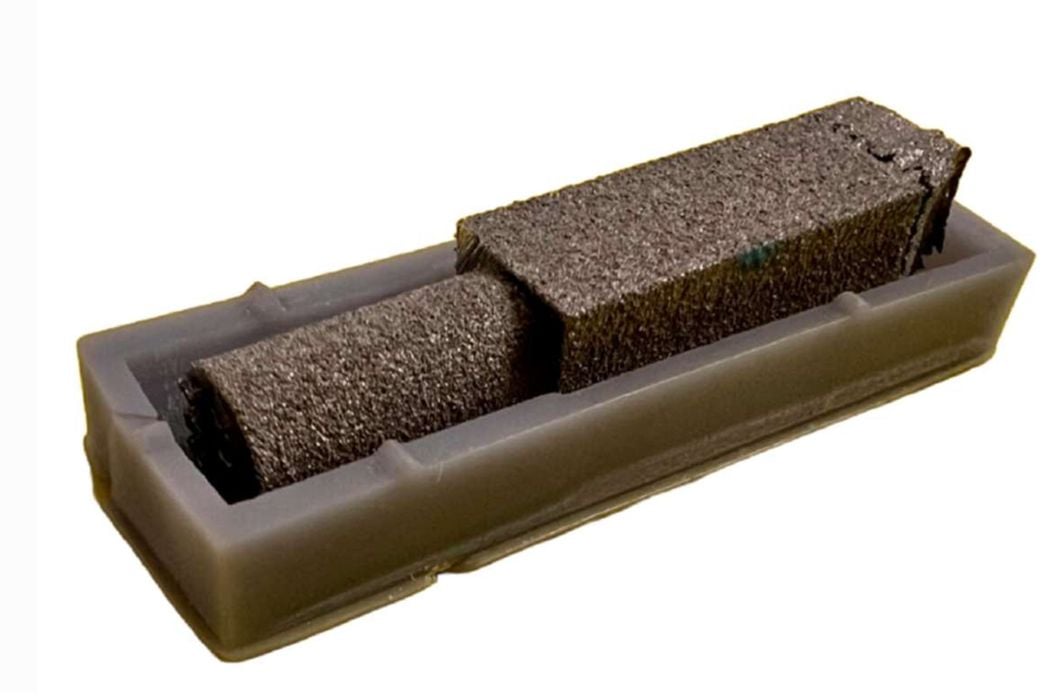
A research team proposes spectral extrapolation to recover determine surface roughness metrics on laser powder bed fusion parts from limited measurements, promising faster quality assurance for AM shops.
Surface condition remains a stubborn variable in Laser Powder Bed Fusion (LPBF). Unmelted particles, balling, and scan track texture influence fatigue, sealing, and heat transfer in aerospace, energy, and medical applications. Yet full-field optical scans of complex parts are slow, struggle on steep slopes, and are often impossible inside narrow channels or lattice cavities.
Shops typically fall back to small fields of view and extrapolate meaning by averaging areal parameters like Sa or Sq under ISO 25178. That approach can be biased when the window is small, the sampling frequency is limited, or the surface texture is anisotropic. Tactile stylus methods help but are even slower and less practical on curved or internal features. The result is a metrology bottleneck that undermines process qualification and continuous improvement.
Why Surface Spectra Matter In LPBF
Instead of relying only on spatial-domain statistics, the study leverages power spectral density (PSD) analysis to describe roughness across scales. In frequency space, the roll off, slopes, and anisotropy encode how energy is distributed from long waviness to fine asperities. If a measurement only captures a narrow band of this spectrum, standard areal metrics can drift because the unmeasured frequencies still contribute to the true value.
Spectral extrapolation addresses the gap by fitting a model to the measured PSD band, then extending it to the frequencies the instrument could not capture due to field of view, resolution, or occlusion limits. With a plausible spectrum spanning low to high spatial frequencies, one can recompute roughness parameters that better reflect the full surface, rather than just the patch that was scanned.
From Small Patches To Full Fidelity Metrics
According to the paper, the workflow begins with a limited topography map captured by optical or tactile means. The team computes the PSD over the accessible frequency band, fits a parametric function that represents the surface’s multi scale behavior, and extrapolates to fill the missing bands. From that completed spectrum, they recover surface statistics such as Sa and Sq, and can also infer correlation lengths or slopes that relate to process physics. The specifics of the fit are not detailed in the summary, but power law behavior is common in self affine technical surfaces and would be a likely choice.
The authors report that this method improves the fidelity of roughness estimation when the available data are undersampled or have limited field of view. In other words, when you cannot scan the whole feature, the spectral route appears to reduce bias and variance versus naive spatial averaging. That could be important for downskin regions, overhangs, and internal channels where optical access is partial and sample prep is constrained.
This could change QA economics. Rather than spending hours mosaicking large areas or rejecting parts due to measurement infeasibility, a shop could scan a handful of strategically placed windows, apply spectral extrapolation, and compute lot level metrics with better confidence. Service bureaus might fold this into incoming inspection; OEMs could link it to parameter development, correlating spectral features with laser power, hatch spacing, or scan vector strategies to tighten process windows.
There are boundaries. Spectral methods assume at least local stationarity and, often, isotropy; LPBF textures can be strongly directional along scan vectors, so directional PSDs or anisotropic models may be required. Large isolated defects, adhered spatter, or pores are not well represented by smooth spectral models and still demand direct detection. Calibration is likely needed per material, machine, and parameter set, and uncertainty quantification will be essential for certification workflows. The paper does not state runtime or software availability; computational cost should be modest, but adoption depends on toolchain integration and transparent error bars.
Regulated sectors will also ask for traceability. Any computed metric reconstructed beyond the instrument’s native bandwidth must come with confidence intervals and validation against ground truth maps. Without that, auditors will treat it as an interesting research result rather than a production control tool.
Signals To Watch For
Two developments would accelerate adoption: open datasets and code that let the community reproduce results across alloys, scan strategies, and machines, and vendor implementations inside common metrology stacks from Zeiss, Alicona, Bruker, or Sensofar. Validation on internal geometries using complementary modalities like CT, and side by side comparisons with machine learning super resolution, would clarify when spectral extrapolation is preferable, complementary, or insufficient.
If this approach holds up under broader testing, AM metrology could shift from measuring more to measuring smarter — a trade that many factories would make today.
Via IOPscience
