
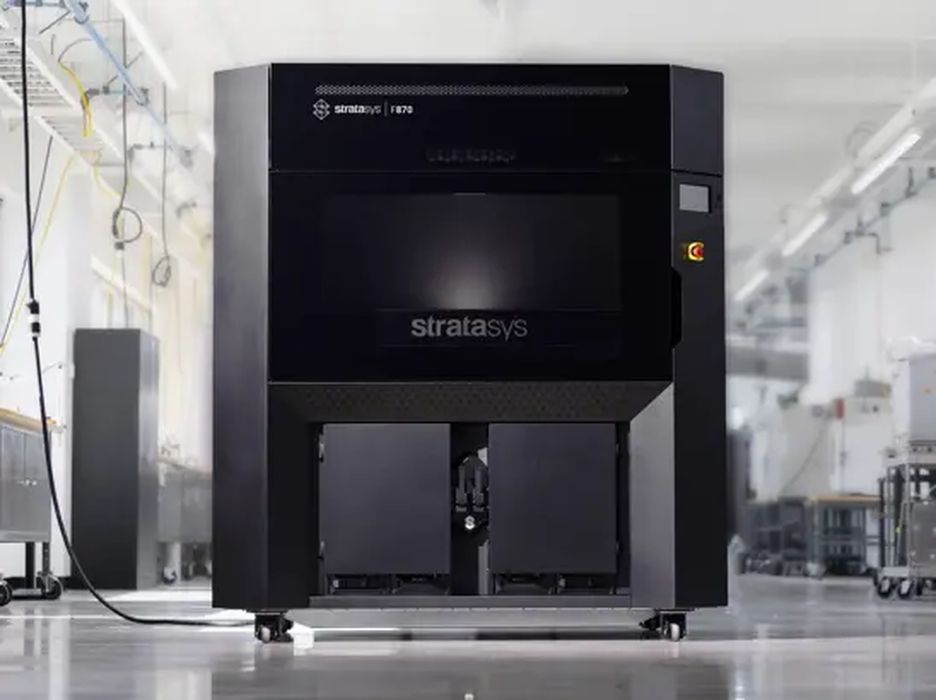
Stratasys announced a new 3D printer, the F870.
The F870 becomes the flagship FDM system for Stratasys’ industrial buyers, intended for production deployment. This is a serious device that will — and has — been appearing in factories worldwide. Stratasys said the F870 is already being used by both Rivian and Toyota.
The system has a massive build volume of 1000 x 610 x 610, and has a dimensional accuracy on the XY plane of only 0.002mm/mm. In the Z axis, it’s 0.002mm/mm, although they do state that ultimate part accuracy is highly dependent on the material and geometry of the part in question.
This is indeed an industrial machine, as it weighs a huge 817kg and is almost 2 m wide. It also requires three-phase power for operation. Unlike some previous Stratasys systems, the F870 does not require external compressed air; instead, the system includes an integrated vacuum pump. This is used to hold down build plates.
One of the main features is that the huge build volume is fully heated, up to 95°C. This is perhaps the main reason why such a large machine can deliver parts with excellent dimensional accuracy: the thermal gradient is low, so far less warping can occur. Stratasys said the F870 has “the longest fully heated build chamber on the market.”
They also said that the F870 is capable of running continuously, without the need for operator intervention, for up to two solid weeks. That’s an incredible capability, and will be very useful for printing massive objects in that huge build volume: those jobs will take a considerable amount of time to complete. Normally, an operator would have to show up periodically to swap filament canisters, but it seems that the F870 has two weeks’ worth of material capacity.
The material spools (do they call them spools now instead of canisters?) are apparently the same as those used on the company’s F3300 system. This means that a workplace with both systems needs to buy only one style of spool.
By the way, all that filament stored on board can be kept dry by their integrated material drying system. This will also help produce high-quality parts.
Another interesting feature is “tool-free” print head replacement. While desktop 3D printer operators are used to that capability, it’s rarer on industrial equipment. I recall swapping print heads on an old Fortus 400mc, and it was definitely not fun: you required not only tools, but a ladder, too. Here, the new F870 should be vastly simpler to maintain.
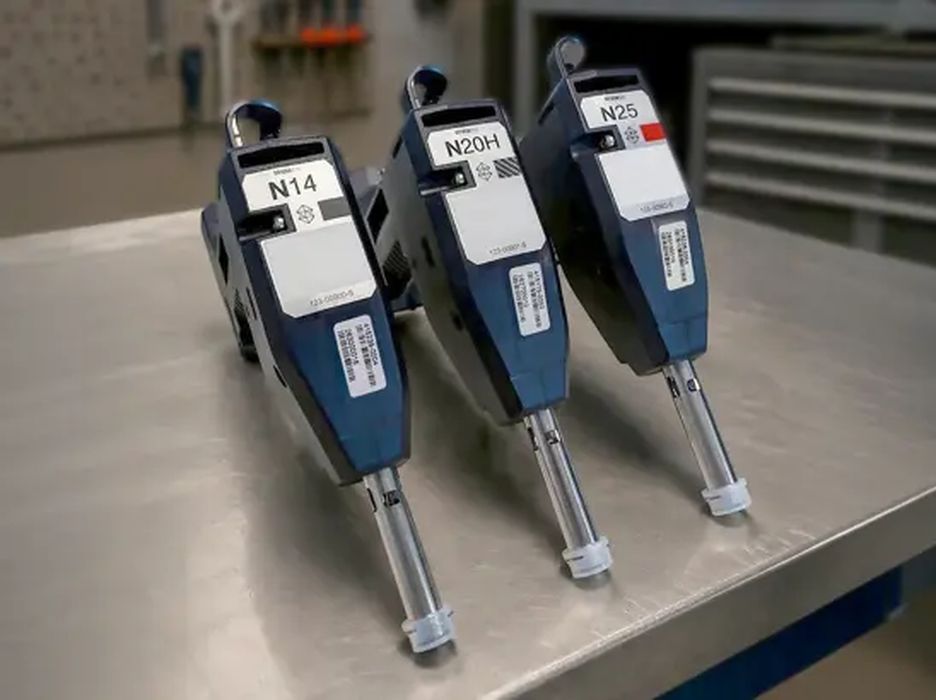
Why replace print heads? It turns out that there are three types you can choose to use on the F870:
- N14: for smaller layer sizes
- N20H: hardened for use with the nylon CF material
- N25: for larger layers, and higher speed prints (2X for ASA, apparently)
For materials, Stratasys has launched the system with support for eight different materials, including nylon CF, ABS, and ASA. The materials are black, except for ASA, which comes in six different colours.
Stratasys is positioning the F870 as a device for factory floors, specifically for producing tooling, jigs, fixtures, and similar items. In fact, their material lists specific traditionally made items that would be replaced by 3D prints made on the F870.
The F870 looks to be a very impressive machine that could be of incredible benefit to factories.
Via Stratasys
