Charles R. Goulding and Nimra Shakoor show how companies like Teradyne are removing bottlenecks and keeping pace with rising AI chip complexity.
The rapid expansion of artificial intelligence has placed unprecedented demands on modern manufacturing, particularly in the semiconductor sector. Companies that enable precision, speed, and reliability in chip development have become essential to this growth. Teradyne, a leading designer of automatic test equipment and industrial automation solutions, operates at the center of this ecosystem, supporting the semiconductor technologies that power AI-driven data centers and advanced computing systems. As demand for high-performance chips has increased, the infrastructure behind their testing, validation, and automated handling has become just as critical as the chips themselves.
AI-driven chips introduce significantly higher levels of complexity, including increased pin counts, faster data rates, tighter thermal constraints, and more stringent reliability requirements. Validating these devices at scale requires advanced automated test systems capable of maintaining accuracy and throughput simultaneously. Teradyne’s electronic test and automation platforms address these challenges by enabling high-speed, high-precision testing while ensuring that gains in production speed do not come at the expense of yield, thermal performance, or long-term reliability.
To meet these demands, Teradyne’s test systems provide precision automated platforms for validating chips, boards, and electronic modules at every stage of production. They cover a range of applications, including semiconductor testing for functional, parametric, and thermal performance; memory validation; system-level and board testing; and wireless and communications device verification. These systems focus on ensuring high yield, reliable performance, and long-term durability while keeping pace with growing production volumes. Integrated with robotics and automated handling, Teradyne’s platforms enable high-speed, lights-out operation, making them critical for advanced AI, automotive, and high-performance computing applications.
Teradyne’s Robot Divisions
Teradyne’s robotics business is organized into four primary divisions, each addressing a distinct layer of industrial automation while supporting its broader test-centric manufacturing strategy. The divisions work in concert with Teradyne’s automated test systems, moving devices under test, wafers, and assembled boards between stations, enabling lights-out production and high-throughput validation.
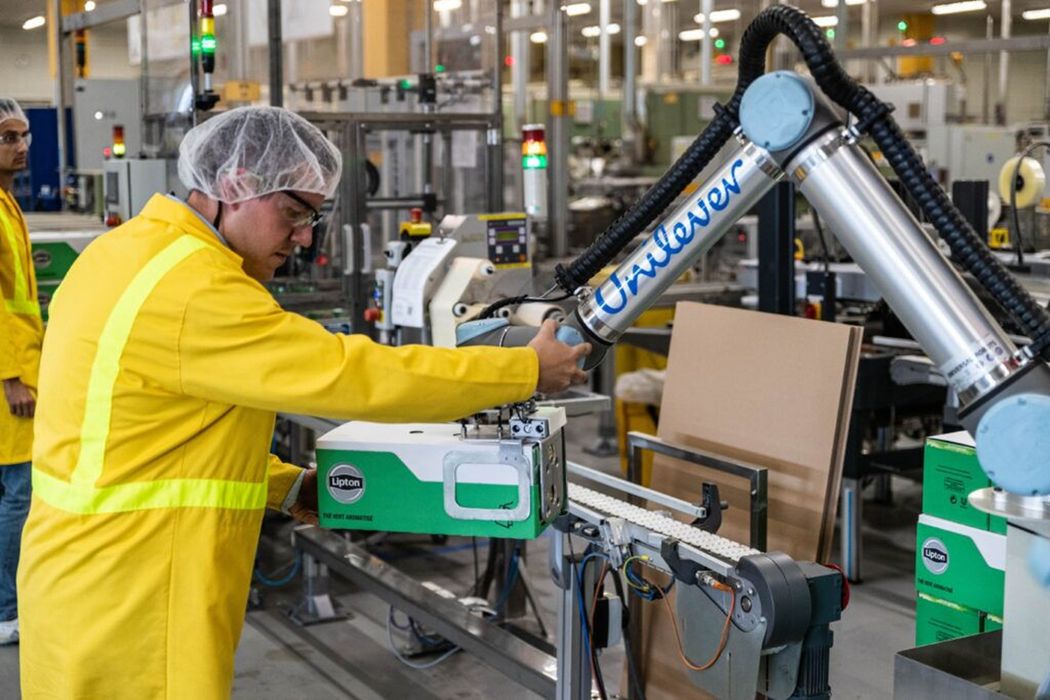
Universal Robots focuses on collaborative robots, or “cobots.” These flexible, lightweight robotic arms work safely alongside humans in manufacturing environments, automating repetitive or hazardous tasks such as machine tending, packaging and palletizing, assembly, material processing, and screwdriving. They are cost-effective, simple to integrate, and enhance consistency and throughput across production workflows.
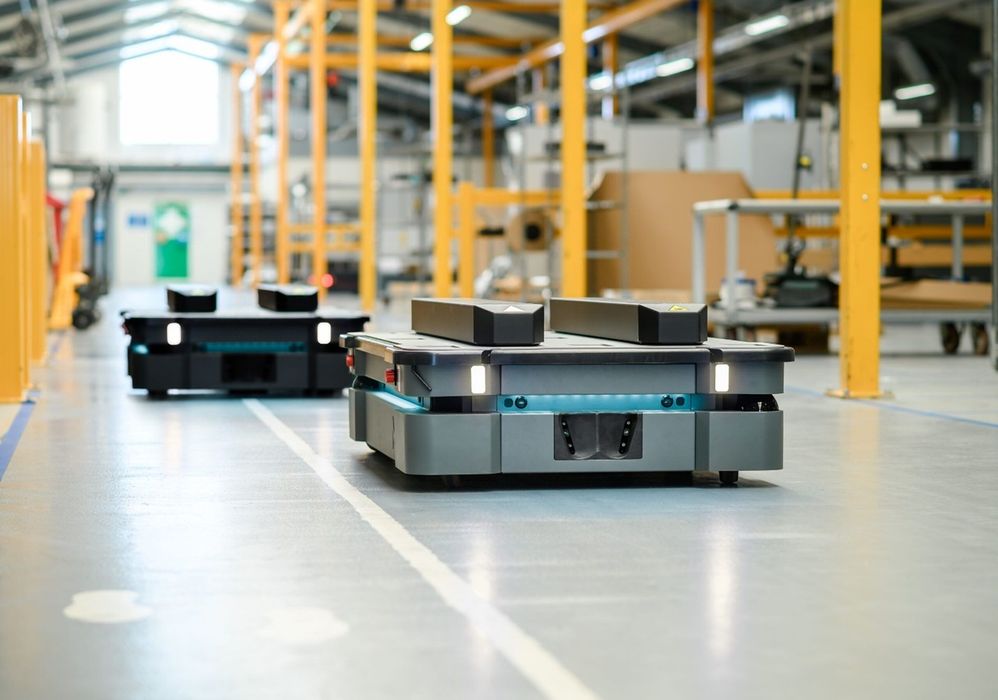
Mobile Industrial Robots (MiR) develops autonomous mobile robots for intralogistics automation. These systems transport materials and move devices under test within factories and warehouses, reducing manual handling, shortening lead times, and improving safety in high-volume production environments.
AutoGuide Mobile Robots specializes in high-payload autonomous mobile robots. These modular systems handle heavier loads, complementing MiR’s offerings, and extend Teradyne’s mobile automation capabilities to more demanding test and assembly applications.
Energid develops advanced robotics control and simulation software, integrating motion control, software, and simulation tools for complex systems in aerospace, agriculture, transportation, and defense applications. These tools are also used to optimize robotic handling in high-speed semiconductor test environments.
Together, these robotics divisions enable seamless integration with Teradyne’s automated test platforms, supporting continuous operation, higher throughput, and reliable handling across semiconductor, memory, and system-level testing workflows.
Automation & 3D Printing
Beyond robotic handling, automation is increasingly embedded directly within the 3D printing process itself. Industrial additive manufacturing systems now operate as automated print farms, where jobs are queued, scheduled, and executed with minimal human intervention. In-situ monitoring systems use sensors, cameras, and data analytics to detect defects and adjust print parameters in real time, improving yield and repeatability. Automated post-processing—including depowdering, support removal, surface finishing, and inspection—further enables 3D printing to function as a production-grade technology rather than a standalone prototyping tool.
As a result, additive manufacturing is reshaping how components are designed and produced. By enabling rapid fabrication of complex and customized parts, 3D printing shortens development timelines and reduces dependence on rigid, global supply chains. When paired with robotic automation, these technologies form efficient manufacturing cells in which robots manage material handling, part removal, inspection, and finishing, while additive processes produce geometries that are difficult or impractical to manufacture using conventional methods.
The convergence of robotics, additive manufacturing, and automated testing is particularly impactful in accelerating the transition from digital design to physical production. Automated workflows support continuous, end-to-end processes that move seamlessly from prototyping to testing and scaled manufacturing. This transition is increasingly supported by industrial software platforms and digital twin technologies, where companies such as Siemens enable manufacturers to simulate, optimize, and validate production workflows before physical deployment. Together, these tools reduce risk when moving new designs into production while maintaining consistency and performance at scale.
As manufacturing systems become faster and more automated, testing has emerged as a critical bottleneck. Higher throughput and increased design complexity place greater pressure on validation systems to keep pace with production without sacrificing quality. Automated test equipment plays a central role in resolving this constraint, ensuring that reliability, thermal performance, and yield remain intact as volumes scale. In this context, Teradyne’s test platforms serve as a foundational element of advanced manufacturing environments.
These shifts are also transforming how companies approach innovation and development. Robotics, additive manufacturing, and automated testing enable rapid iteration, frequent design refinement, and continuous performance evaluation. Engineers increasingly focus on system integration, process optimization, and data-driven decision-making rather than manual operation. The ability to prototype, test, and revise designs quickly has become a core competitive advantage as AI-driven products grow in complexity.
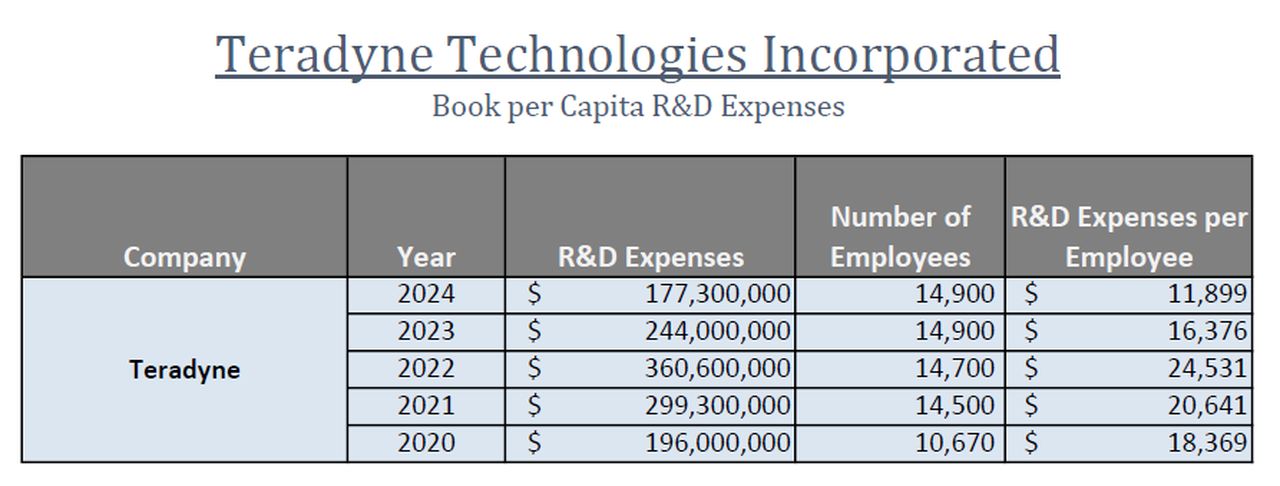
Below is a table that presents the research and development expenses incurred by Teradyne over recent years.
The Research & Development Tax Credit
The now-permanent Research & Development Tax Credit (R&D) Tax Credit is available for companies developing new or improved products, processes and/or software.
3D printing can help boost a company’s R&D Tax Credits. Wages for technical employees creating, testing and revising 3D printed prototypes can be included as a percentage of eligible time spent for the R&D Tax Credit. Similarly, when used as a method of improving a process, time spent integrating 3D printing hardware and software counts as an eligible activity. Lastly, when used for modeling and preproduction, the costs of filaments consumed during the development process may also be recovered.
Whether it is used for creating and testing prototypes or for final production, 3D printing is a strong indicator that R&D-eligible activities are taking place. Companies implementing this technology at any point should consider taking advantage of R&D Tax Credits.
Conclusion
Robotic automation, additive manufacturing, and automated testing exemplify how modern manufacturing is evolving toward faster, more flexible, and more resilient systems. As AI-driven technologies continue to scale in complexity and volume, the integration of these tools will play an increasingly central role in meeting global demand. Supported by advanced test systems, robotics platforms, and automation infrastructure from companies such as Teradyne—and complemented by industrial software ecosystems including Siemens—the manufacturing environments being built today, point toward a future defined by speed, precision, resilience, and sustained innovation.