
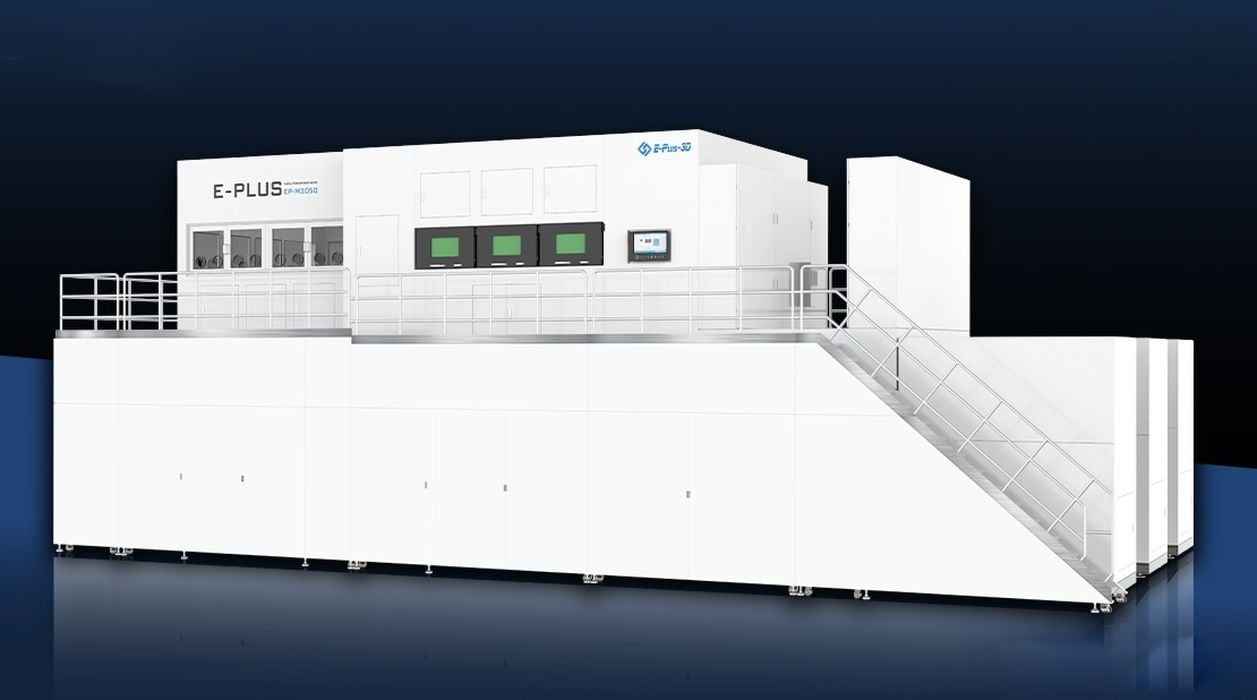
I’m looking at a very unusual new metal 3D printer, the EP-M3050 from Eplus3D.
Eplus3D specializes in manufacturing rather large-format metal 3D printers, as they have multiple devices of this type currently in their product catalog.
This type of machine is quite difficult to produce. There aren’t a lot of large-scale metal 3D printers using the LPBF process for several reasons.
One is a height limitation: most systems use galvanometric mirrors to sweep the laser beam across the build plane. But as the area increases, so does the angle of the reflected beam. This means the laser dot becomes skewed on larger systems. To compensate, the mirrors are mounted higher to decrease the angle. That causes the machines to be taller and taller, and there’s only so high you can go. This constrains the build volume.
Another challenge is airflow. Air is used to blow away smoke and vapours generated during printing, but they cannot interfere with laser operations. A laser traveling through smoke is less powerful, and that might compromise print quality at that location. To overcome this, LPBF systems must have very consistent and regular airflow to ensure predictability. However, doing so on an ever-increasing build volume is challenging.
The new EP-M3050 seems to be taking on those challenges well, as it has an absolutely massive build volume of three metres on a side. And that’s the default standard configuration. The system is apparently scalable up to a house-sized 5 x 10 x 5 m.
To put that in perspective, that’s the volume equivalent of 150,000 desktop 3D printers. Wow.
The EP-M3050 has more innovations than just the build volume.
That build volume can be customized not only in size but in shape. Eplus3D can provide a rectangular volume, a cylindrical volume, or a “ring-shaped volume”. That is the first I’ve ever heard of a ring build volume.
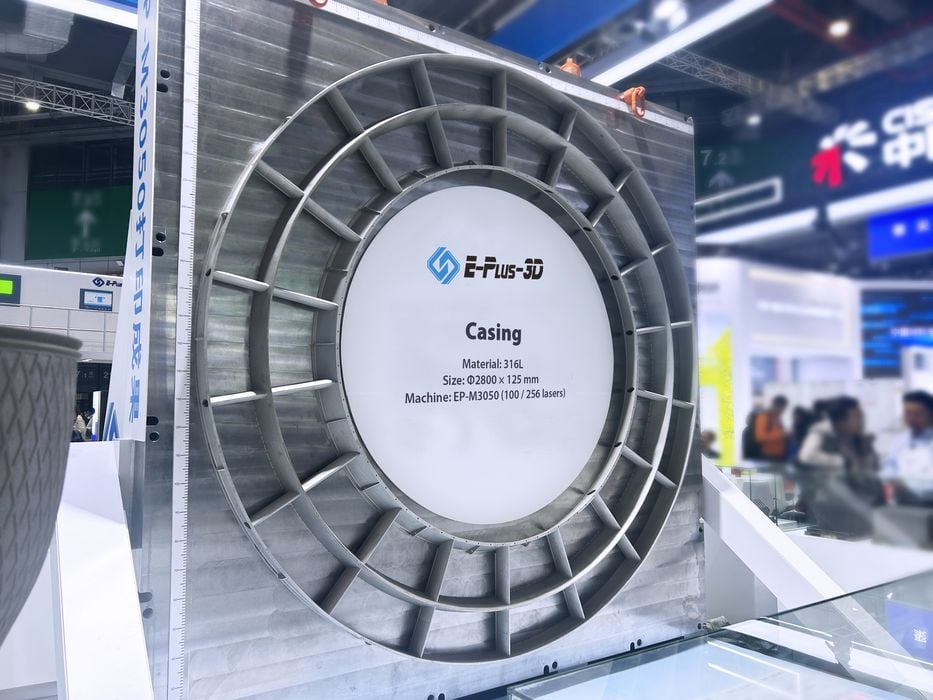
Why such an odd geometry? It turns out that when printing large metal objects, many of them would actually fit in a ring shape. This simplifies the printer if that’s the only type of object being produced.
Another innovation is the number of lasers operating in the system. Incredibly, the EP-M3050 STARTS with 100 lasers, and can be scaled up to an astounding 256 lasers. This is no doubt part of the solution to the height problem: distribute the lasers throughout the build volume.
Eplus3D said the system can theoretically deposit up to 3500 cubic cm per hour, which is an incredible rate. That’s the equivalent of printing around 670kg each day.
In addition, Eplus3D has made improvements in gas flow, which alleviates one of the scaling issues.
It seems that Eplus3D has overcome several of the scaling barriers with the new EP-M3050. Could we expect to see even bigger machines in the future?
Via Eplus3D
