
A metal 3D printed part can be almost completely solid and still not work properly for its application.
Researchers made this observation in a new study of metal additive manufacturing.
For years, one of the most important measures of successful metal 3D printing has been density. The fewer internal voids, the better the part. That sounds intuitively correct, but it turns out there’s considerably more going on inside that metal print.
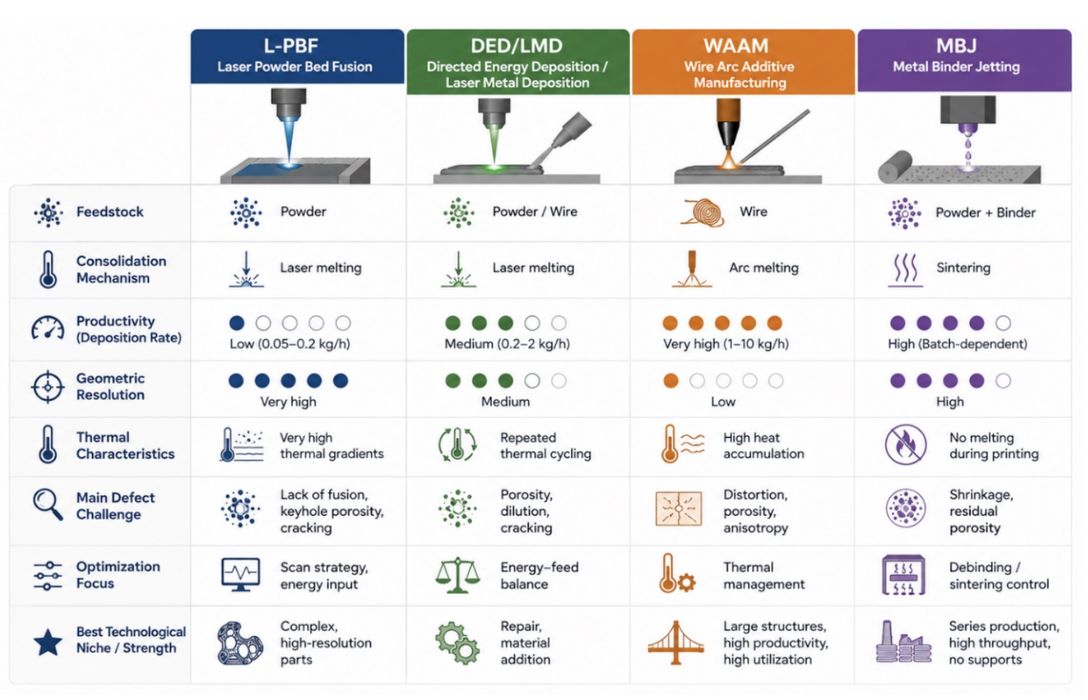
The researchers examined more than 70 publications covering four major metal AM technologies: Laser Powder Bed Fusion (LPBF), Laser Metal Deposition (LMD), Wire Arc Additive Manufacturing (WAAM), and Metal Binder Jetting (MBJ).
Their objective was to understand how the manufacturing process interacts with the particular alloy, and how those interactions determine the properties of the finished component.
First, let’s consider what happens in the LPBF process.
If not enough laser energy hits the powder, the powder may not fuse completely. This creates voids, often with sharp edges that concentrate mechanical stresses.
You could attempt to solve this by increasing laser power, but there’s a problem. Too much energy can produce a deeply penetrating melt pool that traps gas, creating yet more problems..
Both problems produce internal voids, but their causes are almost opposite. So this means that measuring the quantity of porosity doesn’t tell you which is the correct corrective action.
And, it turns out, even eliminating the porosity completely doesn’t always solve all the issues.
The review explains how rapid cooling in LPBF can produce extremely fine microstructures that increase strength but may reduce ductility. In titanium alloy Ti-6Al-4V, rapid solidification can generate a martensitic structure with substantial residual stresses.
Meanwhile, WAAM tends to produce much larger melt pools and slower cooling. This can generate elongated grains that extend through multiple layers.
The resulting component may exhibit anisotropy, meaning its mechanical properties differ depending on the direction.
You could therefore manufacture two components with very high relative density but with very different mechanical behaviours.
The researchers propose a “Process–Material–Defect–Property” (PMDP) framework for dealing with these relationships.
They want to reverse how metal AM processes are selected.
Instead of beginning with an available machine and discovering what properties it has, begin with the mechanical requirements of the finished component.
From those requirements, determine the necessary microstructure, acceptable defects, and material characteristics. Then select the alloy, printing process, operating conditions, and post processing needed to achieve them.
For example, a small titanium component with complex internal geometry might favour LPBF. A massive titanium structure might instead favour WAAM, accepting greater machining requirements in exchange for much higher deposition rates.
They noticed that Hot Isostatic Pressing (HIP), for example, can close certain internal pores, but surface-connected defects stay present. The treatment can also change the metal’s microstructure through prolonged thermal exposure.
This means that post processing should be planned along with the printing process, instead of being treated as a separate operation afterwards, or not being considered at all.
The researchers envision connecting this approach with real-time monitoring and adaptive process control.
Current monitoring systems can observe temperatures, melt pool behaviour, and other manufacturing signals. Then those signals would have to determine what this means for the final material properties.
Metal printers already have increasingly sophisticated ways to observe what they’re doing, but this could be a way to understand more deeply what exactly is going on inside that tiny meltpool.