
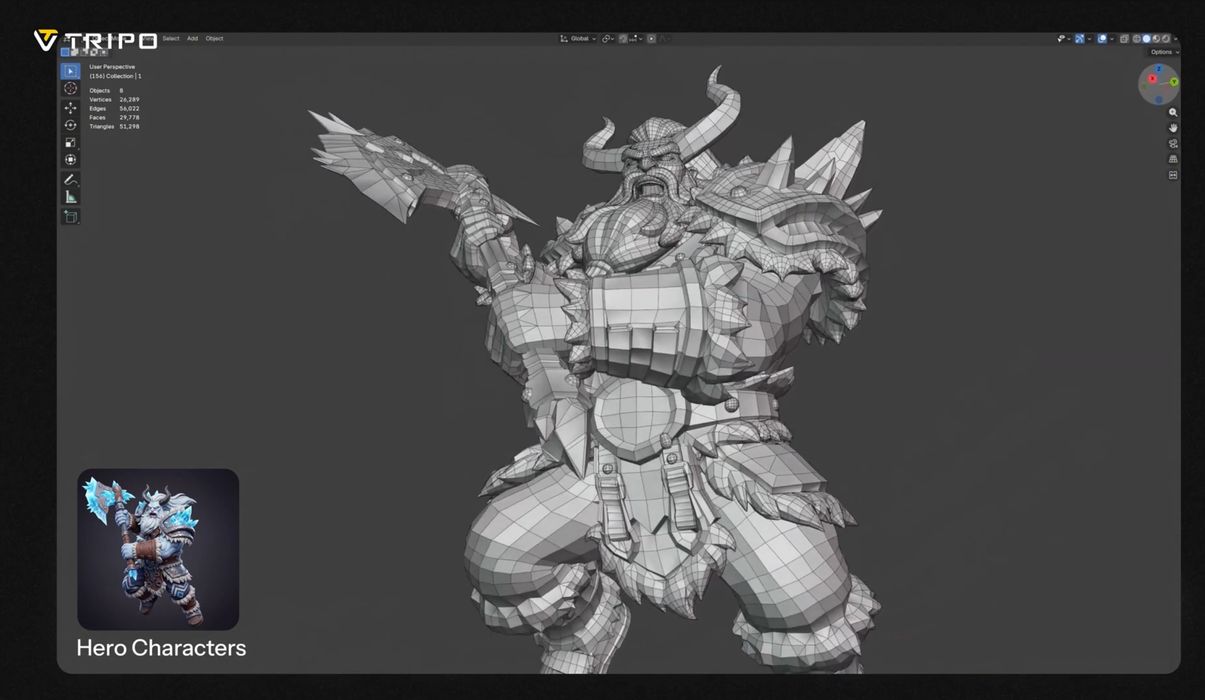
Tripo AI released Tripo P2.0 Preview, which has a unique method to generate 3D models.
On the surface, the main feature of Tripo P2.0 Preview is that it can generate 3D models in only seconds. That’s quite a bit faster than any other generative service, or at least the ones that I have used. While others can produce very good 3D models, it does take a while — sometimes minutes — in order to get the job done.
Another visible feature is that the resolution is better. Tripo P2.0 Preview can generate 3D models in quads natively, up to 25,000 per model. They can also generate models with up to 50,000 triangles.
Triangles are the typical mesh mode for 3D printable assets, while the visual asset community tends to use quads for meshes.
But let’s get back to that speed: how does Tripo speed up the generation process so much?
It’s because under the covers they’ve changed their AI processing workflow.
Normally 3D model generation has been done using the standard token-by-token approach. As an analogy, if you were typing text, and the AI was guessing the next word or character, that’s token by token. After a long period, you’d have an entire email written. But it takes a while.
Instead, Tripo P2.0 Preview uses a technique called Diffusion. It’s quite different, and definitely faster.
You’ve probably already used AI diffusion when generating images, where it is commonly used. The diffusion image generation process starts with a panel of “noise”, random pixels. Then, it slowly iterates, guessing the entire panel at once. In each iteration the image slowly emerges from the noise.
This is much faster than generating an image pixel by pixel, as you can imagine. Now imagine applying that same technique to 3D model generation: that is what Tripo has done here.
They explain:
“The P Series algorithm was designed to move away from traditional ‘linear’ text-like generation toward a “native 3D” spatial approach. Previous approaches serialize a 3D mesh into a long sequence of tokens and predict them one by one, much like a language model writing a sentence. But unlike text, mesh faces have no inherent order. Imposing an arbitrary sequence causes errors to accumulate, efficiency to drop, and output quality to degrade as complexity grows.
However, 3D models are holistic and unordered, unlike linear text. Forcing them into a sequence led to low efficiency and ‘deformities’ caused by the AI losing its way during long sequences.
Tripo’s breakthrough is an algorithm that encodes discrete 3D topology into a continuous, diffusable representation, allowing AI to generate meshes natively in 3D space rather than predicting tokens in a sequence.”
They first released a diffusion model back in March, but that was version 1, and this is version 2, at least in preview form.
You can now try out P2 in Tripo Studio — and for new users, you are able to produce two generations without the need for a subscription.

I gave P2 a test using the same input image I had tested on Meshy 7 the other week, a detailed diving helmet, shown above.
BTW, if you’re doing this test, be sure to select “Smart Mesh”, because that’s the version that uses the latest P2 model.
I selected 50,000 triangles for my test, which is the maximum allowed — I pushed the slider all the way to the right. Because of this, the generation took a bit longer than I expected, 71 seconds. Still, that was much faster than some other image-to-3D services I’ve used recently.
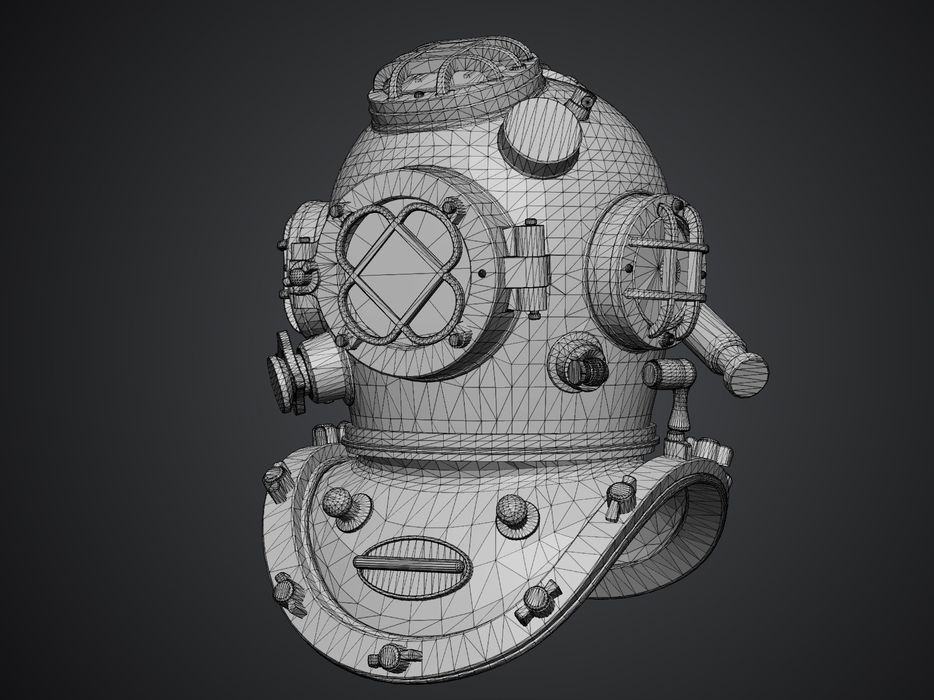
The result was incredibly good. It was fully formed, inside and out, although not quite as detailed as my Meshy 7 experiment. Note that you will require a subscription in order to do a download, which starts at US$13 per month.
Tripo P2.0 is pretty impressive with the very crisp output and generation speed. If you need to generate many 3D models per month, a Tripo Studio subscription could be a good option.
Via Tripo
