
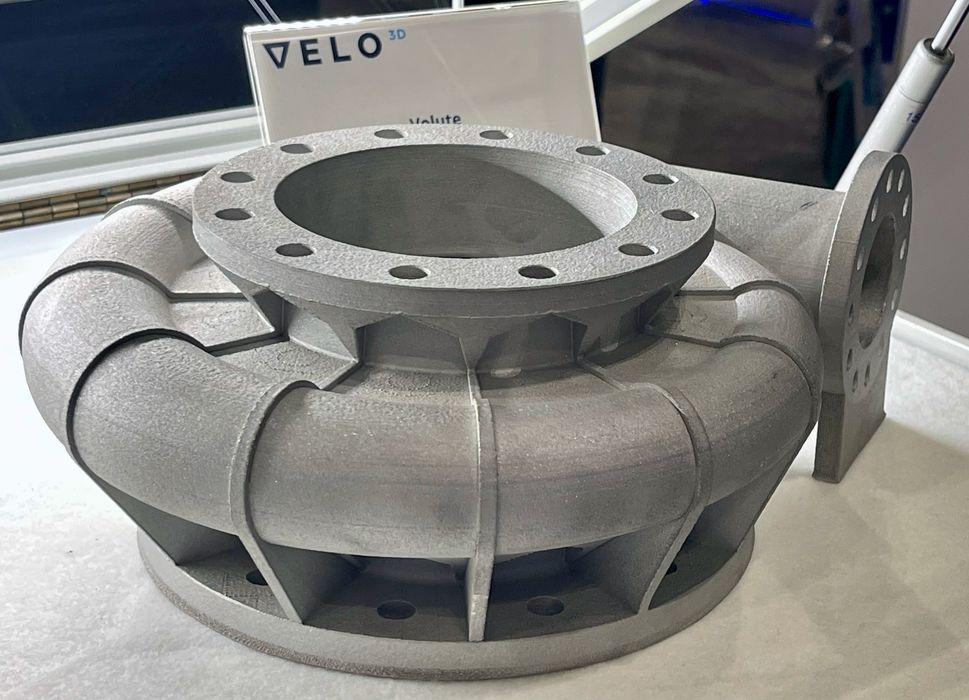
Velo3D has struck a new agreement with the U.S. Army to accelerate qualification of metal 3D printed parts that could relieve ground-vehicle supply bottlenecks.
In a January 13, 2026 press release, Velo3D says it entered into a Cooperative Research and Development Agreement (CRADA) with the U.S. Army Combat Capabilities Development Command (DEVCOM) Ground Vehicle Systems Center (GVSC). GVSC, based at the Detroit Arsenal in Michigan, is the Army’s primary research and development organization for ground vehicle technology and advanced manufacturing.
The target is practical: “rapidly develop and qualify” additively manufactured parts and assemblies for ground combat vehicles and other military systems, specifically to address supply chain disruption. Velo3D says that if several prototype parts are successfully completed and qualified, the resulting additive manufacturing alternatives could be made available for insertion into the Army supply chain.
CRADAs are a familiar vehicle for defense-adjacent additive manufacturing work because they let government labs and companies collaborate without turning the effort into a conventional procurement on day one. That distinction matters: it suggests this is more about proving manufacturability, qualification, and repeatability than it is about announcing a guaranteed fleet-wide purchase of printers.
What The Army Is Buying, Conceptually
Velo3D is positioning the effort around its Rapid Production Solution (RPS), which the company describes as a way to use its equipment, expertise, and “surge capacity” to deliver mission-critical parts at production scale. In other words, this is not only about printing a one-off prototype in a lab; it is also about having a credible path to making more parts when demand spikes or traditional suppliers fail.
On the technology side, the collaboration will use Velo3D’s Sapphire family, which is based on Laser Powder Bed Fusion (LPBF). LPBF is the workhorse metal process for high-detail components, but defense users typically care less about headline resolution and more about consistent results across machines, lots, and sites. Velo3D is clearly leaning into that theme, emphasizing repeatable production “across the entire fleet” and its layer-by-layer in-situ process monitoring.
Velo3D also points out that all Sapphire printers are assembled in the United States and that the platform can produce parts up to 600mm in diameter and 1m in height. That large-format capability is relevant to ground systems, where brackets and housings can quickly exceed the build envelopes of many LPBF platforms, pushing teams back toward castings and machining even when 3D printing would simplify logistics.
Why Qualification And Cybersecurity Matter
Qualification is the focus here. The Army does not just need “a printed part”; it needs a part with known performance, traceable material pedigree, and documentation that survives audits and mishap reviews. Velo3D says the CRADA includes exploration of several Velo3D-qualified alloys for use on the Sapphire platform, including “large-format needs,” but it does not specify which alloys or which specific components are in scope.
Another detail that sticks out is the cybersecurity claim. Velo3D says its systems meet Department of Defense cybersecurity standards and can connect securely to military networks. That may sound like table stakes, but it is a real adoption hurdle for any digital manufacturing system that moves build files, process logs, and quality data around restricted environments. If you cannot deploy the software and securely manage data, you cannot deploy the printer in the ways the US Army (or any military) actually wants to use it.
What Velo3D did not provide is just as important: there is no pricing, no stated number of machines, no list of initial parts, and no timeline beyond “upon successful completion” of prototypes and qualification. That suggests the near-term deliverable is a set of validated workflows and candidate parts, not a purchase order.
Assuming the work progresses, the biggest impact could be in sustainment: replacing hard-to-source legacy parts, reducing repair delays, and creating a fallback manufacturing route when a supplier is down or a casting lead time becomes unacceptable. The wildcard is throughput economics; LPBF can be ideal for complex, high-value parts, but it is not automatically the cheapest answer if a part could be sourced reliably via conventional methods.
If the partnership can demonstrate repeatable production across multiple machines, defensible inspection data, and a clear qualification playbook, it becomes easier for the Army to scale beyond a pilot. Until then, this looks like a sensible bet on process maturity rather than a splashy hardware deployment — which is usually how real defense adoption starts.
In metal additive manufacturing, the part you can qualify is the part you can actually buy.
