
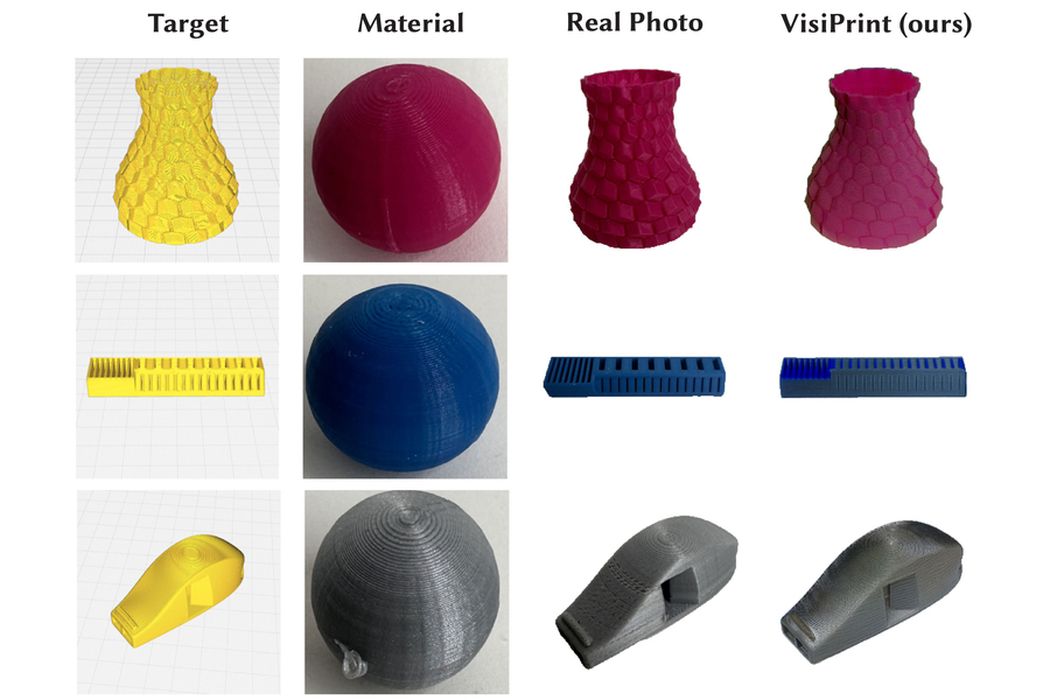
MIT researchers have built a fast preview tool that predicts how an FFF print will actually look, aiming to cut down on wasteful reprints.
If you have ever chosen a filament because the swatch looked perfect, only to pull a part off the printer bed that appears darker, glossier, or strangely banded, you already understand this problem. Most slicers do a good job previewing toolpaths, supports, and time estimates, but they largely ignore the messy reality of visual appearance. That gap is especially challenging for prototypes where “looks matter”, when the part can be mechanically fine yet unusable.
The new system, called VisiPrint, takes an “aesthetics-first” approach. Rather than asking users to rebuild a scene in a 3D renderer, it works from inputs makers already have: a screenshot of the model from slicer software and a single image of the print material. The researchers say the result is a rendering that better reflects real prints, including color, gloss, translucency, and the subtle visual imprint of layer-based fabrication.
MIT describes VisiPrint as compatible with existing workflows because it is not tied to one slicer or a specific material catalog. The material image can come from an online source or a photo of a sample, which is quite important because the “same” filament can vary between brands and batches.
Why Appearance Previews Are Hard In FFF
The researchers focused on the FFF process because it is the most common 3D printing process and because it creates distinctive visual artifacts. In FFF, melted polymer is extruded through a nozzle and laid down in layers that are visible on the part’s surface. Layer height, line width, and even the direction of toolpaths can change how light reflects, producing texture and shading effects that a simple “flat color” preview cannot capture.
VisiPrint attempts to capture those effects by explicitly incorporating slicing patterns into the preview. For 3D print job preparation, this is important because the whole point is to predict what will come out of the machine.
How VisiPrint Works And What It Does Not Do
According to MIT, VisiPrint uses two AI models in tandem. One computer vision model extracts appearance features from the material sample image. A second, generative model then produces a rendering of the object while accounting for the geometry and the slicing pattern implied by the user’s screenshot. The team shows a conditioning method that balances two internal guides: a depth map that preserves shape and shading, and an edge map that preserves contours and structural boundaries. Get that balance wrong, and you either lose the part’s geometry or lose fidelity to the slicer-driven structure.
The workflow is designed for speed and ease of use. Users upload the screenshot and the material image through an interface, and can optionally tweak settings such as the influence of certain colors. In a user study, nearly all participants judged VisiPrint’s output to have better overall appearance and more similar texture compared to other approaches. The preview generation reportedly took about a minute on average, more than twice as fast as competing methods tested by the team.
There are also boundaries to what VisiPrint can do. It is meant to complement a slicer’s functional preview, not replace it. MIT explicitly notes it does not assess printability, mechanical feasibility, or likelihood of failure. In other words, it helps you decide whether that “marble PLA” will look right on your lamp shade, but it will not tell you if your overhang will collapse.
The near-term applications MIT mentions make sense. For example, architects and designers could iterate on visual impact without burning through time and filament. For service bureaus, a credible “this is what it will look like” preview could reduce customer back-and-forth and lower the number of do-over prints that quietly eat profits.
The big question is how well the approach generalizes across printers, profiles, and the enormous variety of specialty filaments. Silk materials, filled composites, and translucent polymers all react differently to nozzle temperature, cooling, and toolpath choices.
In any case, the concept is pretty compelling: desktop publishing took off when “what you see is what you get” became real, and 3D printing has not had an equivalent moment for appearance. If VisiPrint can move aesthetic predictability from guessing to something closer to “it works!”, this could make prototyping feel a lot less like gambling.
Via MIT News
