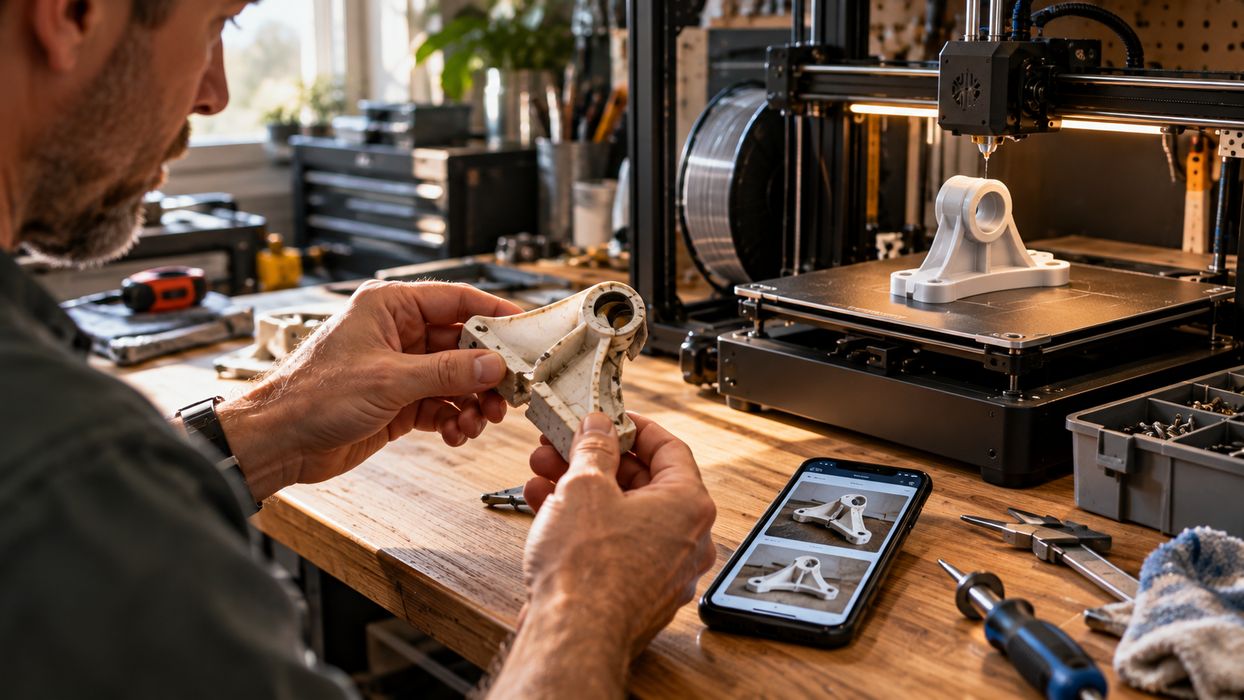
In Part 1, we explored the possibility that AI technology could eventually make 3D design effectively free.
I suspect the consequences could be far more profound than most people realize.
Consider what happened when internet connectivity became inexpensive. Initially, people imagined cheaper communication, easier access to information and online shopping. Those things actually happened, you do them every day.
But nobody really anticipated YouTube, social media, cloud computing and the thousands of other applications that eventually emerged.
These weren’t just cheaper versions of existing services. They were entirely new activities that became possible because the economics of communication had fundamentally changed.
I believe something similar could happen with 3D design. If AI systems become capable of generating useful physical designs at almost no cost, we shouldn’t expect the only result to be cheaper CAD work.
When a design costs next to nothing, people stop asking whether an object is worth designing.
The Disappearance Of Standard Products
Let’s look at how physical products are manufactured today.
A company develops a product, produces it in quantity, stores inventory and offers it to customers. Perhaps the product is available in several sizes or configurations, but the choices are necessarily limited.
That’s because designing, manufacturing and stocking hundreds of variations is expensive.
Now suppose design becomes essentially free.
Why should a bicycle grip be available in only three sizes? Why not generate one that precisely matches the geometry of the owner’s hand?
Why should an organizer for a kitchen drawer be selected from a catalogue? Why not generate one that fits the drawer and its contents exactly?
Why should a piece of protective equipment be designed around a statistical average of human dimensions when it could be customized for each individual?
Some of this already happens with 3D printing, but getting a custom designs remains a big obstacle.
AI-assisted design could mostly remove that barrier.
Of course, mass production would still have substantial cost advantages for standardized products. Injection molding a million identical components would almost always remain much cheaper than individually 3D printing them.
But there’s an enormous space between mass production and expensive custom manufacturing.
When every design can be unique, standardization becomes a choice instead of a necessity.
This could open up entirely new markets for additive manufacturing.
There’s another consequence of all this that might be even more significant.
Today, there are millions of physical products that are simply unavailable because demand is too low to justify manufacturing them.
Consider a replacement component for an appliance manufactured in 1982, an obscure fitting for a particular boat, or a specialized adapter required by a scientific researcher.
These objects might be relatively easy to manufacture — if you had the 3D model. But getting that design would be difficult or expensive, or both. However, in a world of effectively free design, the economics change a lot.
Instead of searching for an existing product, someone could just describe what they require, supply measurements or photographs, and receive a custom design.
The object could then be printed at home or work, or perhaps by a nearby 3D printing service.
Not every part could be reconstructed this way. Unknown material properties, internal geometry and safety requirements would still present difficulties. But many ordinary components could become accessible.
The product catalogue itself might become unnecessary for certain types of objects because they would always be customized.
Imagine an online store that doesn’t actually have any products. Instead, it has the ability to generate products.
Customers describe what they need, the AI prepares an appropriate design, and automated manufacturing equipment produces it.
There are no finished products sitting in a warehouse and no need to maintain thousands of obscure part numbers. Every single item might be unique.
Design Becomes Disposable
Here’s an even weirder possibility. Today, creating a design usually requires enough effort that we save that design for future use. Companies maintain enormous libraries of CAD files, drawings and product documentation.
But what happens when generating a new design is easier than finding an old one?
Consider a factory that needs a specialized fixture for a short production run. Instead of searching for an existing fixture or assigning an engineer to create one, an AI generates the geometry automatically.
The fixture is 3D printed, used for the production run, and eventually recycled. The next production run gets a completely different fixture.
Or consider a robot handling an unfamiliar object.
Today, robots typically use grippers designed for particular types of objects. A sufficiently capable AI system might eventually examine an object, generate an optimized gripper and arrange for its manufacture.
The robot could obtain a new tool whenever the job changes.
Design could become something “consumed” during an operation rather than something created as a separate project.
Suppose an engineer wants to investigate a new mechanism.
Today, that engineer might develop and test a few designs because making each variation takes a lot of time and effort.
With inexpensive AI-generated design, they could explore hundreds or thousands of possibilities. Simulations might eliminate most candidates, leaving a smaller number for physical testing.
The cost and time required for physical testing would be about the same, but the range of designs being considered could expand enormously, and focus on only the best ones. We might discover solutions that would never have been investigated under today’s design economics.
And these are merely applications we can already imagine. There are probably much stranger possibilities.
What Happens To The 3D Printing Industry?
This future presents some interesting questions for our industry.
For decades, 3D printing companies have focused on reducing the cost of manufacturing.
Printers have become faster, more reliable and increasingly automated. Materials have improved, and many once difficult operations have become routine. Today’s machines are truly miraculous, if viewed with 2010 eyes.
But creating the 3D models for them has not significantly changed: they still require a lot of effort to produce. What happens when that effort basically disappears?
Suddenly, millions of people who have no interest in learning CAD might begin requesting unique physical objects.
They wouldn’t think of themselves as designers, engineers or even makers. They would simply be the people who need something.
Perhaps they would own 3D printers. More likely, many would use automated manufacturing services that accept ordinary language descriptions instead of CAD files. That could transform the service bureau business.
Instead of receiving a STEP or STL file, a service might receive a description of the required object, along with photographs, dimensions and performance requirements.
The service handles design, material selection, validation, slicing, manufacturing and delivery.
The customer never sees a CAD model. And the customer is a consumer, not an engineer or near-engineer that had been the typical customer of the service. And, this is important: there are many more consumers than there are engineers.
Meanwhile, traditional CAD software could undergo an equally dramatic transformation.
Today, considerable expertise is required to edit 3D geometry through standard CAD interfaces. In the future, much of that editing could happen automatically.
Engineering knowledge would remain valuable, particularly when designs require exceptional mechanical, thermal or regulatory requirements.
The ability to manually construct ordinary geometry might become considerably less valuable.
What happens to today’s enormous repositories of downloadable 3D models if people can simply request exactly what they need? Will we need a Thingiverse?
And what happens to companies whose business depends on selling standardized designs? The coming shifts could create some difficult challenges for several types of existing businesses.
There’s also a potentially big problem with this future. An AI might generate an a design for a component that doesn’t actually work. It might select an unsuitable material, overlook an important mechanical force, or produce geometry that cannot be properly printed. Someone must still ensure that the resulting object performs its intended function.
When geometry becomes instantly available, trustworthy engineering becomes more valuable.
The industry would need automated verification systems, better integration between design and manufacturing, and methods of establishing responsibility when generated objects fail.
These capabilities could become enormous business opportunities themselves. Imagine a new kind of “trust” service that accepts AI generated CAD designs and validates them using a proprietary series of engineering simulations. “Certified by PartProof” could be a valuable brand, for example.
And then there’s the actual manufacturing.
Even if the design costs virtually nothing, producing the physical object still requires equipment, materials, energy and time. If billions of new designs are produced, demand for manufacturing capacity could increase dramatically.
3D printing is particularly well suited to this scenario because different geometries can be manufactured without dedicated tooling.
Other manufacturing technologies would benefit as well, but additive manufacturing might be the biggest winner.
After decades of attempting to make 3D printing more accessible, the industry might suddenly realize that its biggest opportunity comes from a completely different technological development.
The AI companies currently spending fortunes constructing data centres probably aren’t thinking much about replacement knobs, custom fixtures or unusual household objects.
Yet their investments could eventually make the design of such objects almost free. And those are only the applications we can think of today.
I keep thinking about the experience of the dot-com boom. The people building those enormous networks couldn’t have imagined all the businesses that would eventually depend on them.
We probably can’t imagine all the applications that will emerge when design becomes effectively free, either.