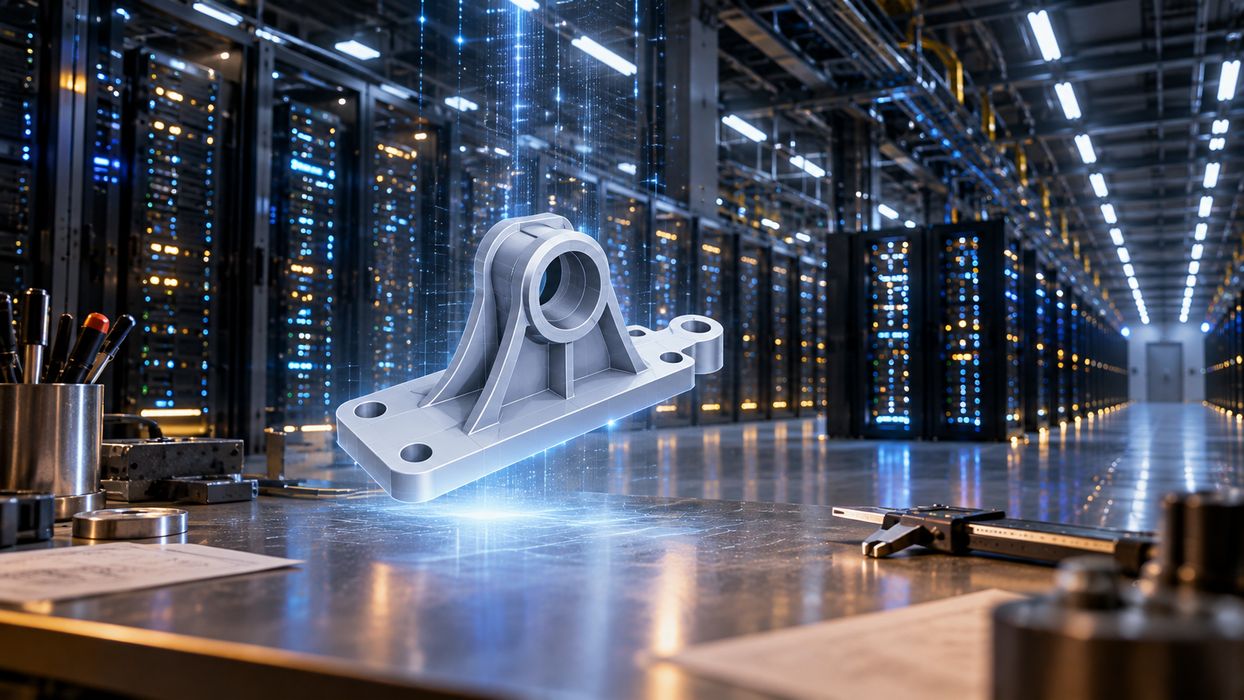
Something rather interesting may be happening in the world of 3D design, and it reminds me of what happened 25 years ago.
During the late 1990s, the dot-com boom was in full swing. Investors poured enormous sums of cash into internet companies, telecommunications infrastructure and just about anything that seemed even slightly connected to then emerging digital world.
Specifically, massive investments were made in communications infrastructure. Companies installed extraordinary quantities of optical fibre, built network facilities and prepared for an anticipated explosion in internet traffic.
Then the bubble burst. Companies collapsed, fortunes disappeared and investors lost hundreds of billions of dollars. The entire episode is often remembered as an enormous financial disaster. You’ve no doubt heard of the term “dot-com” used to negatively position something.
But then things happened. The dot-com companies mostly disappeared, but the infrastructure remained.
Much of the installed network capacity was unused, and prices for communications services fell dramatically. Later improvements in networking technology, broadband access, software and computing made connectivity much more inexpensive and far more accessible.
The result was something that the original investors probably hadn’t thought of at all: Connectivity became so inexpensive that entirely new kinds of businesses suddenly became possible.
Consider YouTube, for example. The idea of millions of people uploading and watching videos continuously would have been completely ludicrous in the early days of the internet: the networking costs would have been insane for both the provider AND the users.
Today, nobody thinks twice about watching hours of video online.
The same would apply to Zoom, cloud computing, streaming television, online gaming and countless other services.
These applications were made possible by a combination of developments, but the availability of inexpensive, high capacity networks was the key that triggered it all, many years ago.
Of course, networking isn’t actually free. Someone still pays for the equipment, electricity and maintenance. But from the perspective of someone developing a new application, their cost of connectivity has become almost irrelevant compared to what it once was.
When a fundamental capability becomes effectively free, entirely new industries become possible.
I think we are rapidly approaching another similar moment.
The AI Infrastructure Boom
Let’s look at what’s happening today with AI.
Companies are spending extraordinary amounts of money building data centres, buying specialized processors, expanding electrical infrastructure and constructing the networks required to connect everything.
The investment is staggering, and there are growing questions about whether the financial returns will justify the expense.
Does that sound familiar? I think so.
It’s entirely possible that we’re witnessing another investment bubble. Perhaps the demand for AI computation will justify these expenditures. Perhaps it won’t, and we’ll see another spectacular financial collapse, just like the dot-com boom.
But regardless of what happens to the investors, something is being created: an enormous amount of computational capacity, along with increasingly capable AI technology.
There are differences from the telecommunications boom. Optical fibre can be used for decades, while AI processors become obsolete much more quickly. Data centres also require substantial ongoing investment and electricity.
An AI investment crash wouldn’t instantly make processing costs zero.
Nevertheless, competition, improvements in processor technology, more efficient AI models and potentially excess capacity could steadily reduce the cost of using sophisticated AI systems.
What happens if the cost of performing a complex AI task eventually becomes almost irrelevant? I think one of the biggest consequences could be in 3D design.
The End Of The Design Barrier?
For decades, the 3D printing industry has worked to make equipment faster, cheaper, more reliable and easier to operate. These efforts have been mostly successful. Today’s desktop 3D printers are dramatically more capable than those available only a decade ago, and at science fiction level when compared to those from twenty years ago.
But there’s still that nagging problem that remains: What do you print?
For many people, obtaining an appropriate 3D design is way more difficult than operating the printer. That’s especially true today with 3D printers featuring massive amounts of automation.
Suppose you need a replacement knob for an appliance. You might search online repositories, hoping someone has already uploaded the precise part. More likely, you’ll have to create the design yourself.
That means learning CAD software, understanding the geometry, taking measurements and constructing a suitable model. Or, you could hire someone to do the work.
In many situations, the cost of creating the design greatly exceeds the cost of 3D printing the object, if you are paying someone to create the 3D design.
This has always been a significant barrier to widespread use of 3D printing. Essentially, the market for 3D printers is constrained by to the number of people who can understand and use the devices and associated hardware.
Now let’s imagine another approach.
You take several photographs of the broken knob, enter a few measurements and tell an AI system what you need. The AI generates the geometry, considers the intended mechanical forces, selects an appropriate material, and produces a model suitable for your particular 3D printer.
Perhaps it asks a couple of questions to clarify the requirements. Then you approve the result and print it. Or maybe there are no questions and it is just sent directly to the 3D printer.
No CAD expertise was required. There was no tedious search through 3D model repositories. No designer was hired.
We’re definitely not there yet, but we are absolutely moving in that direction.
AI-assisted CAD systems are already popping up. Several systems can now generate and modify editable parametric CAD models through conversational instructions. Autodesk has been developing neural CAD technology intended to generate precise, editable designs while understanding geometric relationships and constraints.
These systems are still relatively few in number, particularly when mechanical functionality, complex assemblies and manufacturing requirements are required. However, I do receive several notes each week from new startups that are building this sort of application.
Producing something that looks like a mechanical component is now relatively straightforward. Producing something that will actually perform in the real world as intended is way more difficult.
But the direction is obvious: each month there seems to be better ways to do this stuff, and that progress is not going to stop. AI systems are moving toward producing actual engineering-grade 3D models.
As their capabilities improve, the amount of expertise required from the user should decrease.
Eventually, we may reach a point where someone can describe almost any ordinary object and receive a suitable design almost immediately. The computational cost might be so small that nobody seriously considers it.
In that world, 3D design becomes effectively free.
That doesn’t mean engineering expertise disappears, or that complex and safety critical designs will no longer require validation.
It means the generation of actually functional geometry may become an ordinary type of service, available whenever anyone needs it.
Let’s think about that for a moment. Today, we routinely communicate with people on the other side of the planet without worrying about the cost of transmitting the information.
Tomorrow, we might routinely generate original designs for physical objects without worrying about the cost of creating them.
And just as inexpensive connectivity enabled applications nobody could have imagined during the dot-com boom, inexpensive design could open an entirely new space for entrepreneurs, manufacturers and ordinary consumers.
The most interesting applications will almost certainly be the ones that nobody has thought about. Yet.
It may be that 3D printing has been waiting for a revolution in design instead than another radical 3D printing technology.
And if design really does become effectively free, the consequences for the 3D printing industry could be more than extraordinary.
In Part 2, we’ll explore what that world might actually look like.