Charles R. Goulding and Preeti Sulibhavi consider how America Makes’ newest metal AM initiative is strengthening the U.S. defense supply chain and why participating companies may also benefit from valuable R&D tax incentives.
Since its founding in 2012, America Makes has served as the United States’ national accelerator for additive manufacturing (AM). Based in Youngstown, Ohio, and managed by the National Center for Defense Manufacturing and Machining (NCDMM), the institute was established as the first Manufacturing USA institute with a mission to accelerate the adoption of additive manufacturing technologies across U.S. industry. Through collaborations among manufacturers, government agencies, universities, and technology developers, America Makes has invested in projects that advance materials, standards, workforce development, and industrial adoption of 3D printing.
One of the institute’s primary objectives is strengthening the domestic manufacturing base, particularly for defense and aerospace applications where qualified, repeatable additive manufacturing processes are essential. As the U.S. Department of Defense increasingly relies on additive manufacturing to reduce lead times, improve supply chain resilience, and produce mission-critical components, ensuring suppliers can consistently manufacture qualified metal parts has become a national priority.
That objective is driving America Makes’ latest initiative, which announced the selection of 25 suppliers for a large-scale metal additive manufacturing qualification program. The effort represents one of the industry’s most coordinated attempts to standardize metal AM production while expanding the pool of qualified suppliers capable of supporting both defense and commercial aerospace programs.
The program is part of the Metals Affordability Initiative for Additive Manufacturing (MIAMI) project, funded by the Office of the Under Secretary of Defense for Research and Engineering’s Manufacturing Technology Office (OSD ManTech). America Makes will administer approximately US$10.5 million of the approximately US$25.6 million in funding to help participating suppliers establish qualified additive manufacturing processes using laser powder bed fusion (LPBF). The larger MIAMI effort falls within a broader Defense Department strategy to improve domestic manufacturing readiness and reduce qualification barriers that have historically slowed adoption of metal additive manufacturing.¹²
Rather than funding isolated research projects, the initiative focuses on a practical challenge facing the industry: qualifying production processes across multiple suppliers using common methodologies. Qualification remains one of the largest obstacles preventing broader deployment of metal additive manufacturing in regulated industries. Manufacturers often spend significant time and resources independently demonstrating process capability, producing duplicate testing efforts across the supply chain.
By creating standardized qualification pathways, America Makes aims to reduce costs, shorten certification timelines, and enable qualified suppliers to produce parts more efficiently for defense programs.
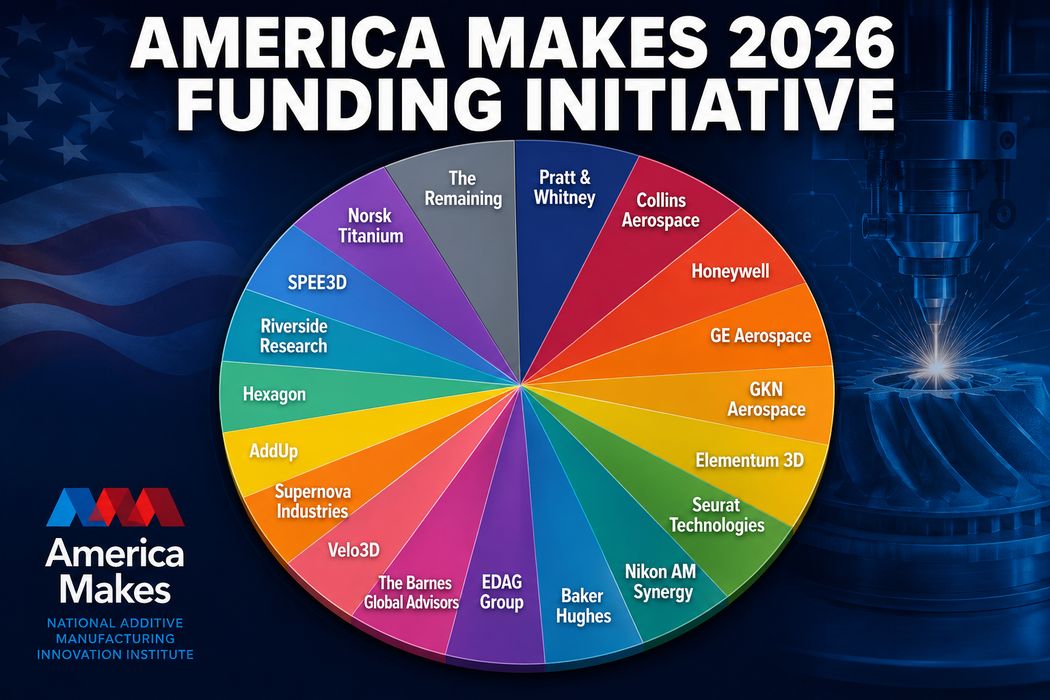
The 25 participating suppliers represent a cross-section of the U.S. additive manufacturing ecosystem, including aerospace manufacturers, industrial companies, service bureaus, machine manufacturers, and materials specialists. Many are already familiar to regular Fabbaloo readers through our previous coverage.
Companies previously covered by Fabbaloo include:
These organizations reflect the diversity of the additive manufacturing landscape. Companies such as Pratt & Whitney, Collins Aerospace, Honeywell, GE Aerospace, and GKN Aerospace have long histories of qualifying flight-critical metal AM components. Others, including Elementum 3D, Seurat Technologies, and Nikon AM Synergy, continue pushing advances in materials, production systems, and manufacturing workflows. Industrial firms like Baker Hughes, Eaton, and Hadrian Automation demonstrate how additive manufacturing is expanding beyond aerospace into energy, industrial equipment, and advanced manufacturing infrastructure.
For Hadrian, we covered their US$260 M Series C fund raise. A 3D printing-enabled manufacturer like Hadrian positions itself not as an accessory user of 3D printing, but as a manufacturing plant that uses additive technologies as a foundational capability for defense and aerospace supply chains. When we covered the Patriot investors in that article, we determined that this orientation checks multiple boxes: manufacturing sovereignty, supply-chain speed, and advanced hardware for defense.
Although the specific funding each supplier receives has not been publicly disclosed, America Makes indicated that the overall program will support supplier qualification activities, data generation, testing, and process validation needed to establish production-ready metal additive manufacturing capabilities.
For many participating companies, these projects may also create opportunities beyond the direct grant funding. Activities performed under the qualification program could qualify for the federal Research & Development (R&D) Tax Credit, provided they meet the IRS’s four-part test for qualified research. Developing or improving manufacturing processes, qualifying new metal powders, optimizing laser parameters, validating inspection techniques, reducing process variability, and designing production tooling frequently involve technical uncertainty and systematic experimentation, making them common examples of qualifying R&D activities.
While government-funded research requires careful analysis because certain funded activities may not qualify under the federal credit depending on contract terms, many companies perform substantial internal development work alongside sponsored programs. Process optimization, software development, fixture design, machine parameter refinement, materials characterization, and quality assurance improvements often represent separately eligible research expenditures. Manufacturers should carefully evaluate whether these internally funded activities may support an R&D tax credit claim.
The credit can provide meaningful cash flow benefits by offsetting federal income taxes and, in some cases, state income taxes where comparable R&D incentives exist. Given the significant engineering effort required to qualify additive manufacturing for aerospace and defense applications, many manufacturers may already be performing qualifying research without fully documenting it for tax purposes.
For younger companies participating in advanced manufacturing programs, the federal startup R&D credit may provide an additional benefit. Qualified small businesses with limited gross receipts may elect to apply up to US$500,000 of their federal R&D credit against employer payroll taxes (for up to five years), helping innovative companies monetize research investments before becoming profitable.
Conclusion
America Makes’ newest qualification initiative illustrates the organization’s broader mission of accelerating additive manufacturing adoption through collaboration rather than isolated development efforts. By bringing together government, industry, and technical experts, the institute seeks to establish common standards, strengthen domestic manufacturing capabilities, and expand the number of qualified suppliers capable of supporting critical defense and aerospace programs. As additive manufacturing continues moving from prototyping to full-scale production, initiatives like MIAMI will play an increasingly important role in building a more resilient and competitive U.S. manufacturing ecosystem.