
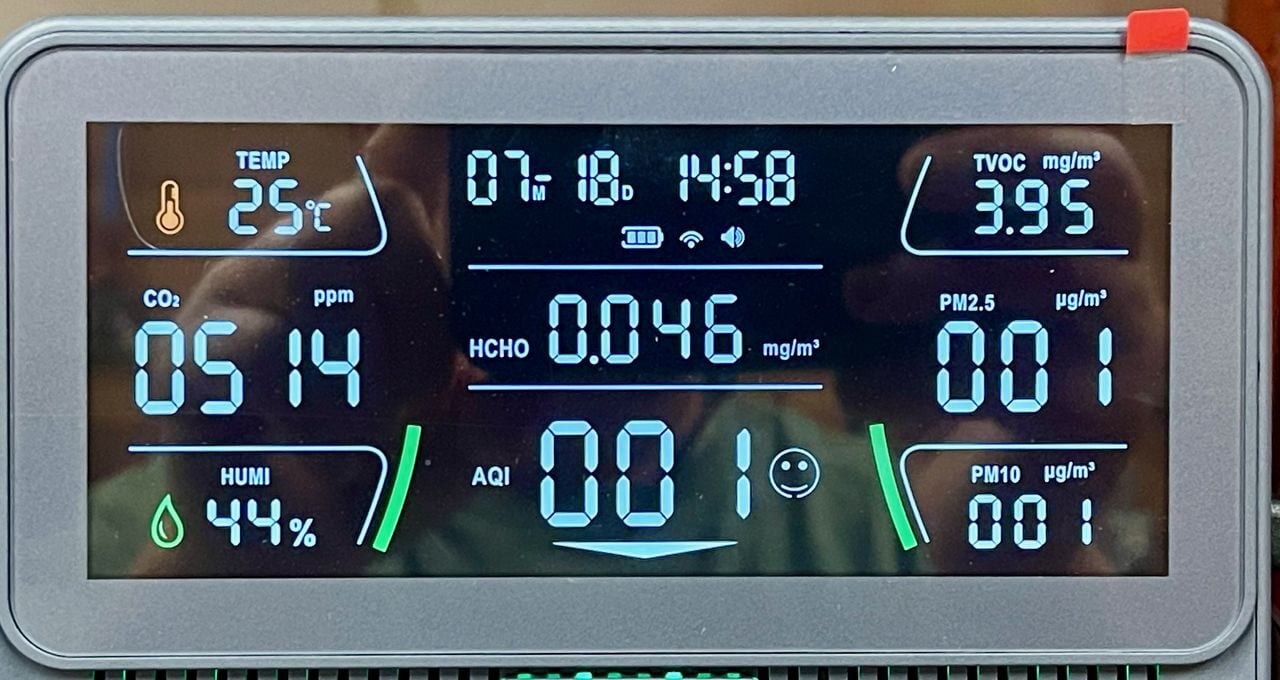
Be careful when you decide to measure the pollution emitted by your desktop 3D printer.
Tens of millions of desktop 3D printers have been sold, and many of them are still operating, some in people’s homes. But many people are still unaware that these devices can generate toxic emissions.
There are two type of pollution generated: nanoparticles, which are tiny airborne chunks of the material, and volatile organic compounds, which are chemicals known to be toxic in sufficient amounts.
The best advice is to always vent the air from the 3D printer area outside, or secondly through a filtration system. Some recent 3D printers have on-board filtration systems.
As 3D printer operators become aware of this danger, some have decided to obtain measurement gear to detect whether their 3D printer configuration is safe. It turns out you can easily obtain cheap air quality meters that can detect temperature, humidity, airborne particles and volatile organic compounds.
I use a device like this myself, mainly during forest fire season when the air quality can get pretty poor. However, it’s also possible to measure VOCs with these devices.
Note that VOCs are a category, not a specific chemical. There are long lists of hundreds of possible VOCs, so these cheap measurement devices test for “total volatile organic compounds”, or “TVOCs”.
I read a thread where the poster had attempted to measure the TVOCs in their environment using a similar device. It turned out they found a surprising burst of TVOCs at a particular time of day. The burst was spectacularly higher than the accepted safe level, raising concerns.
The event happened to coincide with a print job, so the suspicion was on the printer. Windows were opened and the level did not fall. Reddit poster Mewcenary explained what happened next:
“I went to open another window for better ventilation, and then it hit me: The smell of burning plastic from outside.
We have a hill about 0.5 miles away from our house where sadly people sneak up at night and burn off plastic / building waste / all sorts. It’s pretty bad when it happens: A real ‘close your windows’ moment. It wasn’t as bad as normal as I hadn’t noticed it.
Even after closing the window, it took hours for the VOC to come down again.”
So, a false alarm.
I had a similar situation at our workshop. We obtained a simple measurement device and it unexpectedly measured rather high TVOCs — see image at top. We relocated the device around the workshop, hoping to discover a spill of cleaning fluid or something similar, but couldn’t find anything.
Was the meter working correctly? We took it outside, and within a minute the TVOC reading fell sharply. Bringing back inside, the TVOC reading began to rise. Clearly, something inside the workshop was emitting VOCs!
Did we have a problem? As much as we searched, we could not identify the source of the TVOCs.
Then we figured it out. After several weeks the TVOC reading fell to normal levels and has remained reliable since then. It seems that the new device’s plastic case was likely outgassing. Outside the wind would blow it clear, but inside where there was no wind, the gas would accumulate and a reading happened.
At home you will also see TVOCs rise. For example, if you are frying up something in the kitchen, that activity will send countless TVOCs into the air. They end up in the detector and show a high reading.
The moral of the story here is that 3D printer operators hoping to measure their TVOCs should be careful when using any measurement equipment. The equipment might not be properly calibrated and there are plenty of sources of TVOCs beyond a 3D printer.
Via Reddit
