
Charles R. Goulding traces how Yale University’s unique commitment to elite, fully funded music education and its collaboration with Forte 3D on a hybrid carbon fiber cello—supported by Shark Tank investor Lori Greiner and praised by Yo-Yo Ma—signals a pivotal moment where 3D printing, traditional craftsmanship, and live musical experience converge to expand access, durability, ergonomics, and artistic possibility in the future of string instruments.
When tradition meets innovation, music—and the way we make it—changes course. A striking example of this transformation is the new hybrid carbon fiber cello co-designed by Yale University and Forte 3D. This instrument represents a fusion of centuries-old lutherie with state-of-the-art materials and manufacturing techniques, epitomizing a new era in how musicians’ access and engage with high-quality stringed instruments.
Yale: An Ivy League Music Powerhouse
Yale University is unique among Ivy League institutions for housing a renowned music school, the Yale School of Music, established in 1894. With an admission process that is extremely competitive, those admitted join one of the world’s leading programs for advanced musical study. Yale offers graduate degrees that attract top talent from around the globe, and students accepted into the program receive full tuition support, a rare advantage in elite music education.
This supportive environment nurtures musical excellence, encouraging students to explore not only performance but also the intersection of music with science, engineering, and innovation. It is within this fertile intellectual ecosystem that the collaboration with Forte 3D took shape, bringing a fresh perspective to instrument design and technology.
Forte 3D: Reinventing String Instruments with Additive Manufacturing
Forte 3D is an innovative company focused on 3D printed string instruments, co-founded by Alfred Goodrich and Elijah Lee. The company gained wide attention after appearing on Shark Tank, where entrepreneur Lori Greiner invested US$250,000 in exchange for a 16 % equity stake in the company—a strong vote of confidence in their vision and technology.
Based in part on the principle of making high-caliber instruments more accessible, Forte 3D designs, engineers, and manufactures 3D printed bowed string instruments that rival traditional ones in performance, durability, and overall value. Their mission is clear: offer professional-quality musical instruments at favorable price points, opening doors for students, educators, and performers who might otherwise be shut out of the market by the high cost of handcrafted wood instruments.
Forte 3D’s current lineup includes carbon fiber cellos and violins that are not simply novelties, but tools that professional musicians can rely on for performance and practice. According to the company’s website—where the instruments are described as the “world’s finest carbon fiber instruments”—even Yo-Yo Ma has commented on the importance of such innovations: “We need more innovations like this, creative solutions that expand access to music-making and open new paths to imagination and expression.”
A Hybrid Instrument with Real Benefits
The centerpiece of the Yale–Forte 3D collaboration is the hybrid carbon fiber cello. This instrument uses 3D printed carbon fiber components to address several longstanding challenges with traditional wooden instruments:
- Eliminates Warping: Traditional wood instruments are notoriously sensitive to changes in humidity and temperature, leading to warping and frequent repairs. The carbon fiber construction resists such deformation, ensuring consistency in performance.
- Enhanced Ergonomics: By adjusting the shape and structure through digital design, the instrument can be optimized for player comfort, potentially reducing strain and injury.
- Outstanding Acoustics: Despite its unconventional material, the carbon fiber instrument delivers excellent tone and projection, rivaling well-crafted wooden instruments while offering a unique sonic character.
The term “hybrid” is used because while many elements—including the body and structural components—are printed or carbon fiber composites, traditional parts like the fingerboard, bridge, and soundpost remain conventional, honoring the craftsmanship and acoustical standards that generations of musicians’ trust.
This blending of high technology with respected tradition is a true STEAM achievement, integrating science, technology, engineering, art, and math in one instrument—something that would make educators and creatives alike proud.
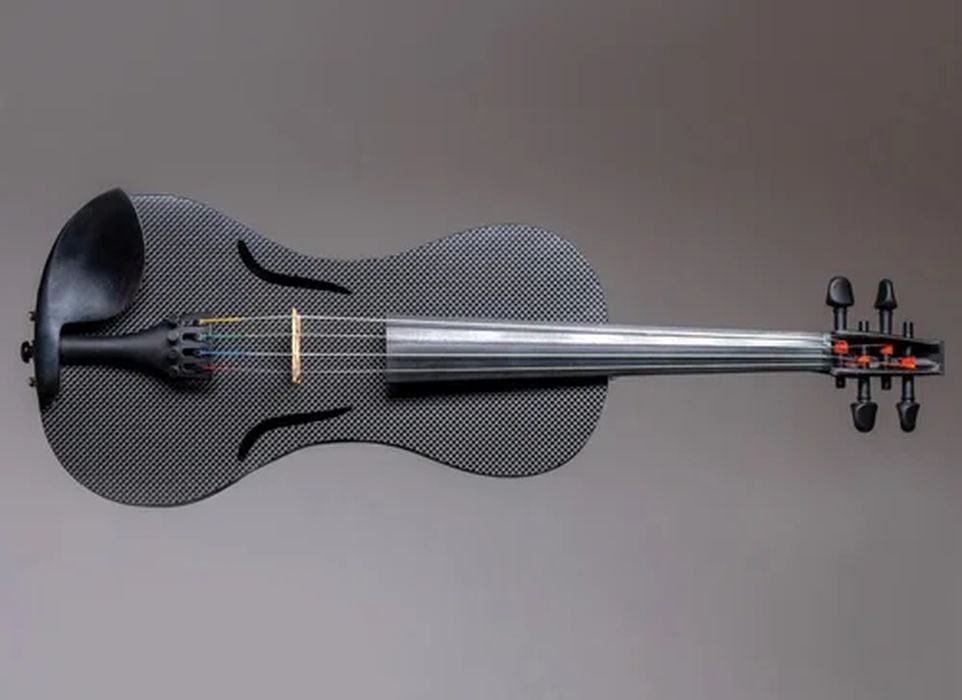
3D Printing in String Instrument History: Beyond the Forte Cello
Forte 3D’s innovation sits within a broader trend of additive manufacturing being used to rethink musical instruments, especially stringed ones. While not yet mainstream, several notable examples show how designers and musicians have experimented with 3D printing over the past decade:
- MONAD Studio’s 3D Printed Cello and Violin: In 2015, Miami’s MONAD Studio unveiled a 2-string 3D printed violin and a single-string 3D printed cello, showcased at the 3D Print Design Show in New York. These instruments were made from PLA plastic and demonstrated that fully 3D printed string instruments could be playable and intriguing to professional cellists, including performances by a Metropolitan Opera cellist.
- Unique-3D Acoustic Violin: In Russia, Unique-3D created a 3D printed acoustic violin, illustrating how additive manufacturing can be applied not only to plastics but also to larger and more acoustic-oriented designs.
- Ottawa Symphony’s 3D Printed Project: The 3D String Theory Project explored producing multiple 3D printed string instruments—including violins, violas, and small cellos—demonstrating how technology enables customization for size, player preference, and accessibility.
These projects underscore both the potential and limitations of 3D printing: while early printed instruments often require refinement to achieve tonal nuances comparable to wooden counterparts, the technology dramatically lowers cost barriers and invites bold experimentation.
The Research and Development Tax Credit
The now permanent Research and Development (R&D) Tax Credit is available for companies developing new or improved products, processes, and/or software. 3D printing can help boost a company’s R&D Tax Credits. Wages for technical employees creating, testing, and revising 3D-printed prototypes can be included as a percentage of the eligible time spent on the R&D Tax Credit. Similarly, when used as a method of improving a process, time spent integrating 3D printing hardware and software counts as an eligible activity. Lastly, when used for modeling and preproduction, the costs of filaments consumed during the development process may also be recovered.
Whether it is used for creating and testing prototypes or for final production, 3D printing is a great indicator that R&D Credit-eligible activities are taking place. Companies implementing this technology at any point should consider taking advantage of R&D Tax Credits.
Personal Experience: A Yale University Concert
This month, my wife and I had the privilege of attending a Yale University 8-piece brass concert at the Yale Club in New York City. We expected a standard student recital, but instead we were awed by the caliber of performance—a blend of Yale students and distinguished faculty members delivering lively Italian and Baroque pieces that transported the audience. The event highlighted the depth of talent cultivated by Yale’s music program and the vibrant community it fosters.
Experiences like this make the collaboration with Forte 3D especially meaningful: they show how educational institutions can honor classical tradition while embracing innovation that invites broader participation in music.
Why This Matters
The hybrid carbon fiber cello isn’t just a technical curiosity; it points toward a future where quality instruments are more accessible and sustainable. Students won’t have to choose between playing great music and owning an instrument they can afford or bring to rehearsals in all conditions. Conservatories and orchestras can expand their reach, enabling more musicians to participate without the prohibitive costs associated with high-end handcrafted instruments.
As Yo-Yo Ma reminds us through his support and words, music flourishes when innovation harmonizes with tradition—and when creative solutions expand access to music-making for performers of all backgrounds.