Charles R. Goulding and Preeti Sulibhavi reveal how Caterpillar’s US$1.5 billion tariff exposure is accelerating its 3D printing strategy to localize production, cut costs, and safeguard supply-chain resilience.
Caterpillar, the global leader in construction, mining, and farm machinery, reported 2024 revenues of US$64.8 billion, underscoring its dominant role in heavy machinery markets. In 2022, the company relocated its headquarters from Illinois to Irving, Texas — a move widely interpreted as a step toward a more favorable regulatory and business environment.
But hurdles persist: in its second quarter of 2025, Caterpillar warned of a potential US$1.3 to US$1.5 billion hit from import tariffs, with US$400 to US$500 million expected just in Q3. This hefty figure reflects rising trade tensions and underscores the urgent need for strategic adaptation.
Such an unexpected blow—especially with the updated exposure notably higher than prior estimates—signals a lack of granular supply-chain visibility, particularly in components reliant on global sourcing. For Caterpillar’s additive manufacturing team, these circumstances provide a compelling economic rationale to accelerate projects that localize production, reduce dependency on tariff-vulnerable imports, and enhance supply-chain resilience.
Why Complex Supply Chains Make 3D Printing Vital
Caterpillar’s CEO acknowledged the complexity and rigidity of its supply chains—particularly long-standing contracts that are not easily restructured. The strong implication: 3D printing offers a stop-gap or preemptive solution, particularly before contract renewals come due.
In practical terms, the additive team can prototype and produce parts domestically at scale more quickly than waiting for foreign supplies—or renegotiations—to play out. This flexibility can be essential in mitigating tariff costs, avoiding production delays, and maintaining uptime.
3D Printing in Action: Real-World Applications at Caterpillar
Assembly Racks & Subassemblies
Caterpillar engineers used FDM (Fused Deposition Modeling) to prototype an assembly rack for fuel components. This allowed off-line pre-assembly, cutting installation time by approximately 40%—a critical efficiency gain compared to traditional metal fabrication.
Fixture Tools to Reduce Rework
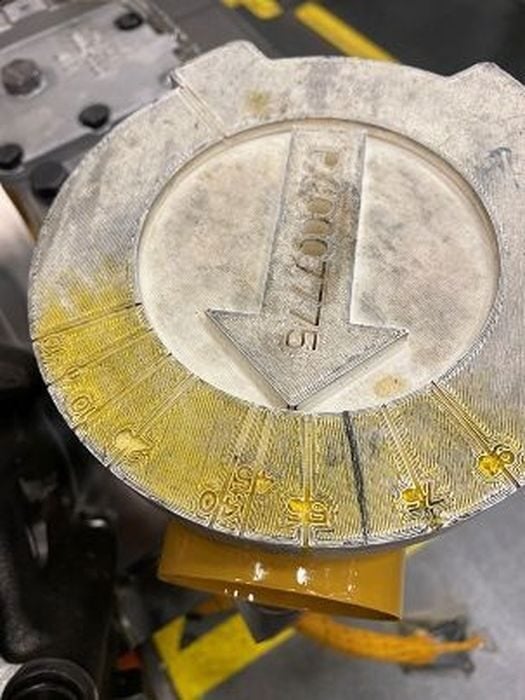
Misaligned outlet tubes once caused 3–5 hours of rework per day on engine lines. A simple 3D printed fixture, which incorporated angular degree indicators, eliminated misalignment—adding precision and saving valuable assembly time.
On-Demand Repair Tools
A transmission assembly line faced shutdown due to a faulty seal installation. Rather than waiting weeks for a machined tool, engineers 3D printed a two-piece tool overnight, delivered it the next day, and resumed production immediately—dramatically mitigating downtime.
Gauges and Precision Tools
Caterpillar printed bowl-shaped gauges used to verify piston cores—tools that would be expensive and time-consuming to manufacture conventionally. Additive technology made them at less than 10% of the cost and over 90% faster.
Aftermarket Parts and Sand Molding
Caterpillar already offers about 80, 3D printed composite and plastic parts to aftermarket customers—grommets, hose fixtures, insertion tools, and holders—for long-lifecycle machinery. They are also deploying sand binder-jet printers to produce molds, enabling fast, low-cost production of replacement cast parts.
Additive Manufacturing Factory & Culture
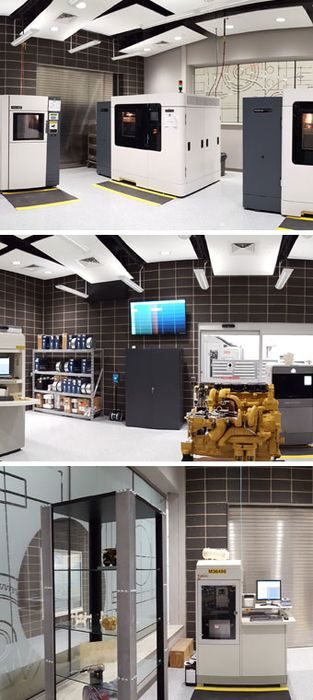
At its Mossville, Illinois R&D center, Caterpillar operates an Additive Manufacturing Factory fitted with 10 industrial printers (Carbon M1, MicroFoundry, sand binder-jet, DMLS, SLS, FDM, SLA, PolyJet). Its Nomadic Printer Program deployed printers across U.S. facilities, giving engineers freedom to experiment. This evolved into formal “Design for Additive” workshops and internal design competitions, where winning engineered parts—like a metal ball check valve that consolidates assemblies into a single 3D printed unit—are scaling up.
End-Part Printing & Track Link Savings
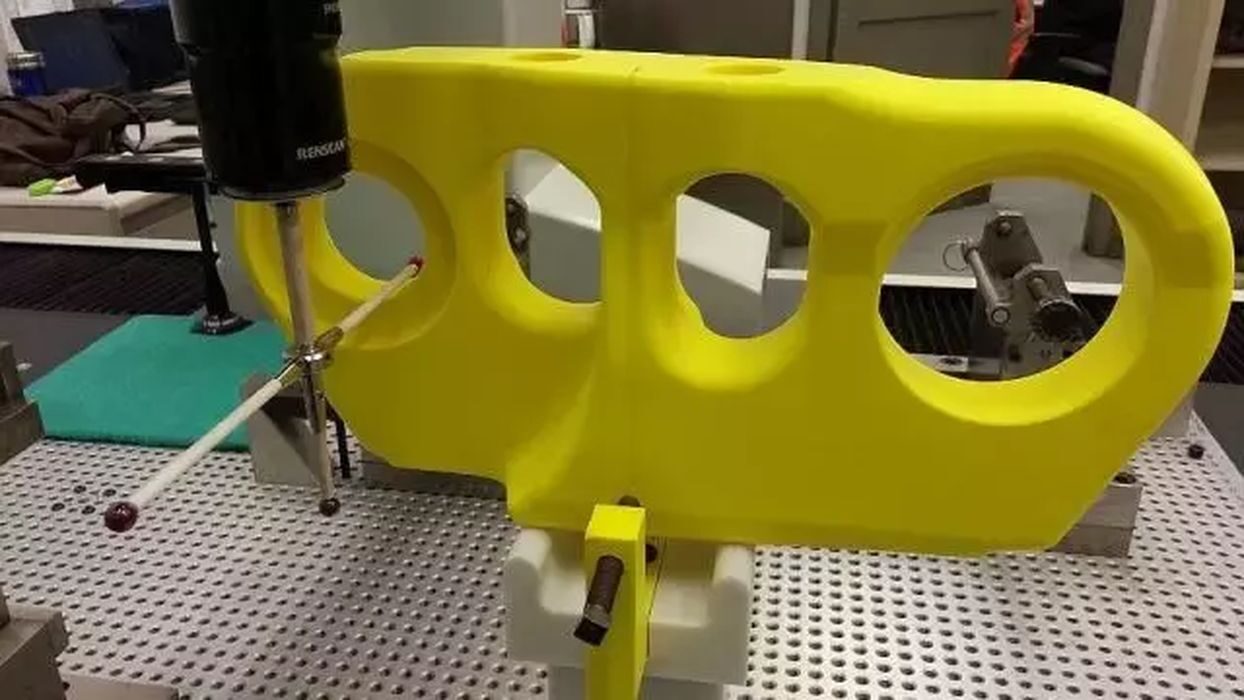
Caterpillar’s Solar Turbines subsidiary is printing end-use parts—like a fuel swirler with complex geometry that traditional manufacturing couldn’t produce economically. In another example, printing 36 different track links before production saved the company US$160,000 in labor and time.
FIT AG Partnership
In early to mid-2025, Caterpillar finalized a three-year partnership with German AM provider FIT AG, aimed at producing aluminum and titanium parts for its large machinery lines. This move signals scaling of additive at higher structural and material value levels.
Texas Advantage: Learning from Oilfield Additive Leaders
By relocating to Texas, Caterpillar can tap into the deep additive manufacturing ecosystem in the oil & gas sector. Baker Hughes, for example, has established multiple AM centers of excellence globally, including in Houston. It has qualified over 450 parts, printed 25,000 times, and employs advanced techniques like hybrid 5-axis CNC + DED (Directed Energy Deposition) for restoring worn drill bits—a practice that reduces waste and avoids downtime.
Caterpillar, positioned nearby, could benefit from knowledge sharing in design-for-additive, hybrid repair workflows, materials expertise, and AM logistics—further accelerating its own literacy and speed in additive deployment.
Why Now? The Tariff Imperative
- Tariff pressure: With a significant hit forecasted—US$400–US$500 million just in Q3—Caterpillar can’t afford delays in offsetting costs.
- Supply-chain visibility: The increase in exposure reveals gaps in sourcing oversight—3D printing helps address this by enabling localized, on-demand manufacturing.
- Contract timeline alignment: If supply contracts are locked in, ramping up additive capabilities before renewals gives Caterpillar stronger bargaining and sourcing agility.
- Efficiency gains: As demonstrated across examples, additive is already reducing cycle time, improving precision, slashing tooling costs, and minimizing rework—all translating into tangible profit retention.
The Road Ahead: Shaping Additive’s Role Post-Tariffs
Scale up end-part additive
Moving beyond fixtures, Caterpillar is already prototyping and deploying end-use metal parts (e.g., fuel swirlers). Scaling this via its Mossville AM Factory and FIT AG collaboration will help reduce reliance on traditional supply chains.
Expand design-for-additive culture
Design competitions and workshops should now include tariff-driven criteria: weight reduction, complex geometry, materials cost savings, and parts within tariff-sensitive categories.
Integrate hybrid repair workflows
Learning from Baker Hughes, Caterpillar can develop hybrid additive repair workflows—e.g., restoring worn components via additive deposition—which improves sustainability and avoids sourcing delays.
Regional AM hubs
Given its Texas HQ, Caterpillar could establish regional AM hubs (Houston or Irving) aligned with operations, enabling rapid deployment of parts to U.S. facilities and cross-industry collaboration.
Virtual inventory & scanning
Digitizing legacy inventory via 3D scanning—creating a virtual parts library—will allow rapid printing of spare parts on demand, particularly for long-tail, discontinued machine models.
The Research and Development Tax Credit
The now permanent Research and Development (R&D) Tax Credit is available for companies developing new or improved products, processes, and/or software. 3D printing can help boost a company’s R&D Tax Credits. Wages for technical employees creating, testing, and revising 3D-printed prototypes can be included as a percentage of the eligible time spent for the R&D Tax Credit. Similarly, when used as a method of improving a process, time spent integrating 3D printing hardware and software counts as an eligible activity. Lastly, when used for modeling and preproduction, the costs of filaments consumed during the development process may also be recovered.
Whether it is used for creating and testing prototypes or for final production, 3D printing is a great indicator that R&D Credit-eligible activities are taking place. Companies implementing this technology at any point should consider taking advantage of R&D Tax Credits.
Conclusion
Caterpillar’s US$1.5 billion tariff exposure in 2025 isn’t just a financial warning—it’s a wake-up call. The company’s expansive additive manufacturing infrastructure—from its R&D AM Factory and “Nomadic Printers” to partnerships with FIT AG and aftermarket 3D printing—is now more critical than ever.
Through 3D printing, Caterpillar can:
- Tilt production toward localized, flexible manufacturing
- Reduce cycle times, rework, and tooling costs
- Prototype innovative, lightweight, complex parts
- Support long-tail aftermarket needs
- Accelerate response to contract and tariff volatility
Moving forward, additive manufacturing isn’t merely a tech novelty; it’s a strategic lever, enabling Caterpillar to weather tariff storms, enhance supply-chain resilience, and sustain its leadership in heavy machinery well into the future.