
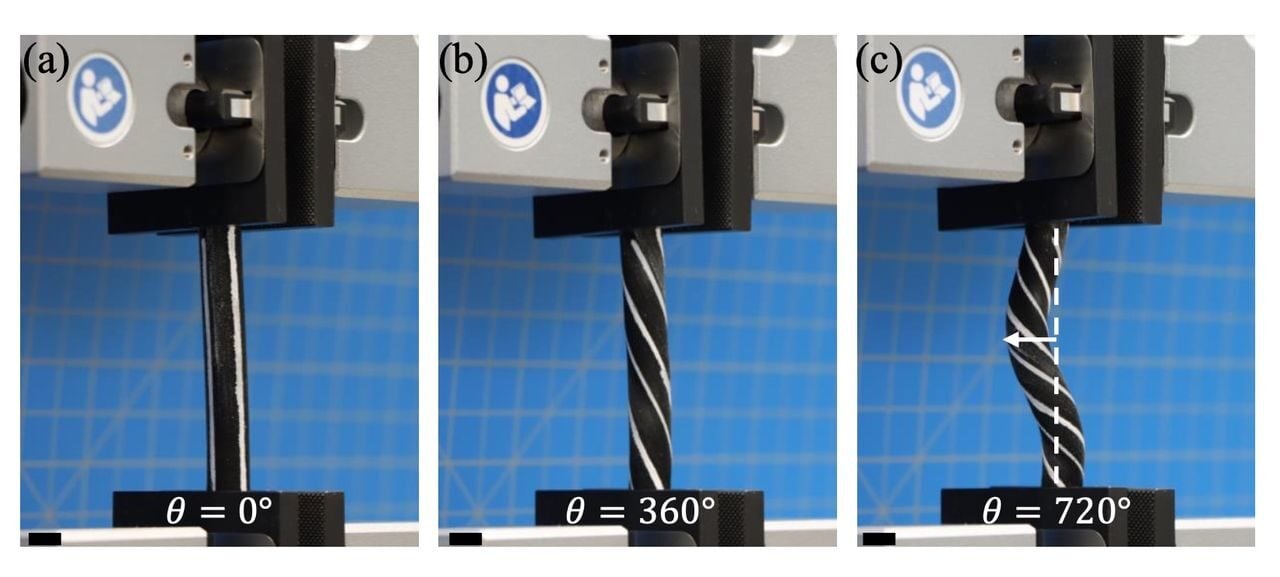
Researchers have developed a method of predicting the engineering properties of mixed resins.
The problem in this study is all about Stratasys’ PolyJet technology. PolyJet uses fine inkjet print heads to selectively deposit tiny droplets of photopolymer resin. As each layer is laid down, a second pass of a UV light source cures that layer, bonding it to the layers below.
Stratasys has had this technology for decades, inheriting it from Objet during the acquisition many years ago. However, since then, they have dramatically improved the tech. The key innovation was to use many different photopolymer inks: these can be mixed at the droplet stage before curing.
Today’s full-colour PolyJet systems can use up to seven different inks in a single print job. It’s possible to mix and use these types of materials on a per voxel basis:
- Rigid opaque resins, with CYMK combinations providing access to almost any colour
- Clear & Transparent Resins for see-through applications
- Flexible Elastomers: for simulating rubber-like textures or soft-touch parts
- Advanced Engineering Materials providing extra strength or other properties including high temperature resistance
Let’s make this clear: in theory, a PolyJet system could print each voxel in a job with different combinations of these materials. The possibilities are quite endless.
Now, this leads to a problem: for a given resin mix, what would the engineering properties be?
Up to now, there really hasn’t been a systematic approach to predict this. Operators would simply print objects and physically test them.
The new research goes well beyond that stage by developing a system to do so.
Their approach was to print a series of mixed material objects and do a series of tension and torsion tests. This allowed them to gather a considerable amount of data about mixed resins.
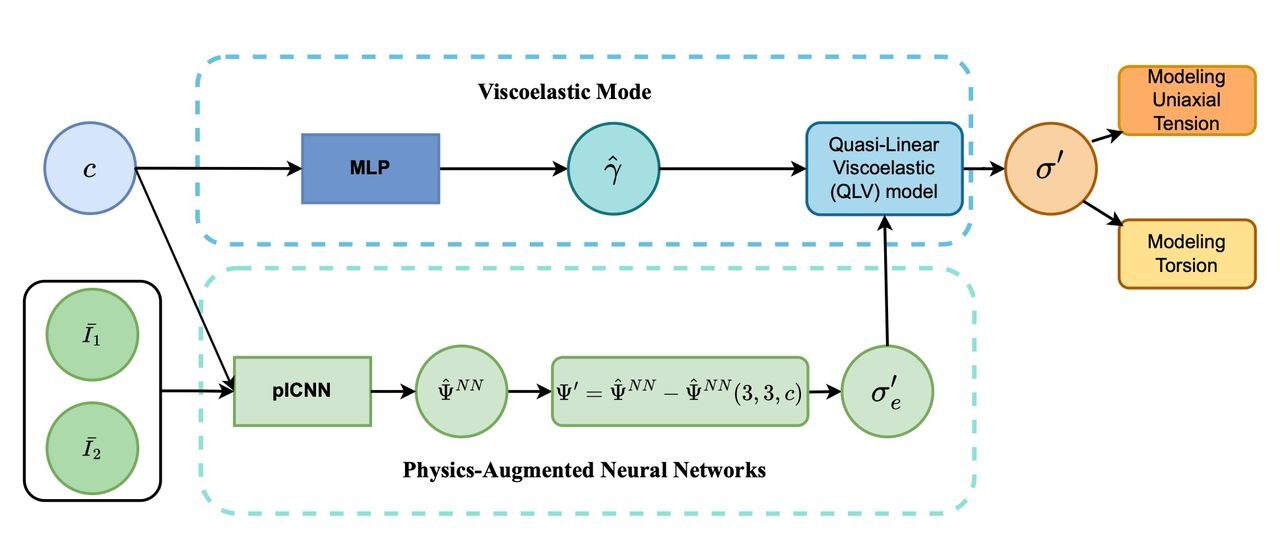
These were used as input to develop an entirely new AI physics model. Instead of making a separate model for each material mix, their model uses the mix ratio as input. That means one model can describe many materials at once. The AI is “physics-aware” so it doesn’t just memorize the data; it also follows the rules of mechanics (like energy must be positive, materials can’t behave impossibly, etc.).
They found that the model was quite accurate, but tended to drift off accuracy a bit as the resin mixes became stiffer.
The implication of this development is that it might be possible to build software that could design 3D printed parts having gradients of materials with predictable mechanical properties.
This would clearly reduce the iteration required to build parts of this type, as the model would do the work of predicting the outcome. The AI knows how the mixed materials behave.
I’m sure that Stratasys is well aware of this research and might possibly incorporate its findings into future GrabCAD software releases.
Via ArXiv
