
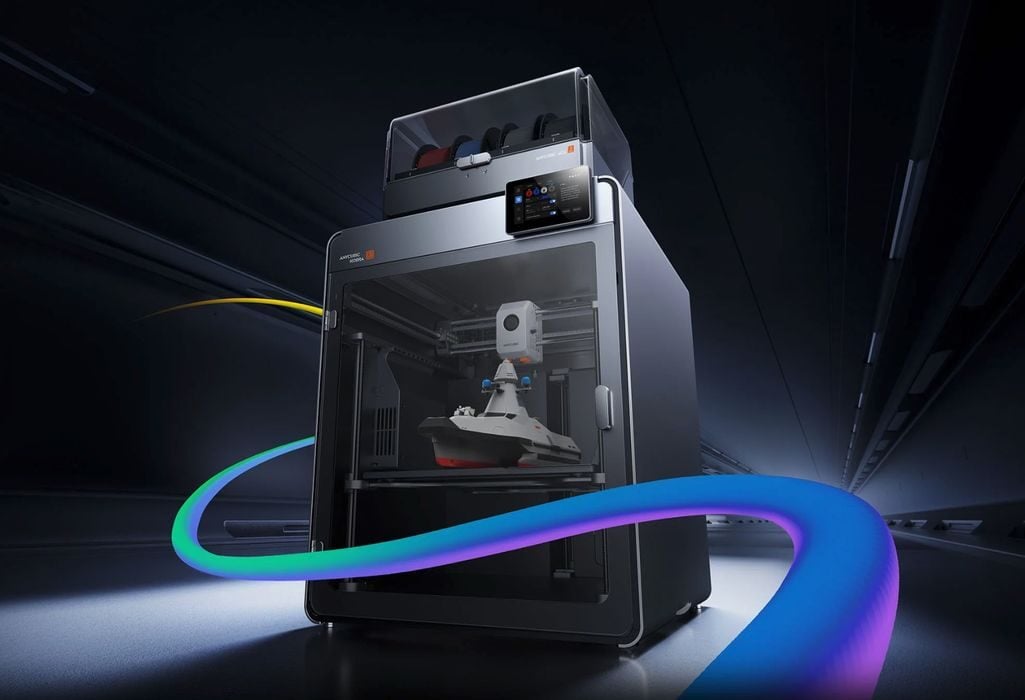
Anycubic revealed their latest desktop 3D printer: the Kobra S1 Max Combo.
The market space for this style of 3D printer has been quite busy in recent weeks, with a number of companies announcing multiple machines with larger build volumes. It’s been a while since we’ve heard from Anycubic, and now they’ve joined the party with a larger format device.
The Kobra S1 Max builds on the prior model, the Kobra S1, which we tested extensively this past spring. We found that machine to be capable of producing very high quality output.
Both machines are sold as a “combo”, meaning they are bundled with a filament swapping accessory. These are now common among desktop 3D printer manufacturers, as they allow operators to print objects with multiple colors.
But what’s new with the Kobra S1 Max? How is it different than the base Kobra S1?
The most notable difference is the build volume. While the Kobra S1 had a build volume of 250 x 250 x 250 mm, the Kobra S1 Max moves up to 350 x 350 x 350 mm. That’s 2.75X the volume, and 40% taller. You can print some rather large 3D models on the Max, including full helmets in one piece that you can wear.
Another big difference is in the extrusion system. The Kobra S1 Max’s nozzle is made from hardened steel, as opposed to the soft brass of the Kobra S1. This means that the Max is capable of 3D printing exotic composite materials that tend to be abrasive. These would include carbon fiber and glass fiber reinforced filaments. The hot end can also reach 350C, while the Kobra S1 was “only” 320C.
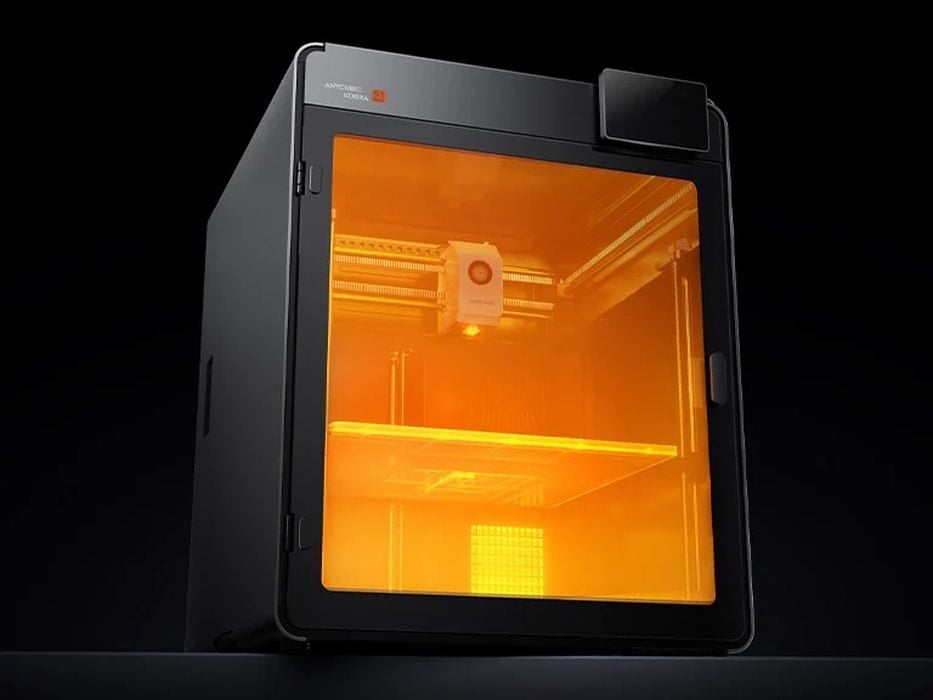
The build chamber is actively heated on the Max, while the Kobra S1 had a passively heated chamber (up to 65C) that would collect stray heat from the hot end and build plate. This feature makes the thermal environment far more predictable and operators should expect far less warping.
Whereas the Kobra S1 supports 3D printing PLA, PETG, TPU, ABS, and ASA, the Max has a much longer list of supported materials: PLA, PETG, TPU, PET, PLA-CF, PETG-CF, PVA, ABS, ASA, PC, PA, PA6-CF, PC-CF/GF, PET-CF.
This makes the Kobra S1 Max a professional-level device capable of printing engineering materials.
The on board webcam moves to 720p from 480p, which should make remote monitoring imagery a bit more crisp. The Max also sports an Ethernet port, something that would be desirable in factory setups.
There’s another difference, but it isn’t on the Max; it’s the filament swapping accessory, the ACE Pro, which has now been upgraded to the ACE 2 Pro.
The biggest difference on the ACE 2 Pro is that it doubles as a filament drying system. This is similar to many other manufacturer’s second generation filament swappers, but a requirement to properly print the engineering materials listed above.
In order to efficiently dry the spools, the ACE 2 Pro provides proper air sealing, unlike the ACE Pro. This means that not only can the ACE 2 Pro dry filament, but it can also store dried filament without much risk of moisture absorption.
One more interesting feature of the ACE 2 Pro is that it appears you can connect up to four of them to the Kobra S1 Max at a time. That means print jobs could theoretically use up to 16 colors.
Anycubic is to officially release the Kobra S1 Max on November 25th, and there is a hierarchy of prices for combo. They’re launching with an early bird price of US$799, which is very good for a combo system of this size. Later, the price escalates over a couple of months, ending up at US$999 as the final “pre-order” price.
Anycubic has set up a pre-order page, where buyers can today leave a deposit of US$50 to obtain a later discount of US$100 on the final price. A US$50 discount, if you will.
There’s one curious thing, however. If you look at the dates of the escalating price, it says: “Pre order price Feb 1 – Feb 28”. This implies that the machine would not be shipping until at least March of next year, almost five months away. That’s a very long time, and we are expecting advanced systems from competitors to be announced in that time period.
The Kobra S1 Max and ACE 2 Pro put Anycubic on the same level as several of their competitors, including Creality, Prusa Research and possibly Bambu Labs, at least for now. Anycubic has not yet announced a waste free multicolor technology as several of the others have done.
Via Anycubic
