
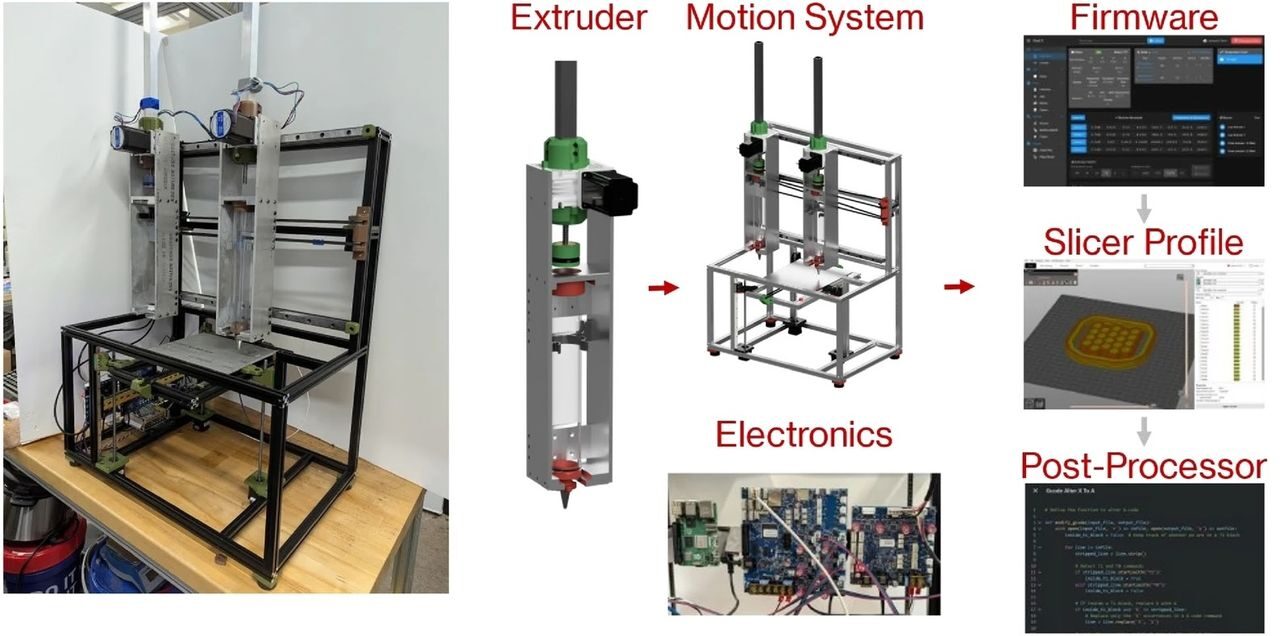
MIT researchers unveiled an open-source dual-extruder syringe 3D printer aimed at reliable, multi-material printing of renewable biomaterial pastes.
Biotic materials such as cellulose, chitosan and pectin are drawing interest as sustainable alternatives for prototyping, packaging and even structural applications. But unlike thermoplastic FFF, many of these hydrogels cure as they dry, not by melting and solidifying, which makes flow control tricky. Early biotic printers often used pneumatic extruders that were highly sensitive to viscosity swings from temperature, humidity and age. The result was frequent mid-print tweaking, retries and variable outcomes.
Enter the Biotic Extruder for Additive Volumetric Engineering and Research — better known as “BEAVER” — a dual, independently actuated mechanical syringe system. Instead of compressed air, it uses a worm gearbox driving a leadscrew plunger for displacement-controlled extrusion. For readers familiar with ceramic paste systems like 3D Potter, think along those lines but purpose-built for biomaterial hydrogels and configured for synchronized two-material work.
From Pneumatics To Precision Syringe Extrusion
The research team reports peak extrusion force near 2,975 N and a calculated volumetric flow up to 775 cubic mm per second, enough headroom to push viscous cellulose–chitosan blends with stability. Each extruder docks a tool-free, fully disassemblable cartridge designed for easy cleaning, interchangeable nozzles and repeatable seating using V-groove constraints. That focus on hygiene matters because organic pastes can mold if residues linger.
BEAVER’s motion platform provides a 250 × 250 × 250 mm build volume. The two extruders travel on independent X rails — the second mapped as an A axis — while the bed handles Y and Z. Precision linear rails, micro-stepped steppers and leadscrews aim to minimize backlash. In testing, the team saw dimensional errors within about ±0.3 mm and reports positional accuracy within ±0.05 mm.
Control is handled by a Duet 3 mainboard plus expansion, running RepRapFirmware with custom macros. PrusaSlicer generates toolpaths, then a post-processing script remaps moves to the redundant X/A architecture and handles nozzle offsets and orientation. That hack highlights a real constraint today: mainstream open slicers do not natively support this dual independent syringe setup.
What The BEAVER Platform Actually Delivers
The headline feature is reliable flow. Displacement-controlled paste deposition eliminates the air compressibility and pressure-chasing that dog pneumatic rigs, reducing human touch time and improving repeatability. The dual extruders enable compositional gradients, alternating-layer parts and side-by-side material interactions, with purge walls and ooze shields managing cross-contamination. For labs and classrooms, the all-open build — CAD, firmware and BOM live on GitHub — lowers barriers to entry and invites forks.
Because these biomaterials cure by drying, throughput will depend on layer height, ambient conditions and part geometry; prints may need post-processing or controlled drying to hit desired properties. Surface quality can suffer if nozzles drag across still-soft layers, though Z-lift and parameter tuning help. And while the electronics support future heaters, this first release is ambient-only; temperature-sensitive formulations will need hardware add-ons.
Compared to mainstream FFF systems from Prusa or Bambu, BEAVER is not a general-purpose plastic printer; it’s really for paste-extrusion ceramics, but optimized for renewable biomaterials with a cleaner, modular cartridge workflow. Service bureaus are not going to swap over to this system, but research labs and design studios exploring bio-based composites and education programs focused on sustainability should find real value.
What would prove the concept further are long-duration reliability logs, standardized rheology-to-parameter recipes and community benchmarks across different paste chemistries. The authors describe next steps that include machine vision and force sensing to close the loop — a plausible route to automatic calibration across viscosities.
If BEAVER builds a community the way popular open FFF projects have, the “materials” in materials science might get a little greener, and a lot more programmable.
