
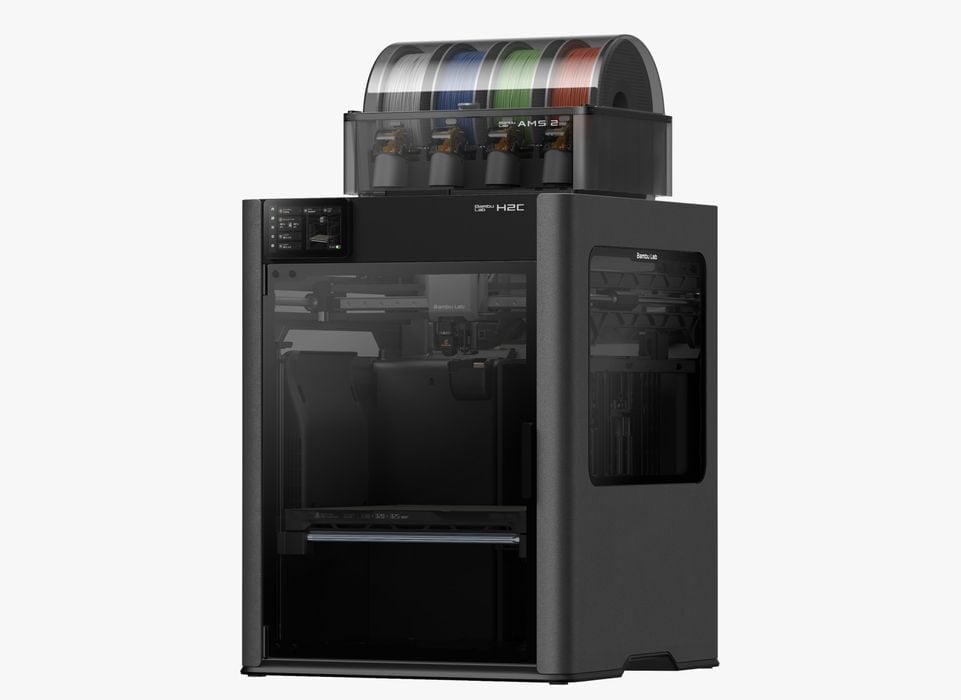
As promised, Bambu Lab released the much anticipated H2C 3D printer today.
The device might visually resemble their recent H2D system — and it should — the hardware inside is notably different. The H2C uses a brand new extrusion system Bambu Lab calls “Vortek”.
Vortek is an entirely new approach for switching materials during printing. Up to now, most multicolor 3D printers used the “filament swapping” process. That process involved pushing and pulling filament to and from a single nozzle. It works very well, and has been adopted by a dozen or so desktop FFF 3D printer manufacturers.
However, filament swapping to a single nozzle has a massive disadvantage: the nozzle must be purged each time a new material is introduced. This generates massive quantities of waste material. This effectively raises the cost of material per print, up to 10X in some cases.
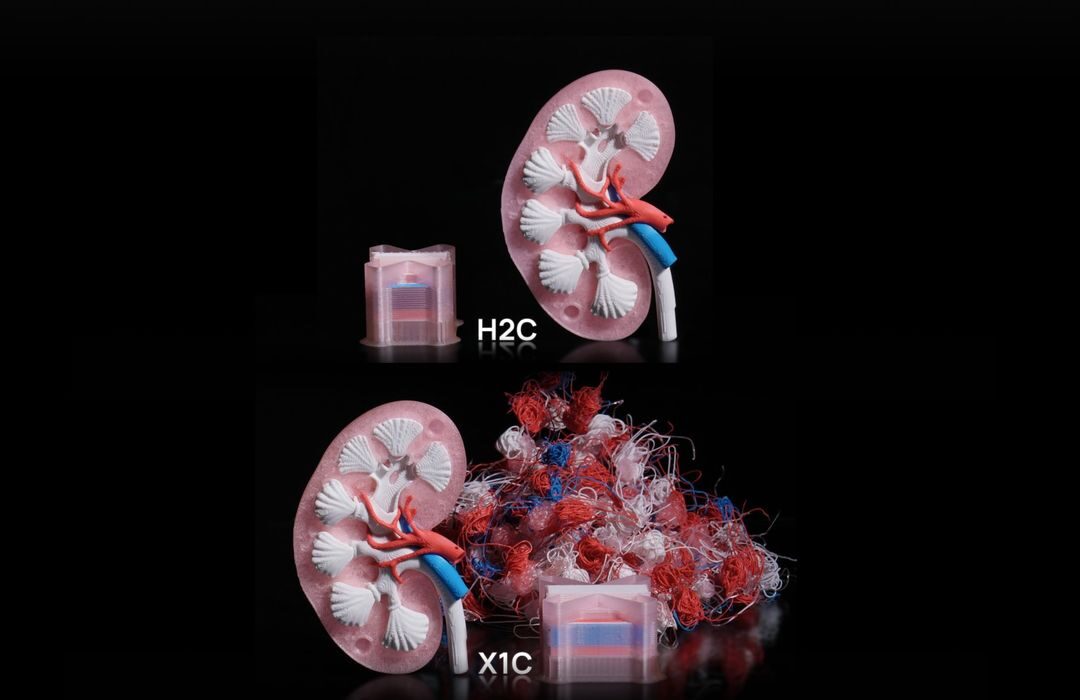
Vortek changes that by instead swapping hot ends. The concept is that each hot end would typically be dedicated to a specific material, so there’s little need to perform purges over and over.
Now we know the full specifications for the H2C.
H2C Specifications
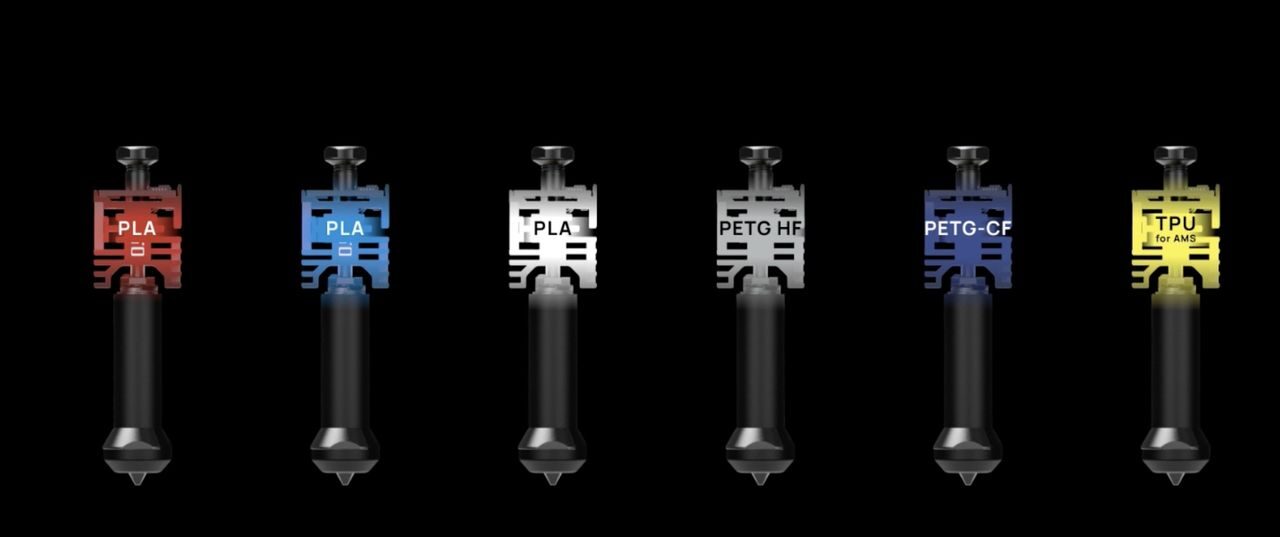
The device will have seven hot ends in total, with two hot end mount points. One mount point has a permanently mounted single nozzle, and the other mount point accepts any of six different hot ends that are garaged on the right hand side of the build chamber. As the print proceeds, the H2C swaps nozzles as required.
You might think this could take a while because hot ends would become cool ends as they await use. In the H2C Bambu Lab introduces induction heating, which very rapidly heats up a hot end after it’s mounted. They’re attached magnetically, and communicate/accept power wirelessly — ingenious!
The build volume is different for the H2C, something you might not expect because other than the Vortek hardware the machine is mostly identical to the H2D and H2S each of which we recently tested (H2D / H2S). The total build volume for the H2D is 350 x 320 x 325 mm, while the new H2C’s build volume is slightly smaller at 330 x 320 x 325 mm.
This is likely due to the Vortek hardware taking up some space on the right hand side. Unfortunately, this likely makes the H2C’s build plate have different dimensions than the other existing machines.
The H2C also optionally comes with a laser engraving system, just like the H2D, which might be of interest to some folks.
Otherwise, the H2C is basically an H2D with Vortek hardware. H2D features like advanced filtration, AI vision monitoring, 65C heated build chamber, closed loop mechanical control, 350C nozzle temperatures and more are all present.
H2C Benefits and Considerations
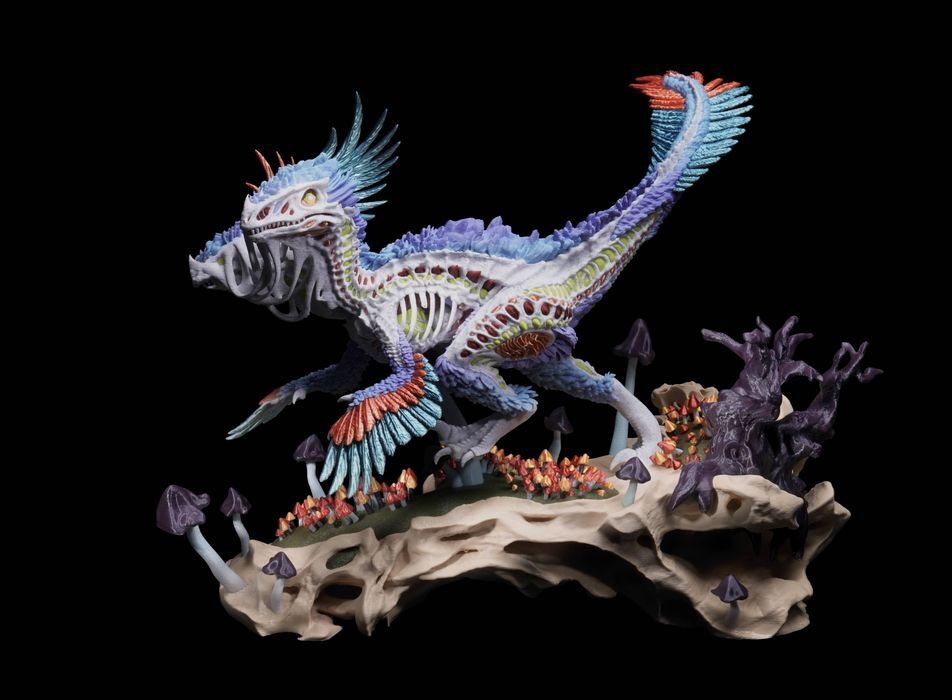
That said, there are a number of interesting benefits to using Vortek. Since hot ends are being swapped, it would be possible to use different nozzle diameters in a single print job. You might, for example, use a 0.2mm nozzle for detailed exteriors, while also using a 0.8mm nozzle for coarse infill. This could dramatically speed up print jobs, increase quality or more. There are endless possibilities with this capability.
While there are seven hot ends in total on the H2C, you can print parts in more than seven colors by leveraging the company’s AMS filament swapping accessories. The maximum configuration, according to Bambu Lab, is 24 colors by attaching a number of AMS units — six, one per Vortek hot end.
However, there are complications. How do you best assign filaments to these complex spool configurations? It gets worse when you mix in different nozzle diameters. For example, in the example above you’d have to ensure the AMS unit attached to the 0.2mm nozzle would have a spool of “green” as well as the 0.4mm nozzle’s AMS if you are printing that color in both those diameters.
Fortunately, Bambu Lab has also introduced an intelligent “allocation algorithm” in BambuStudio. This is almost certainly based on the patent we recently discovered that describes a method for performing this function.
The allocation system examines your current print job and recommends the optimal spool configuration: put this spool in that AMS, this filament to the fixed extruder, etc. This should vastly simplify the overly complex job of figuring out the best way to set up a job. This strongly aligns with Bambu Lab’s ongoing strategy to simplify 3D printing for operators.
Another issue will be print speed. While the requirement for purging effectively disappears, the H2C still will be subject to delays while waiting for filament to arrive from the AMS. This means print jobs on the H2C might be slower than competing systems that have permanently attached filaments to their toolheads.
H2C Availability and Pricing
Can you buy an H2C? Yes, and no.
The machine (combo including AMS 2 Pro) appears on Bambu Lab’s online store, and has prices as follows:
- EU: €2249 (US$2610)
- Asia: US$2199
- CA: CA$3149 (US$2246)
- UK: £1999 (US$2630)
- AU: AU$3699 (US$2402)
The machine does not yet appear in the Korean and Japan stores, so it’s likely Bambu Lab isn’t launching them there quite yet.
As for the US, the price is listed as “NOTIFY ME WHEN AVAILABLE”. This strongly suggests the H2C is falling into the same troubles as the previously announced P2S machine. It’s rumored that machine is tied up in US FCC regulations, likely caused by trade conflict between the US and China.
When will that be resolved? I fear that it could never be resolved. The US authorities are giving Chinese companies a very hard time, with a prime example being DJI, the leading drone manufacturer. It’s effectively been banned from sales of new products in the US, and it’s quite possible that Bambu Lab may suffer the same fate.
Meanwhile, the rest of the world (mostly) can order themselves a brand new H2C.
Via Bambu Lab
