
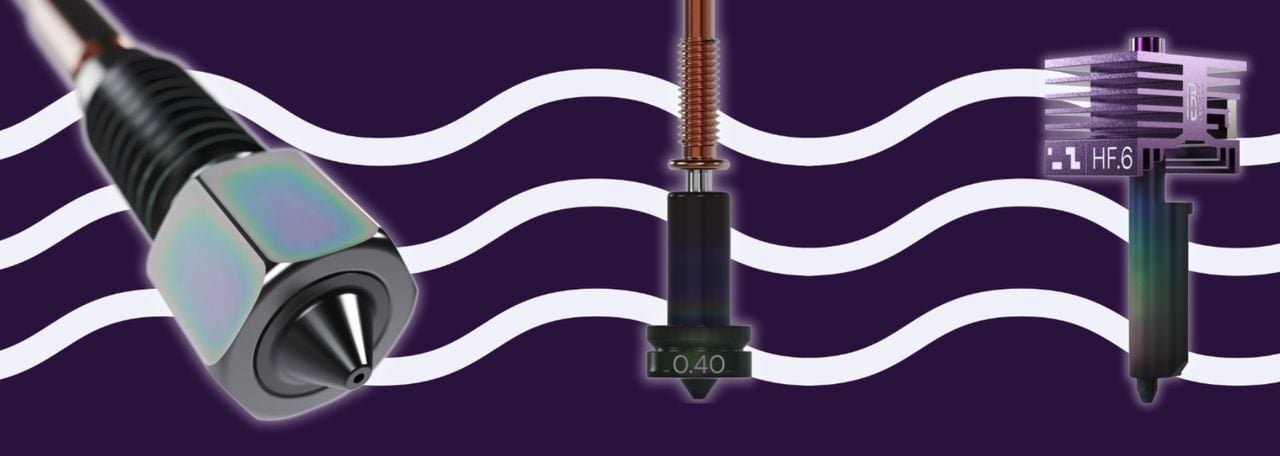
E3D announced what might be the most powerful hot end on the market: the ObXiDian 500.
The UK-based company is well-known for their high-end 3D printer components, and in several cases has effectively defined the standards for interconnection of hot ends in the past.
One of their more popular products has been the original ObXiDian hot end, which attempted to balance flow and abrasion resistance. These two factors typically conflict in most hot ends. Smooth flow is required for printing at high speeds and to allow “sticky” materials like TPU to print without clogging. Abrasion resistance is required when printing composite materials that contain very hard fibers, such as glass or carbon fiber. Brass nozzles are basically worn away after printing a single spool of an abrasive material and require replacement.
The original ObXiDian hot end solved this by using a special DLC coating on the nozzle that provided for both smooth flow and abrasion resistance. This created a hot end that could handle both types of material without requiring a hot end change. Evidently this proved quite popular, as E3D said they have sold over 250,000 of these hot ends.
Then the story gets interesting. When the original ObXiDian was released, typical desktop FFF 3D printers had maximum nozzle temperatures in the 250-300C range. That has changed notably since then, as an increasing number of machines target engineering materials — and therefore higher temperatures. We saw machines have maximum temperatures of over 300C, even 350C, become more frequent.
Unfortunately the DLC coating used on the ObXiDian begins to degrade when exposed to temperatures higher than 300C. If the ObXiDian was fine in the past, it is less able to handle today’s equipment. It was time for a change.
E3D when back to the drawing board and developed an entirely new coating. This coating is apparently “good” until a whopping 500C is encountered. That should cover off all conceivable hot end needs for the foreseeable future.
And it’s not just the temperature that’s interesting here. The ObXiDian 500’s coating turns out to be 5X harder than the original ObXiDian, which itself was a hardened nozzle. It seems that the ObXiDian 500 might last forever in some 3D printers.
The ObXiDian 500 also inherits E3D’s high flow capabilities, introduced on the company’s HTA variants. This introduces a split in the flow through the nozzle, exposing the material to more hot metal surface area. This extra heating allows much more material (up to 70%) to be pushed reliably though the hot end. In other words, much faster printing.
The ObXiDian 500 is available in three formats: Bambu Lab (H, P, X), Prusa Nextruder and E3D’s own Revo system, with prices ranging from £52-90 (US$68-119).
Via E3D
