
Charles R. Goulding and Preeti Sulibhavi build the case for how HNI’s US$2.2 billion acquisition of Steelcase could fuse industrial scale with 3D printing innovation to reshape the future of office furniture.
In a major shake-up of the contract-furniture world, HNI Corporation has announced plans to acquire Steelcase Inc. in a transaction valued at roughly US $2.2 billion. The deal would unite two of the biggest names in workplace furnishings—and potentially accelerate the use of additive manufacturing in mainstream furniture production.
Who’s Who
HNI Corporation, based in Muscatine, Iowa, was founded in 1947 and has grown into a diversified manufacturer through its Workplace Furnishings (brands like HON and Allsteel) and Residential Building Products divisions. HNI’s strategy has always leaned on operational efficiency, dealer relationships, and a reputation for pragmatic, well-engineered designs. Think of HNI as the industrial backbone of office furniture: steady, methodical, and optimized for scale.
Steelcase, headquartered in Grand Rapids, Michigan, is the design-driven innovator in this story. Founded in 1912, Steelcase built its name on research, ergonomics, and sustainability. Its “WorkSpace Futures” group and collaborations with institutions like MIT’s Self-Assembly Lab made it one of the first traditional manufacturers to treat 3D printing not as a novelty, but as a legitimate production tool.
The Business Case: Scale Meets Innovation
The acquisition would create a powerhouse with combined annual revenues of about US $5.8 billion and an expected US $120 million in annual cost synergies once integration is complete. The savings are likely to come from overlapping plant consolidation, streamlined logistics, and shared corporate infrastructure.
Beyond cost-cutting, HNI gains access to Steelcase’s R&D pipeline—an area where it has historically been quieter. Steelcase’s deep design culture and HNI’s supply-chain discipline form a classic “complementary strengths” scenario. HNI’s scale can push Steelcase innovations into mass production, while Steelcase’s design and digital capabilities can give HNI products a sharper technological edge.
Where 3D Printing Fits In
Steelcase has already demonstrated real-world additive manufacturing value. Its collaboration with MIT’s Self-Assembly Lab produced Rapid Liquid Printing (RLP)—a process that prints furniture-sized parts directly into a liquid medium. This technique bypasses the slow, layer-by-layer approach of conventional 3D printing and produces full-scale pieces, such as a Bassline table, in under 30 minutes. It’s the kind of “design freedom meets production speed” innovation that traditional furniture lines could never achieve through standard injection molding or CNC methods.
The company also explored lattice-structured components for its SILQ office chair, 3D printing lightweight, high-performance parts that cut material usage by 70 percent without sacrificing strength. These examples aren’t prototypes—they’re proof of concept for a new manufacturing model: local, flexible, and customization-ready.
HNI Corp hasn’t publicly shown much on the 3D printing front, but it’s research and development arm, HNI Technology, Inc., offers SLS and FDM 3D Printing services. Some items that they cover include mold builds, cast parts, and finish parts. With Steelcase’s expertise in AM, HNI could integrate localized 3D printing cells across its manufacturing network—producing low-volume or custom components closer to the customer, shortening lead times, and trimming shipping costs.
The Bigger Picture
The merger signals more than market consolidation; it’s a pivot toward the digitally enabled furniture factory. Steelcase’s additive manufacturing experiments, once confined to research labs, could find real production footing under HNI’s operational scale.
For customers, this could mean more configurable office solutions—chairs, desks, and partitions tailored to specific users or spaces, produced quickly without the traditional tooling penalty. For the industry, it’s another example of how additive manufacturing is slipping quietly but firmly into established sectors, not as a disruptor, but as an amplifier of what already works.
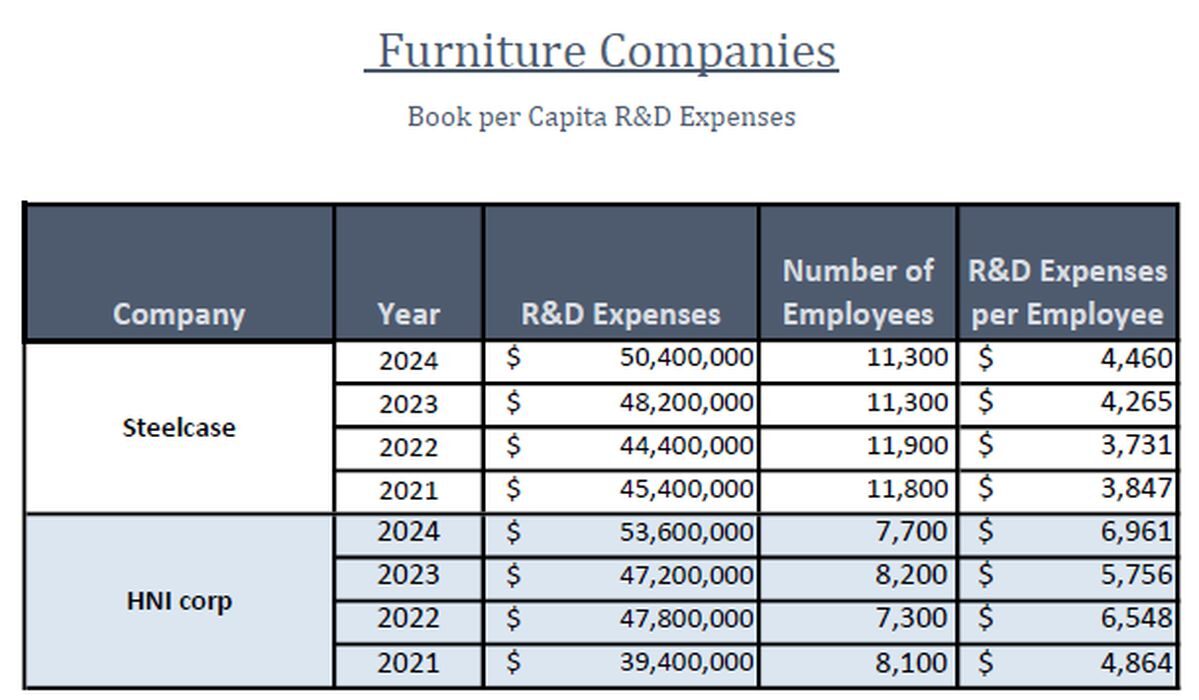
The annual research and development expenses for each company over the past few years are presented in the table below. Note how each company shows a steady increase in R&D per capita over the past 4 years. The data supports our assertion that the merger will encourage innovation.
The Research and Development Tax Credit
The now permanent Research and Development (R&D) Tax Credit is available for companies developing new or improved products, processes, and/or software. 3D printing can help boost a company’s R&D Tax Credits. Wages for technical employees creating, testing, and revising 3D-printed prototypes can be included as a percentage of the eligible time spent on the R&D Tax Credit. Similarly, when used as a method of improving a process, time spent integrating 3D printing hardware and software counts as an eligible activity. Lastly, when used for modeling and preproduction, the costs of filaments consumed during the development process may also be recovered.
Whether it is used for creating and testing prototypes or for final production, 3D printing is a great indicator that R&D Credit-eligible activities are taking place. Companies implementing this technology at any point should consider taking advantage of R&D Tax Credits.
The Bottom Line
If HNI can capture its promised US$120 million in annual synergies while scaling Steelcase’s design-first innovation culture, this deal could redefine how office furniture is imagined, built, and delivered. The combined company could become the first major furniture maker to treat 3D printing not as a sideline experiment, but as an integrated capability within a global production network.
Steelcase once said its goal was to make workplaces “as dynamic as the people who use them.” With HNI’s manufacturing muscle behind it, that promise might finally scale—and the next desk you sit at could have been printed, not machined.