
By Charles R. Goulding and Preeti Sulibhavi take readers inside the way an AI-powered bills of materials could help U.S. manufacturers close the humanoid robot production gap and build a stronger domestic supply chain.
The race to manufacture humanoid robots is becoming an economic and political contest as well as a technological one. For years, Chinese manufacturers have benefited from established electronics supply chains, competitive component costs, and the ability to scale production rapidly. Now, U.S. restrictions on Chinese robotic systems are adding urgency to efforts to develop domestic manufacturing capabilities.
In July 2026, the Federal Communications Commission announced restrictions on imports of new Chinese humanoid and other advanced robotic devices, citing national security risks involving surveillance, data theft, and remote access. Separate federal measures have also restricted some government procurement of robotic systems linked to foreign adversaries. These measures reflect growing concern about dependence on foreign technology in strategically important industries, according to the Reuters report on the FCC action and the relevant Congressional Record.
The restrictions do not mean that every Chinese-made robot or component is prohibited in every circumstance. Their precise scope depends on the applicable rule and procurement requirements. Nevertheless, they create a stronger incentive for U.S. manufacturers to establish domestic production and more secure supply chains. The strategic importance of domestic manufacturing is also explored in our coverage of Japan’s renewed investment in humanoid robotics.
China’s manufacturing lead
The scale of China’s current advantage is striking. According to market research firm Omdia, global humanoid robot shipments reached 13,318 units in 2025. Shanghai-based AgiBot shipped 5,168 robots, while Hangzhou-based Unitree Robotics shipped approximately 4,200, placing the two Chinese companies at the top of the market. Reported Unitree figures can vary with the reporting period and definition of a shipment, so comparisons should be treated carefully. See the South China Morning Post’s report on 2025 humanoid shipments.
By comparison, Omdia figures reported by the South China Morning Post put shipments from Tesla, Figure AI, and Agility Robotics at approximately 150 units each in 2025. These are company-level comparisons, not complete national production totals, but they demonstrate the difference between China’s early manufacturing scale and the more limited output of several prominent U.S. developers.
The gap extends beyond final assembly. Chinese manufacturers have access to extensive domestic networks supplying motors, precision gearboxes, electronics, sensors, batteries, and mechanical parts. This ecosystem can shorten procurement cycles and help suppliers improve costs as production volumes increase. We have also examined the broader implications of humanoid robots, AI, 3D printing, and automation.
The AI-enabled bill of materials
During a recent week, I visited two leading domestic manufacturers actively pursuing U.S. humanoid robot manufacturing. One development was particularly interesting: AI is making it easier to organize and analyze detailed bills of materials.
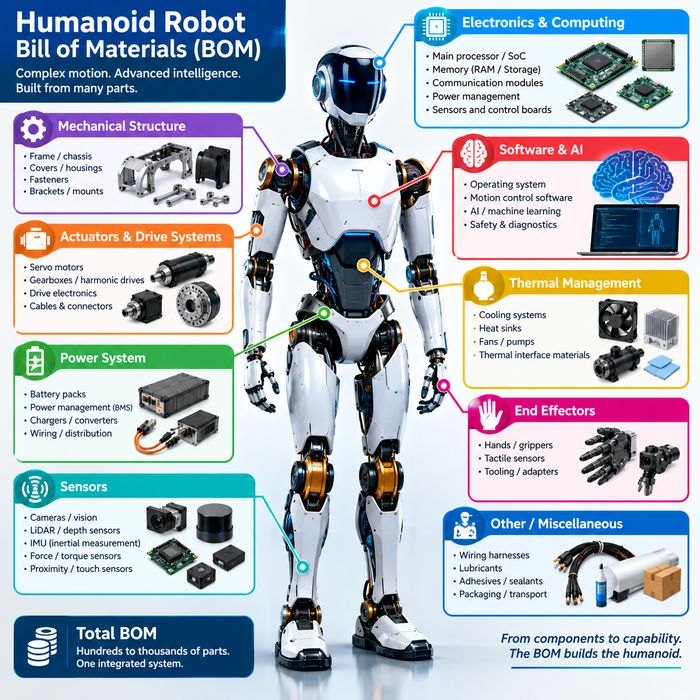
A bill of materials (BOM) is the structured inventory of parts and materials required to manufacture a product. In a humanoid robot, that inventory can extend from a complete joint assembly down to its electric motor, bearings, gears, encoder, wiring, and control electronics.
AI tools can help engineers expand these categories into component-level lists, compare technical specifications, map potential suppliers, and identify gaps in sourcing information. The resulting BOM can support purchasing, cost estimation, engineering changes, and supply-chain risk analysis.
The six major categories are actuators and joints; hands and manipulation; sensing and perception; compute and control platforms; structure, frame and housings; and battery and power modules. Together, they offer a useful framework for understanding both a robot’s engineering and its manufacturing costs.
What the major BOM categories include
Actuators and joints are the robot’s muscles. Electric motors, precision gear reducers, bearings, encoders, and motor drivers work together to provide controlled movement at the hips, knees, shoulders, elbows, wrists, and other joints. These assemblies must deliver torque and precision while remaining compact, lightweight, and durable. McKinsey’s analysis of the humanoid supply chain identifies actuation as a major cost driver; its estimates should be understood as market analysis rather than a universal percentage for every design. See McKinsey’s discussion of humanoid supply-chain constraints.
Hands and manipulation deserve separate attention because handling real objects remains a difficult engineering problem. A useful robotic hand may require multiple small actuators, linkages or tendon mechanisms, tactile sensors, and force feedback. Picking up a fragile object, manipulating a tool, or grasping an irregular component requires considerably more than simply opening and closing a gripper. These assemblies offer opportunities for precision machining, small molded parts, custom mechanisms, and potentially additively manufactured components.
Sensing and perception provide the robot with information about its surroundings and its own movements. Cameras, depth sensors, inertial measurement units, joint encoders, force sensors, and tactile devices help it locate objects, maintain balance, estimate position, and respond to contact. The challenge is integrating these inputs reliably while controlling cost, weight, and power consumption.
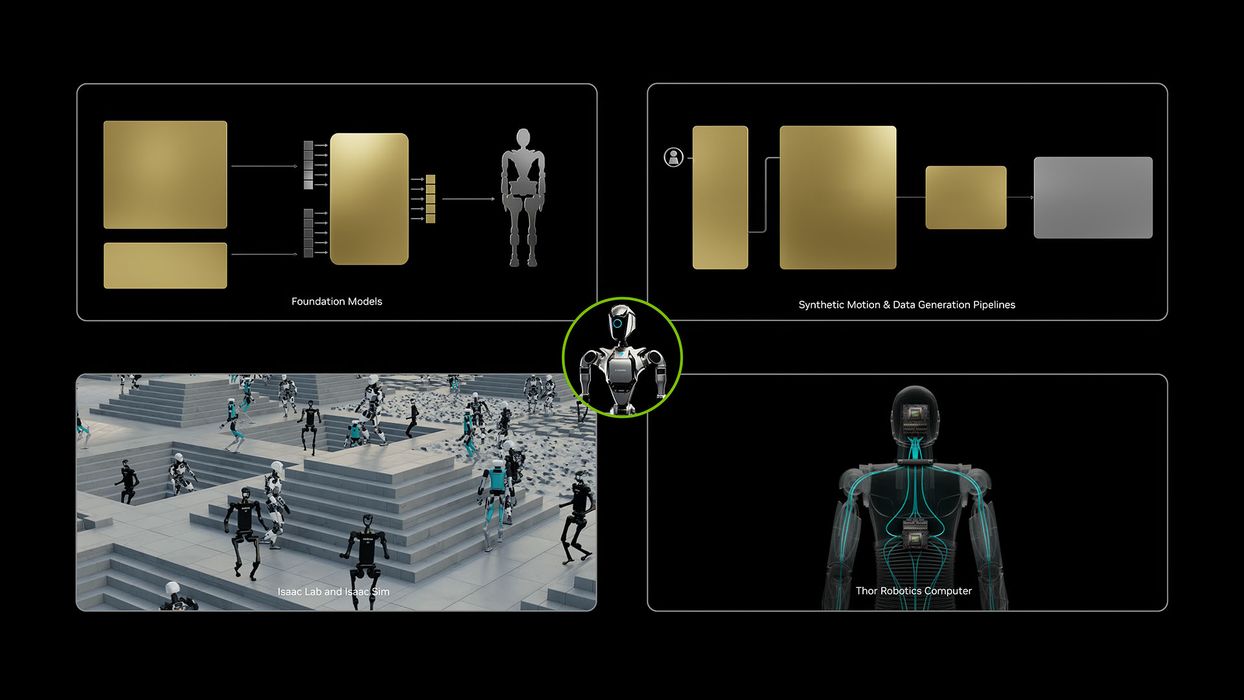
Compute and control platforms form the robot’s information-processing system. Conventional controllers manage real-time motor movements, while more powerful processors run perception algorithms, task planning, and AI models. NVIDIA is an important supplier of robotics computing platforms, although the processor, software, and control architecture vary by manufacturer. AI models help interpret instructions and select actions; the control system translates those decisions into coordinated physical movements.
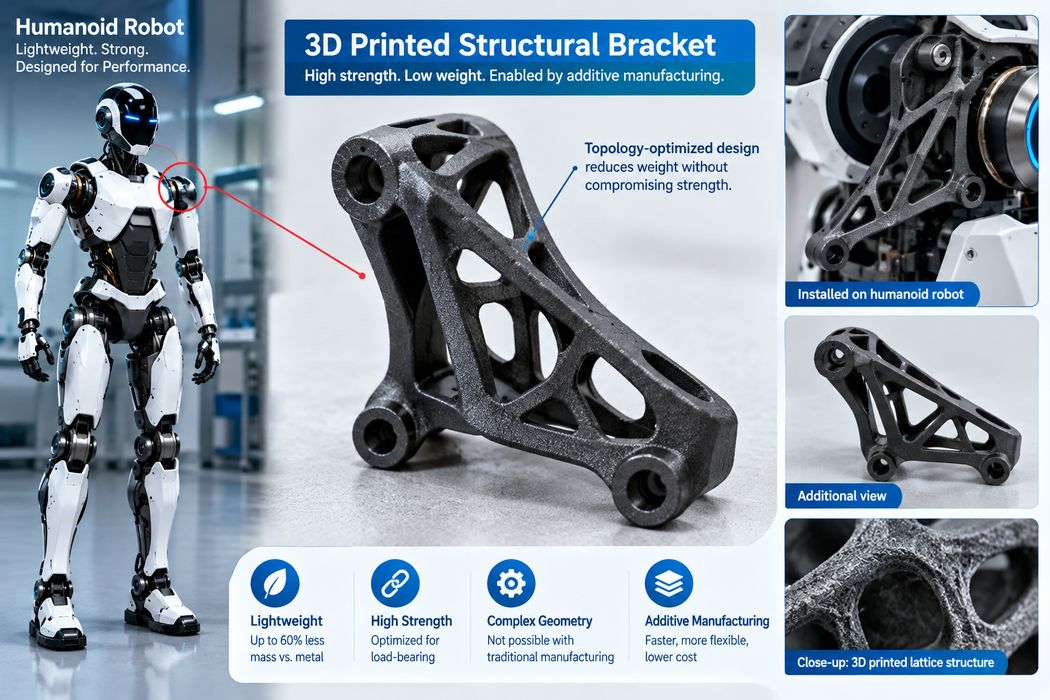
Structure, frame and housings provide mechanical foundation. Frames, brackets, covers, joints, fasteners, and protective enclosures must be strong enough to withstand repeated movement without adding unnecessary weight. Lightweight alloys, engineering plastics, composites, machined components, and additively manufactured parts may all have a role, depending on the design and production volume.
Battery and power modules supply the energy required by every other subsystem. Battery cells, pack enclosures, battery-management electronics, power distribution, and thermal management must fit within a tight mass and volume budget. More battery capacity can extend operating time, but it also increases weight, potentially requiring larger actuators and additional structural strength.
These categories overlap in real designs. An actuator may incorporate sensors and electronics, while a dexterous hand may be classified under both manipulation and actuation. A useful BOM must define these boundaries clearly to avoid double-counting costs.
From robot designs to supplier opportunities
Detailed component information is increasingly available for leading manufacturers, including Tesla and Unitree. Public specifications, technical disclosures, teardown analyses, and supplier research can help engineers reconstruct parts of a robot’s BOM. However, a complete and verified production BOM is not necessarily publicly available for every model.
Morgan Stanley has published humanoid-robot supply-chain analysis that breaks robots into components such as motors, reducers, screws, bearings, vision systems, chips, and sensors. Its research maps component requirements to potential suppliers and examines companies positioned to benefit from increased production. See Morgan Stanley’s Robot Almanac.
AI-assisted analysis can make this work more accessible to manufacturers that lack the resources of a large investment bank. By combining component specifications, supplier databases, manufacturing constraints, and cost estimates, an AI-enabled BOM workflow can help purchasing teams identify alternative sources and assess where domestic production makes sense. The process still requires engineering validation. AI-generated component lists may contain incorrect specifications, duplicate entries, or suppliers that cannot meet the required quality and volume. Engineers and procurement specialists must verify the results before using them to qualify parts or commit to production.
IRC § 41 R&D Credit Opportunities from AI and Additive Manufacturing in Humanoid Robotics
There are several development areas that may help companies identify and document qualified research under IRC § 41, particularly where teams are using AI and additive manufacturing to resolve technical uncertainty in humanoid robot design and production. Under IRC § 41(d), qualified research generally must be technological in nature, intended to develop or improve a business component, and involve a process of experimentation to resolve uncertainty regarding function, performance, reliability, or quality. The article’s AI-enabled bill-of-materials concepts—such as using AI to create component-level BOMs, compare technical specifications, map suppliers, evaluate sourcing gaps, support cost estimates, and analyze engineering changes—can support R&D credit claims when those tools are used in iterative engineering workflows rather than routine purchasing or administrative activities. Similarly, AI compute platforms that run perception algorithms, task planning, and coordinated motion-control decisions may involve experimentation in computer science, robotics, and engineering. Additive manufacturing may also create credit opportunities where engineers test alternative materials, geometries, tolerances, and production methods for lightweight brackets, custom housings, sensor mounts, cable-management components, fixtures, or low-volume replacement parts; the article notes that 3D printing can allow rapid iteration before committing to tooling. Potential qualified research expenses may include employee wages, supplies, computer-use costs, and qualifying contract research costs. Eligible startups may also elect to use up to US$500,000 of research credits against payroll taxes if they satisfy the qualified small business requirements under IRC § 41(h).
R&D Tax Savers has been helping companies navigate the complexities of the R&D tax credit since it was introduced into law in 1981.
An opening for additive manufacturing
For the 3D printing industry, the emerging humanoid supply chain offers opportunities well beyond printing complete robot bodies. Potential applications include lightweight structural brackets, custom housings, sensor mounts, cable-management components, assembly fixtures, and low-volume replacement parts. Additive manufacturing can also help engineers iterate quickly on mechanical designs before committing to expensive production tooling.
Embedded electronics and power systems present another opportunity, although printed mechanical parts should not be confused with the separate challenges of manufacturing semiconductor devices and electronic assemblies. The practical value of 3D printing will depend on part performance, certification requirements, production volumes, and total cost.
We have previously considered related questions around humanoid robots, human work, and 3D printing, as well as the less obvious connections between robotics, industry, and investment in Hard Hats, Humanoids, and Nasdaq. These developments point to a supply chain that spans robotics companies, component makers, software developers, and advanced manufacturing firms.
The broader opportunity is to use AI to connect robot design with manufacturing reality. A detailed, searchable BOM can show which components are needed, where they might be sourced, and which are candidates for redesign or domestic production.
China has demonstrated how quickly a coordinated manufacturing ecosystem can scale humanoid robots. U.S. manufacturers now have an incentive to build a more resilient alternative. AI-enabled BOM analysis, combined with sound engineering and advanced manufacturing methods, could help them identify the most promising opportunities and bring domestic humanoid production closer to commercial scale.