
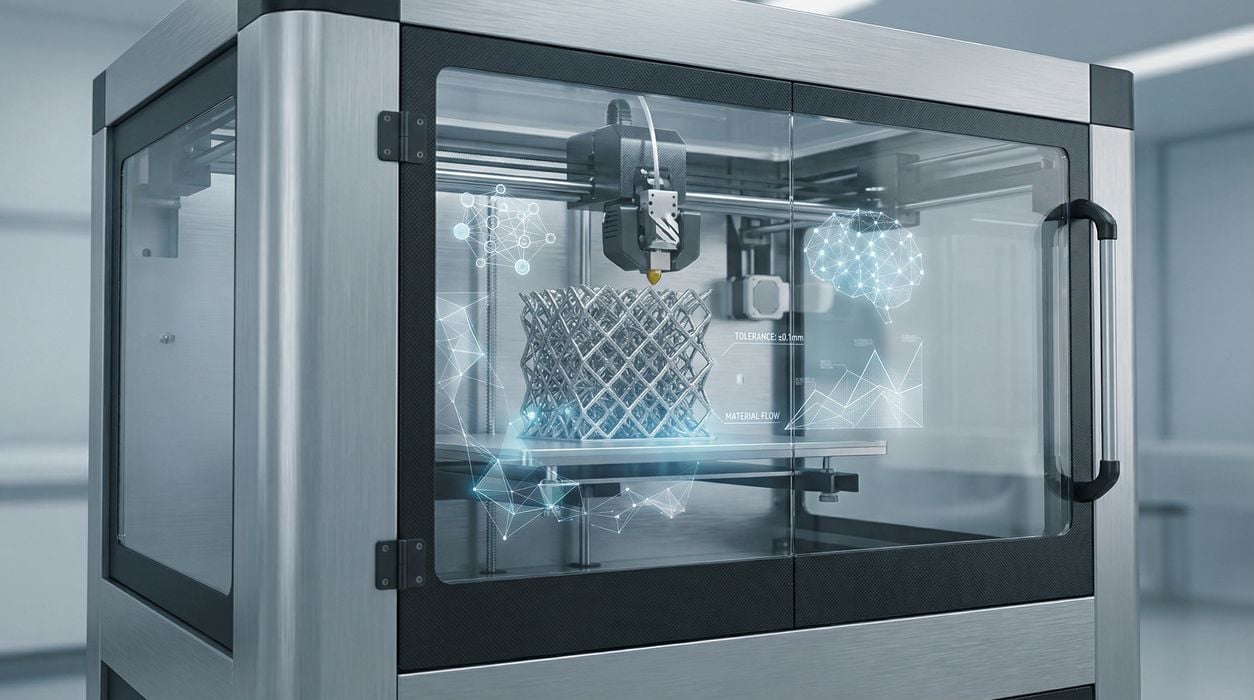
Where is AI going in the 3D print world?
AI is clearly a very powerful tool, and it is rapidly appearing everywhere, with integrations into software, workflows, even your washer and dryer. It seems that in order to stay relevant, many companies feel they have to do “something” related to AI.
This is both good and bad.
Some of the uses of AI in the 3D print universe seem to be catching on: AI spaghetti detection is quickly becoming a default feature on most modern desktop FFF systems, for example. While experiences vary, I’ve generally had very good results from these systems, and saved on material costs by stopping problem jobs before wastage occurs.
But that’s only one AI application in 3D printing, and surely there are hundreds more, most of which have yet to be discovered.
Some are visible. Authentise, for example, uses AI extensively in their service to analyze workflows and data used in projects. Artec 3D, makers of 3D scanners and software, is also working on a new AI feature. CEO Art Yukhin explains:
“Let’s say you’re reverse engineering an engine. You can manually compare scans to a CAD drawing to see if the plane is flat enough, or if an angle is within predefined tolerances. But imagine if there’s tons of data, like in a production scenario. With Workflows in Artec Studio, we can now do it automatically, and we can do it without the hands of technicians or construction workers. You don’t need a PhD to do that, and you don’t now need to spend a lot of time.
When we have this huge, big data, we can feed it to AI, and extract the information we need. That’s what our team is working on. There are different names for it, we call it ‘Scan-to-CAD.’ Some software tools out there already allow you to do it. We’re working on automating this process – this is just one example of what you can expect to see over the next decade.”
Yet among these success stories, there are also skeptics of AI. I continue to see reports of “AI being rolled back in corporations”, usually because of failures of one kind or another.
What does this mean? Is AI really going to fail and go away?
My thought is that the current state of affairs regarding AI is identical to previous introductions of significantly different and powerful technology. You will see these types of activities:
- Investors plowing in large amounts of money without really understanding the tech because they want to get in on the ground floor, basically gambling.
- Companies trying “anything” so that they can issue PRs and advertising about using the new tech, whether it is practical or not.
- Managers who don’t understand the tech directing underlings to make something with it, even though they don’t really know what they are doing and thus fail.
- Manufactured “buzz” pushing the tech with glorious predictions of a golden future.
- Clever people building systems and mechanisms to give them a future monopoly over a portion of the tech space.
- Entrepreneurs testing all manner of uses of the tech, knowing that most will fail and only a few will find something that actually is practical.
Meanwhile, those that have been fiddling in AI are discovering that it truly can be an extremely powerful tool for certain types of activities. What’s ominous is that each week the tools get even more powerful and capable.
What can we make of all this? Is AI going to succeed or fail in 3D printing?
To me the answer is obvious: Of course it is going to succeed — but we are going to see plenty of crashes in the initial phases (now) as everyone figures out what works and what doesn’t.
The strategy should not be: “I saw something fail, so I’m giving up”, as some seem to be doing. No, instead the strategy should be: “I saw something fail, so I know that doesn’t work, and I will try something different.”
Those who are persistent will eventually uncover very profitable ways to leverage AI tech, which will ultimately be used by those who weren’t persistent.
