
Flashforge appears to be looking at a smarter way to control resin 3D printing.
A newly published Chinese patent application, CN 122125908 A, assigned to Suzhou Flashforge 3D Technology Co., Ltd., describes a light curing printing method that dynamically adjusts two important process parameters for each layer: the initial peel speed and the resin refill waiting time.
That sounds obscure, but it could be quite practical.
In bottom-up resin systems, including many desktop MLSA and DLP machines, each newly cured layer must separate from the release film at the bottom of the vat. After that, liquid resin must flow back into the gap before the next exposure begins.
Those two operations are very familiar to resin users: peel, wait, expose, repeat. Especially the time it takes to complete them.
The problem is that many machines and slicing profiles treat those steps too simply. A printer may use a fixed peel speed, or adjust it based mainly on exposed area. Refill time may also be fixed, or scaled roughly by area.
That works good enough for many models. But it is not always ideal.
A large solid disk, a thin spidery support structure, a C-shaped channel, and a perforated part can all behave very differently during peel and refill, even if their total exposed area is similar. One may create high suction. Another may have fragile narrow features. Another may need resin to travel into a deep internal pocket.
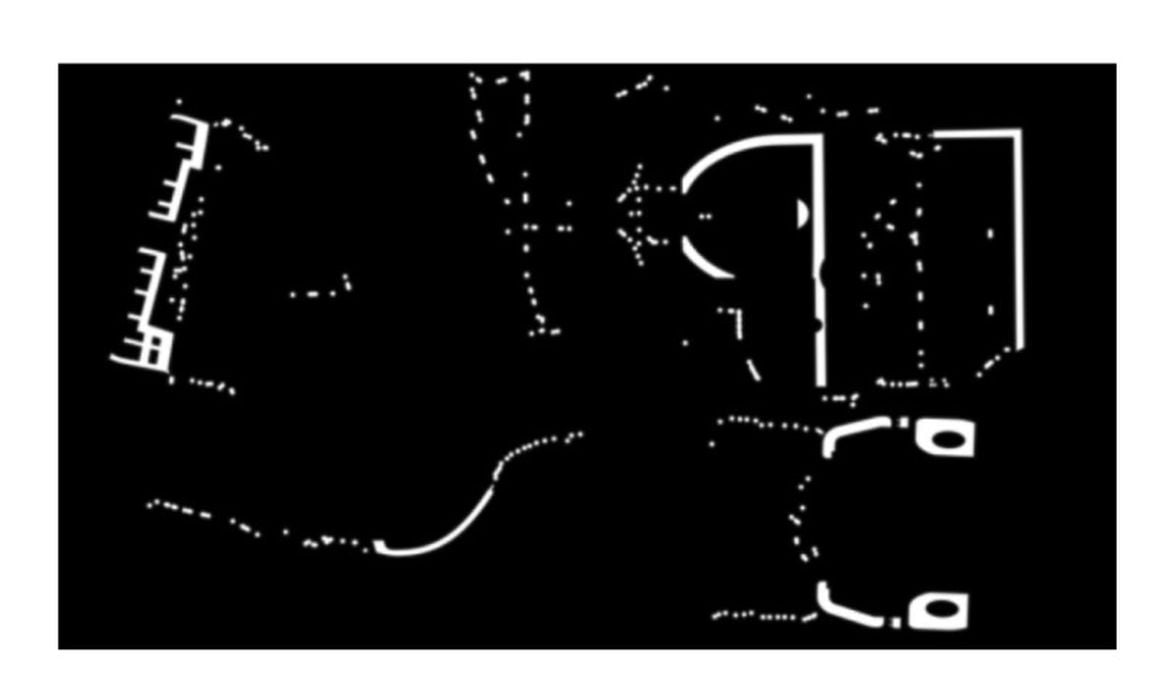
Flashforge’s patent proposes using the actual layer image to make better decisions.
The method starts by taking the image for the layer to be printed and converting it into a binary grayscale layer. White pixels represent areas that will be cured, while black pixels represent empty regions. From that image, the system extracts several geometric features: equivalent radius, maximum flow distance, compactness, and normalized perimeter.
In other words, the printer or slicer would not simply ask, “How much area is exposed?” It would ask, “What shape is this layer, how compact is it, how far does resin need to flow, and how complex is the boundary?”
The patent then uses those values to calculate the initial peel speed and the resin refill waiting time for that specific layer.
The equivalent radius represents the overall size of the cured region, which relates to suction and separation force. Compactness helps distinguish a strong, roundish section from a long, fragile, branched, or jagged one. Maximum flow distance estimates how far resin must travel to refill the deepest area of the layer. Normalized perimeter provides a way to account for boundary complexity and flow access.
Resin 3D printing failures are often caused not by bad exposure alone, but by mechanical and fluid behaviour between exposures. A fragile feature can tear during separation. A deep pocket can underfill. A fixed “safe” delay can waste time across thousands of layers.
The commercial benefit is pretty obvious: faster printing without increasing risk.
If Flashforge can shorten waits on easy layers and slow down only where geometry requires it, total print time could shrink and reliability improves. That would be especially useful for users printing dental parts, miniatures, engineering prototypes, and batches of varied small objects, where layer geometry changes constantly.
There is the question of where this intelligence would live. It could be implemented in slicing software, printer firmware, or a closed Flashforge resin profile system. Each route has different implications for users. A slicer-based approach could be more transparent. A locked profile approach might be easier for beginners but less flexible for advanced users.
Resin 3D printing has spent years improving light engines, resolution, and materials, but the mechanical choreography of peel and refill is still a major limitation. Geometry-aware process control is one way to make machines feel less like fixed profile devices and more like adaptive manufacturing systems.
Via Espacenet
