
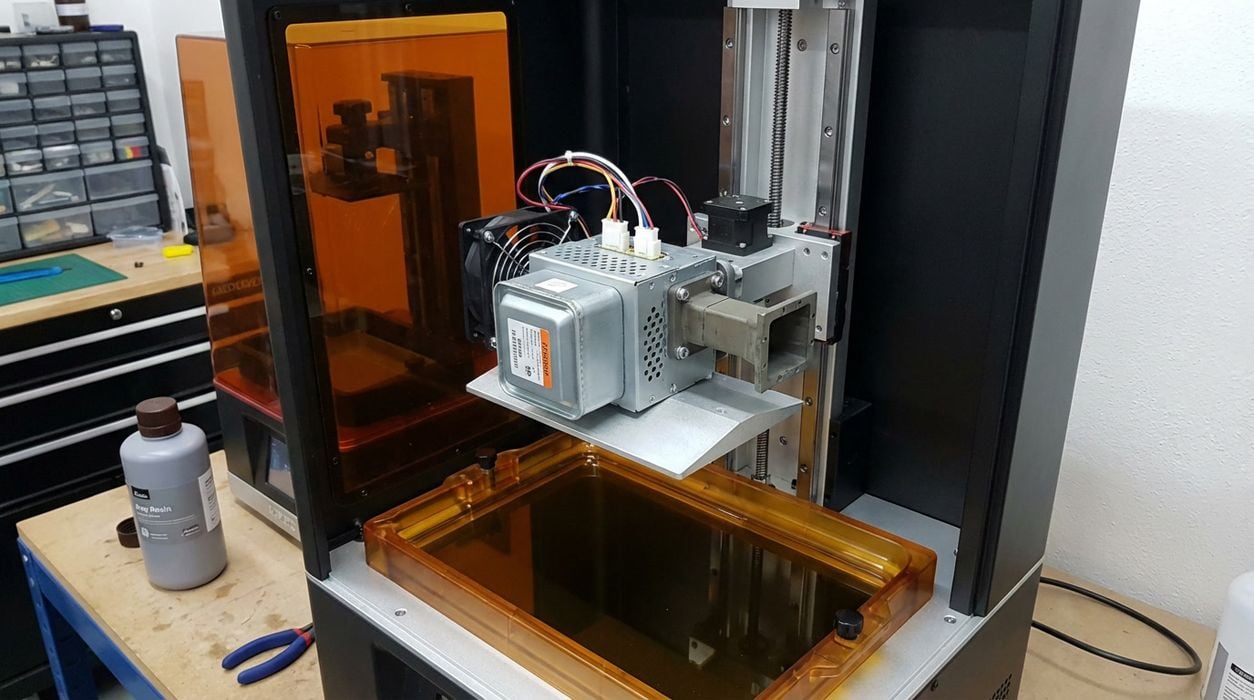
A new patent describes a printer that cures deposited material with variable frequency microwaves, eliminating separate post curing.
Post curing remains a persistent bottleneck across additive manufacturing. Resin systems rely on UV flood lamps, printed electronics often need IR or oven-based annealing, and many materials demand extended heat soaks that slow throughput and risk part distortion. The patent positions microwave energy as an in-situ alternative that could shorten cycle time and reduce thermal budgets for applications ranging from conductive traces to soft biomaterials.
The core idea is not just microwaves, but variable frequency microwave (VFM) irradiation. Conventional microwave systems typically operate at a fixed frequency, which can create standing waves and hot spots. By sweeping the frequency across a range, VFM aims to distribute the electromagnetic field more uniformly in the chamber, promoting even heating. In principle, that means fewer localized burns, less undercure, and the ability to meet curing objectives at lower temperatures.
Microwave Curing Moves Into The Build Chamber
According to the filing, the system places a nozzle that dispenses a printing material inside a shielded chamber alongside a microwave irradiation unit. A control unit coordinates deposition and VFM exposure so the emitted material is hardened in place, with the patent asserting complete cure without a separate post process. Claimed benefits include low curing temperature — room temperature or slightly higher — shorter curing times, improved adhesion, and lower energy consumption.
If it works as described, that arrangement collapses a multi-step workflow into one operation. In-chamber cure could reduce human labor, improve first-part yield by locking features before they slump or creep, and enable faster handoffs between layers or toolpaths. It also opens possibilities for selective or incremental cure strategies that lock critical regions on the fly while leaving others tacky for subsequent bonding — though the patent does not detail toolpath-level control or sensing.
Constraints And Open Questions
The document is light on engineering data. It does not specify frequency sweep ranges, power levels, field uniformity metrics, or chamber size, and it leaves the materials class broad. Microwave processing depends on dielectric properties: highly conductive inks and certain ceramic-filled pastes often couple well, while many neat polymers absorb poorly without susceptors. Bioprinting, which the patent names as a target, would demand very low thermal rise and tight dose control; whether VFM can deliver uniform, gentle crosslinking in hydrated gels remains unproven.
Throughput will hinge on how quickly sufficient energy can be delivered without overheating adjacent geometry. Complex part shapes can distort fields, so consistent cure may require mode stirring, tuned cavity design, or motion strategies. Safety and compliance are also nontrivial — robust RF shielding, interlocks, and electromagnetic compatibility with motion controllers and sensors would be essential. The patent mentions a control unit but does not describe closed-loop temperature or cure monitoring, which many industrial users would expect for process assurance.
Context matters here. UV-curable systems already achieve fast, predictable cure at room temperature with mature chemistries and metrology, while thermal ovens remain simple and scalable for larger builds. Microwave curing has seen success in broader materials processing, but it is rarely integrated directly at the printhead level in AM. The real test will be material-specific data that shows equal or better mechanicals, adhesion, and dimensional stability versus incumbent post-processing — and does so with higher throughput and lower energy per part.
Watch for evidence that ties VFM exposure to measurable outcomes: frequency and power profiles and cure results versus UV or IR baselines. If the approach can be packaged as a compact, well-shielded module with recipe control, it could find early traction in labs printing conductive traces, antennas, or microfluidics. It is also possible this appears first as an add-on curing head rather than a ground-up printer.
As with many patents, this is a concept, not a product announcement; there is no pricing, availability, or timeline. Still, if the oven can live inside the printer, post processing might finally live up to its name and disappear.
Via Google Patents
