
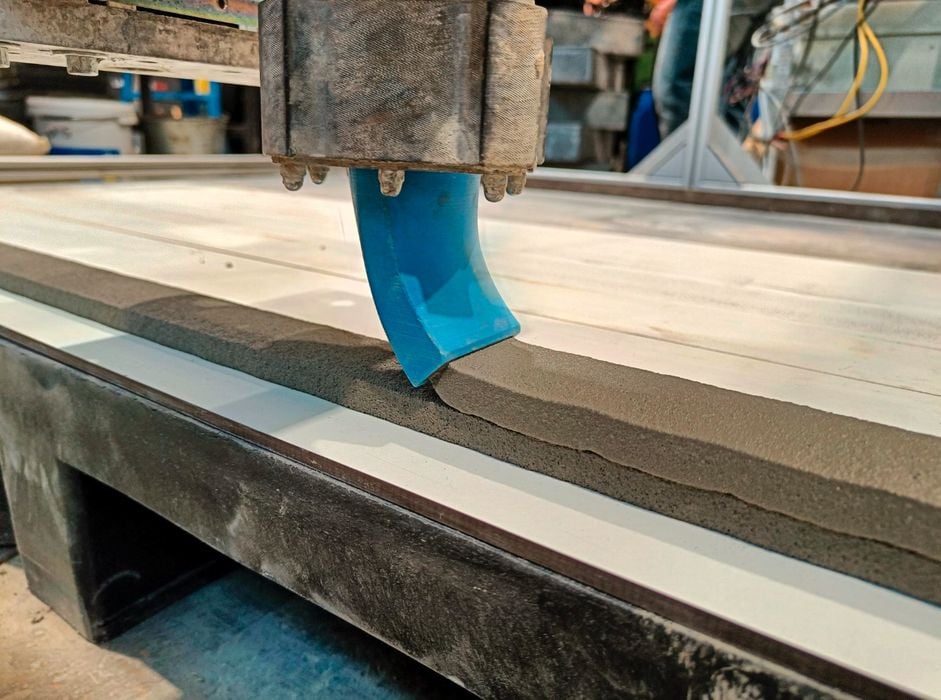
A new research paper benchmarks ways to measure early age shrinkage in 3D printed cementitious mixes and points to practical low cost setups that labs and contractors could deploy quickly.
Construction 3D printing keeps scaling from pilot huts to multi room shells, but the first hours after deposition remain a fragile window. Early age shrinkage affects interlayer bonding, dimensional stability, and crack formation, especially as mixes balance shape retention with pumpability and set control. Without reliable, fast feedback, print parameters and admixture dosing become guesswork.
Conventional concrete shrinkage tests were designed for cast prisms over days or weeks, not for extruded filaments and walls that evolve over minutes and hours. That mismatch has left researchers and site labs improvising methods to quantify autogenous and drying shrinkage under realistic printing conditions. This study takes a systematic look at what works, what does not, and where low cost instrumentation can fill gaps.
Why Early Age Shrinkage Matters In Printed Cement
Early age behavior in printable mortars is a tight coupling of rheology, hydration heat, moisture transport, and restraint from previously deposited layers. Shrinkage from drying can pull fresh filaments inward even before noticeable drying. As evaporation kicks in, the effect compounds, risking interlayer gaps, edge curling, or microcracks that later propagate under load.
3DCP printer manufacturers like COBOD and ICON focus on motion systems, toolpaths, and nozzle design, but the durability story begins with mix design and process control in the first hour. A measurement toolkit that resolves small dimensional changes on site allows teams to tune accelerators, supplementary cementitious materials, and print speeds, and to set pause times and lift heights with data rather than rules of thumb.
Inside The Methods And What Could Scale
The paper compares common lab techniques — contact displacement sensors, image based tracking, and restrained configurations — applied to cementitious mixtures tailored for extrusion. Contact approaches such as linear displacement transducers can deliver high precision on printed strips but require rigid fixtures and careful alignment to avoid bias from handling. Digital image correlation or simpler marker tracking are non contact and sample friendly, yet they are sensitive to lighting, lens distortion, and surface texture.
Restrained tests like the ring setup reveal cracking propensity under constraint but blend shrinkage and stress development, so they complement rather than replace direct measurement of free shrinkage. Corrugated tube or sealed specimen methods help isolate autogenous components by limiting moisture exchange with the environment. The important contribution here is not a single winner, but a side by side discussion of tradeoffs when the specimen is a printed filament or wall segment instead of a cast prism.
The authors look at low cost alternatives that could be assembled in a teaching lab or a temporary site container. Camera based tracking with consumer sensors, simple fiducials, and open source software can achieve useful resolution for millimeter scale changes, provided a decent calibration routine and stable lighting. Hobby grade displacement sensors, logged by a microcontroller and clamped to 3D printed fixtures, offer a repeatable path to continuous time data without expensive DAQ systems.
For AM operators, it is all about throughput and reliability. A few inexpensive sensors watching specimen strips printed alongside a wall can flag mix drift, ambient swings, or nozzle heat effects early enough to adjust pump rate, layer time, or curing strategy. Link these signals with temperature and humidity sensing and it is plausible to close the loop on process stability, even before heavier analytics arrive.
There are constraints. The study’s data are specific to its mixtures and fixtures, and cross correlation among methods will need interlab studies to harden confidence bands. Image based methods demand disciplined lighting and stable mounts; contact gauges need robust mechanical coupling and thermal isolation. Environmental control remains pivotal, since small RH or temperature shifts can overwhelm the signal of interest. Field portability and operator training are real adoption barriers.
Watch for two things next: standard protocols tailored to extrusion based construction and integration of shrinkage monitors into printer QC workflows. If vendors automate time lapse imaging at the gantry and expose sensor hooks in their controllers, shrinkage tracking could graduate from a research exercise to a commissioning step for every job. The critical proof will be linking early age shrinkage metrics to long term cracking performance on full scale prints.
If concrete AM lives or dies in the first hour, then measuring that hour well might be the most affordable strength upgrade money can buy.
Via Materials
