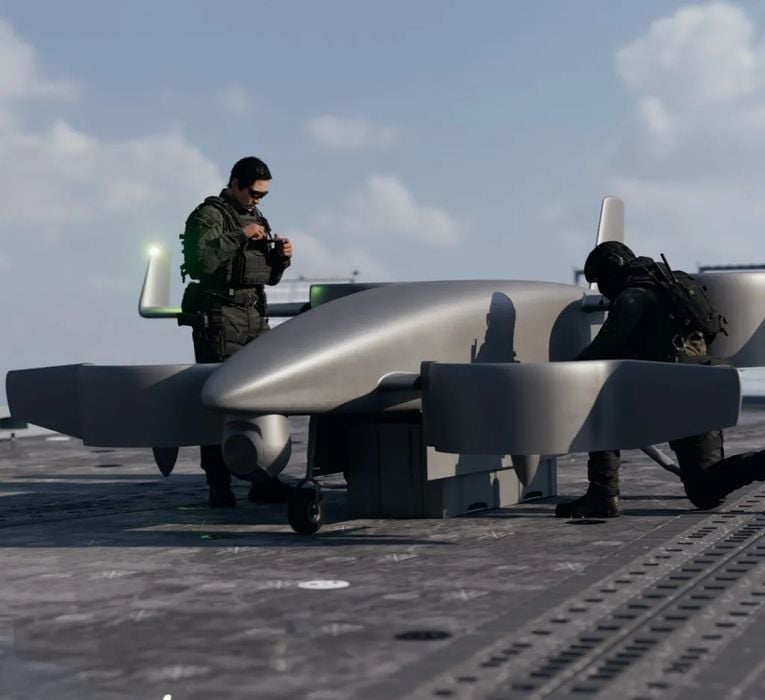
Charles R. Goulding and Preeti Sulibhavi explore how Dallas, Texas, has quietly become a national hotspot where drone manufacturing and 3D printing converge to drive rapid innovation, scalable production, and defense-focused growth.
Fabbaloo recently published an article describing how Dallas has emerged as a leading center for 3D printer product companies. Not long after, we followed up with a look at 67 Designs, a Dallas-based firm that produces vehicle mounting systems and accessories for popular platforms such as Jeeps and Ford Broncos. While those products target consumers rather than industrial users, they share a common thread with a much faster-growing sector in North Texas: drones.
Drone manufacturing and 3D printing are tightly connected. Modern unmanned aerial vehicles rely heavily on additive manufacturing for prototyping, tooling, and increasingly for end-use parts. Frames, shrouds, mounts, housings, and even aerodynamic structures are often printed rather than molded or machined. As drones move toward rapid iteration, field repair, and customization for specific missions, the role of 3D printing only grows.
North Texas has quietly become a hub where these trends intersect. A cluster of drone manufacturers has settled across Dallas suburbs such as Allen, Frisco, and McKinney. These companies are building advanced systems for defense and security markets, and each of them uses additive manufacturing as a core enabling technology.
Eagle NXT: Choosing Texas for Scalable Drone Manufacturing
Eagle NXT is a clear example of how additive manufacturing influences location decisions. The company recently announced plans to open a 33,000-square-foot manufacturing facility in Allen, Texas, after evaluating multiple states for expansion. According to reporting by The Dallas Morning News, Eagle NXT selected Allen for its workforce availability, infrastructure, and proximity to defense and aerospace partners.
Fabbaloo previously interviewed Eagle NXT CEO Bill Irby following the announcement, where he described the company’s emphasis on rapid development and production scalability. Those priorities align closely with additive manufacturing workflows. For drone manufacturers, 3D printing allows fast design iteration without committing to expensive tooling. New airframe components, internal mounts, and payload interfaces can be tested and revised in days rather than months.
Eagle NXT’s production model reflects a broader trend in drone manufacturing. Instead of treating additive manufacturing as a prototyping-only tool, companies increasingly rely on it for short-run production, jigs and fixtures, and customized variants for specific customers. Texas offers space for expansion and access to engineering talent, but it also offers a growing ecosystem of suppliers and service providers familiar with additive manufacturing.
As Eagle NXT scales operations in Allen, the presence of in-house and nearby 3D printing capabilities will likely remain central to its manufacturing strategy, particularly as defense customers demand faster delivery cycles and more adaptable platforms.
Shield AI: Large-Scale Operations Meet Digital Manufacturing
Shield AI represents the larger end of the drone manufacturing spectrum in North Texas. The company, which has raised substantial venture and defense-related capital, operates a 107,000-square-foot unified facility in Frisco, Texas. Shield AI is known for autonomous systems and AI-driven flight software, but hardware manufacturing remains a critical part of its operations.
According to detailed analysis published by Garden Research on Medium, Shield AI is part of a broader movement often referred to as “American Dynamism,” where advanced manufacturing, defense technology, and software-driven design converge. In this environment, additive manufacturing plays a practical role rather than a promotional one.
Shield AI’s drones must integrate sensors, compute hardware, and ruggedized structures that can survive harsh operational environments. 3D printing supports this by enabling complex geometries, internal channels, and weight-optimized components that are difficult or impossible to produce with traditional methods. Printed parts can also be modified quickly to accommodate changes in electronics or mission requirements without redesigning entire assemblies.
Large facilities like Shield AI’s Frisco plant benefit from consolidating design, printing, testing, and assembly under one roof. This reduces feedback loops between engineering and production teams. When a drone component fails testing, revised designs can be printed and evaluated almost immediately.
The scale of Shield AI’s operation also demonstrates that additive manufacturing is no longer limited to startups or small labs. When deployed correctly, it becomes part of a mature manufacturing system supporting high-volume production, testing, and continuous improvement.
Delta Black Aerospace: Tactical 3D Printing for Military Drones
Delta Black Aerospace, located in McKinney, Texas, offers one of the clearest examples of 3D printing as a core technology rather than a supporting one. The company develops advanced hybrid-electric military drones such as the RAIDER 330, designed for long endurance, heavy payloads, and operation in challenging environments.
Delta Black’s approach aligns with a growing military trend known as “transformation in contact,” where systems are designed to be modified, repaired, or even manufactured at or near the point of use. Additive manufacturing is central to this concept.
According to Dallas Innovates, Delta Black has partnered with Taqtile, Inc. to integrate digital maintenance and manufacturing platforms into its drone programs. Taqtile’s platform is an augmented reality solution used by multiple military branches to enhance maintenance, training, and operational procedures. This enables technicians to identify parts, access digital designs, and produce replacements or modifications using 3D printing when traditional supply chains are unavailable.
Delta Black reportedly uses a range of common additive manufacturing materials depending on the application. Polycarbonate (PC) is used for strong structural components such as frames and motor mounts. PLA is suitable for lightweight shrouds and housings, while TPU is used for flexible or impact-absorbing parts like landing feet and protective bumpers. These material choices allow engineers to tune strength, weight, and durability without redesigning entire systems.
This model mirrors broader military experimentation. The U.S. Army’s 101st Airborne Division has publicly demonstrated field-level 3D printing of drone components, allowing units to adapt platforms in real time. The U.S. Air Force’s Black Phoenix project has similarly shown how automated software and additive manufacturing can dramatically reduce the time required to deploy new drone designs.
Delta Black’s presence in McKinney places it within a regional ecosystem where additive manufacturing expertise, software integration, and aerospace engineering are readily available.
The Research & Development Tax Credit
The now permanent Research & Development Tax Credit (R&D) Tax Credit is available for companies developing new or improved products, processes and/or software.
3D printing can help boost a company’s R&D Tax Credits. Wages for technical employees creating, testing and revising 3D printed prototypes can be included as a percentage of eligible time spent for the R&D Tax Credit. Similarly, when used as a method of improving a process, time spent integrating 3D printing hardware and software counts as an eligible activity. Lastly, when used for modeling and preproduction, the costs of filaments consumed during the development process may also be recovered.
Whether it is used for creating and testing prototypes or for final production, 3D printing is a strong indicator that R&D-eligible activities are taking place. Companies implementing this technology at any point should consider taking advantage of R&D Tax Credits.
Why Industry Clusters Matter for 3D Printing and Drones
Fabbaloo has long been interested in the advantages of industry clusters. In previous coverage, we examined 3D printing activity in Boston and Singapore, as well as Indiana’s medical device cluster, where additive manufacturing is heavily used for both prototyping and production.
The North Texas drone cluster shows similar characteristics. When multiple companies operate in close proximity, they attract specialized talent, shared suppliers, and educational partnerships. Engineers experienced with additive manufacturing can move between firms without relocating, while universities and technical schools can align programs with real-world industry needs.
This effect is already visible in the region. Eagle NXT’s decision to locate in Allen was influenced in part by workforce availability. Shield AI’s large Frisco facility benefits from access to software, AI, and manufacturing talent. Delta Black’s advanced use of 3D printing reflects a regional familiarity with digital manufacturing tools and practices.
For fast-growing industries facing skills shortages, clusters matter. They reduce friction, accelerate learning, and make advanced manufacturing technologies like 3D printing practical at scale. Dallas, and North Texas more broadly, is becoming a place where drones and additive manufacturing evolve together.
As these companies continue to grow, the region’s role as a drone and 3D printing hub is likely to strengthen. For those watching additive manufacturing move from promise to practice, Dallas is increasingly becoming a place to be.