
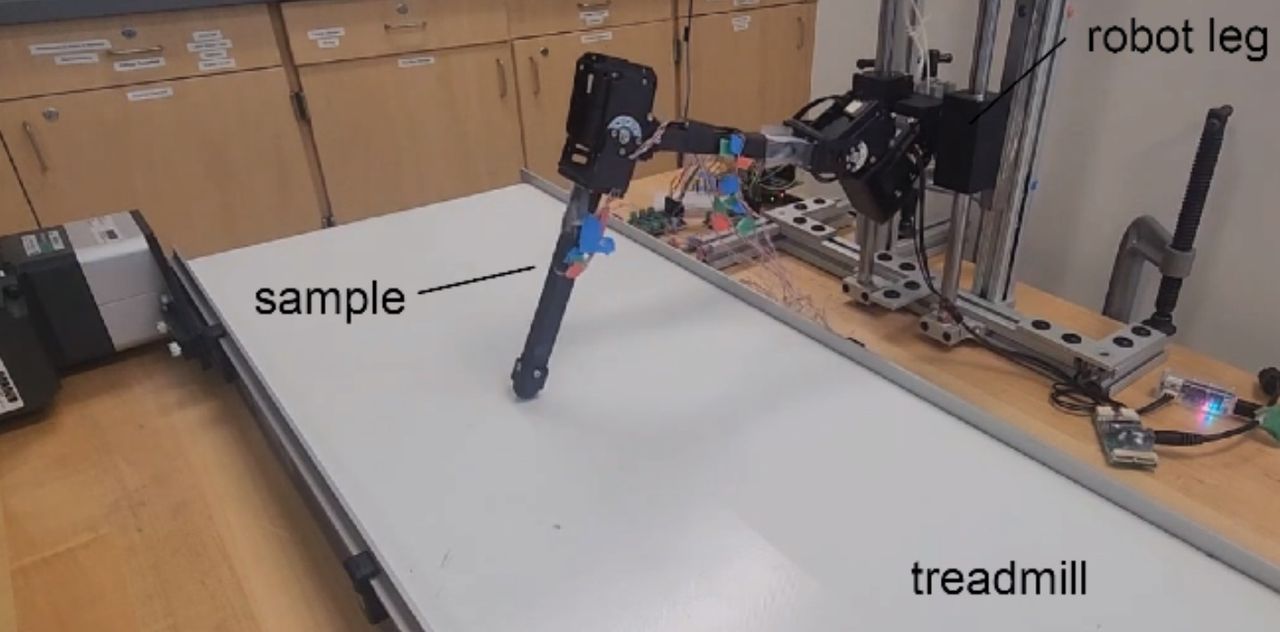
Researchers report on a bioinspired, additive approach that stiffens robotic limbs while improving embedded strain sensing.
The study explores how material placement inspired by natural structures can be optimized for robotic limbs and then produced by additive manufacturing. The researchers focus on two outcomes that often contrast each other — structural stiffness for load-bearing performance and sensitivity for proprioceptive feedback — and they claim that both can be advanced simultaneously via material optimization.
While traditional mechatronic builds bolt on foil gauges, flexures, or external encoders, polymer 3D printing increasingly enables geometry and materials to do the sensing from within the part itself. Multi-material extrusion, inkjet-style systems, and even clever single-material designs with tuned infill can bias strain where it is useful and stiffen regions that must carry load.
The robotic use case is pretty compelling because arms and legs face a constant tradeoff between rigidity for precision and compliance for safety. If the structure can shoulder more of the stiffness budget, actuators can shrink, and if the structure can report strain reliably, separate sensor stacks and cabling can thin out. The paper’s basic promise is to use AM’s voxel-level control to play both sides of that tradeoff.
Bioinspired Layout Meets Multi-Material AM
The researchers describe an optimization flow that allocates materials through a limb segment to follow load paths for stiffness while locating sensitive regions for strain readout. In practice, that looks like an analysis model that assigns stiffer material where stress concentrates and routes compliant or sensing-capable material along directions where strain information is most informative. Additive manufacturing then turns that concept into a physical part.
What is new here is not merely printing a flexible skin over a rigid core; it is the optimization of structure and sensing as one combined problem, then building it additively as a single object. The result is a printed limb segment that, according to the paper, increases stiffness while simultaneously improving strain observability compared to a previous approaches. .
Achieving robust interfaces between dissimilar materials is non-trivial across AM platforms; interlayer bonding, anisotropy, and long-term creep can erode both stiffness and sensor repeatability. Strain sensing, especially if based on piezoresistive composites or geometry-induced resistance changes, can drift with temperature and loading history. Calibration, signal conditioning, and shielding still matter, even if the sensing element is part of the structure.
What It Could Change For Robotics
If the reported gains in the paper are true, the approach could reduce mass and part count in arms, grippers, and legged robots by shifting capabilities into the printed structure. Service bureaus with multi-material polymer capacity, research labs prototyping soft-hard hybrids, and integrators building small-batch manipulators stand to benefit most. Even single-material processes could adopt the placement logic by varying infill and ribbing to bias stiffness and strain, though the sensing improvement would then rely on external gauges.
There could be reduced assembly and lower human labor required: fewer brackets and harnesses, less adhesive bonding, and minimal secondary machining. Throughput will depend on the chosen process; inkjet-style systems can place multiple photopolymers in one pass, while dual-extrusion FFF may pay a time penalty for tool & material changes and purges.
As additive manufacturing continues going deeper into robotics, designs that make the structure carry both loads and information could become quite a bit more important.
