
A new Chinese patent application describes a way to make large format resin systems much cheaper.
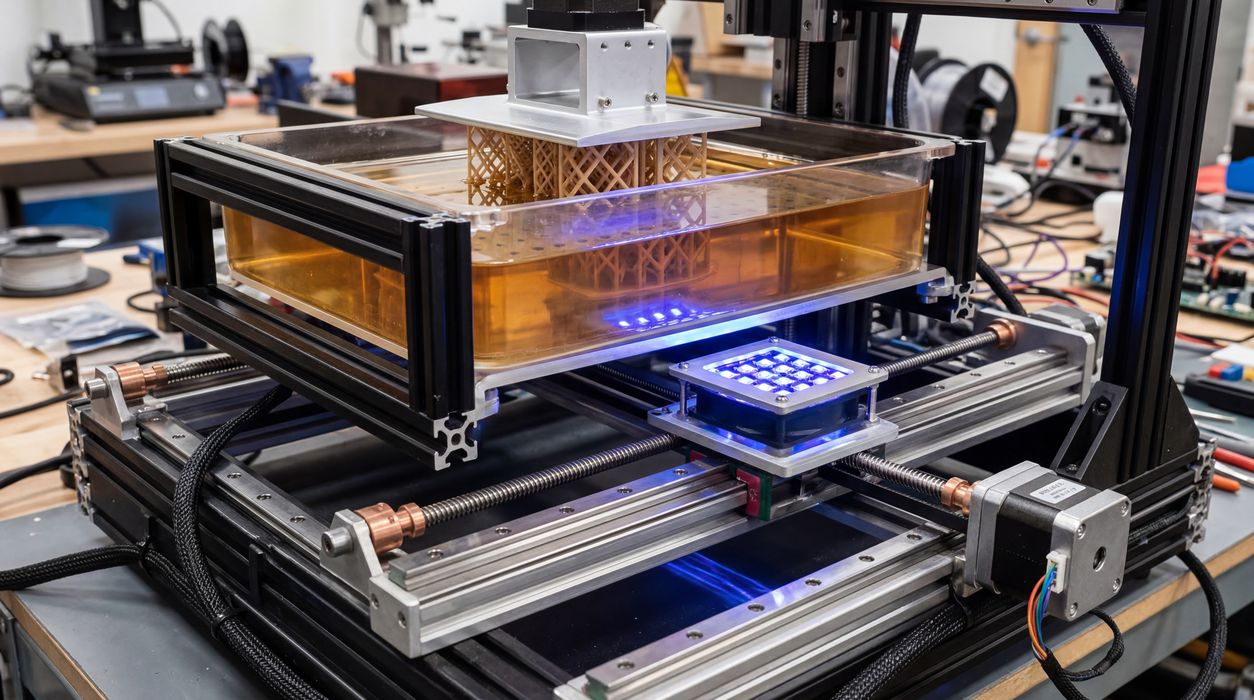
The application, CN121608383A, is titled “A photocuring 3D printing device and its printing method,” and it was filed by Fujian Huistone 3D Technology Co., Ltd. The abstract describes a machine with a housing, a UV light source plate, a build platform above it, and an adjustment mechanism that repositions the UV source under different parts of the working area. Instead of flooding the entire vat from a larger fixed UV source, the machine moves the light source to expose selected regions in sequence.
This is somewhat similiar to Prodways’ “moving light” concept that has been around for about a decade.
That matters because vat photopolymerization systems usually scale awkwardly. Desktop masked stereolithography and related resin processes work well when the illuminated area is modest, but once build volume expands, the optics, light uniformity, heat, and cost all become more difficult. Huistone’s idea appears to attack that scaling problem by moving the light engine instead of enlarging it. That is not an entirely new printing process, but it is an interesting adaptation of current machine architecture.
The mechanism looks pretty straightforward. The patent abstract says servo motor A drives screw A to shift a crossbeam laterally, while servo motor B drives screw B to move another driven block longitudinally. Guided by sliding rods, the assembly repositions the UV light source plate so different regions of the build platform can be irradiated and formed. In other words, it is a traveling light engine for resin printing.
Huistone lists the benefit as lower energy consumption because the machine no longer needs a larger ultraviolet source to cure resin across the full area at once. That claim is technically correct, but it deserves some thought. On a desktop resin machine, the UV source is already fairly compact, so the saved wattage may be minor once servos, screws, motion control, and longer exposure cycles are included. A likely explanation is that this concept makes more sense on much larger systems, where illumination hardware becomes expensive, bulky, and harder to keep aligned.
That is where the patent gets more interesting. If a manufacturer can cover a wider build area with a smaller light engine, it may reduce bill of materials cost, simplify thermal management, and avoid the challenge of building a very large uniform source.
But the tradeoff is throughput. A full layer can no longer be flashed in one go if the machine must tile exposures across the vat. Service bureaus or factories requiring large parts might accept that compromise if machine cost drops enough, but dental labs or production users focused on cycle time may not. The patent does not provide throughput figures, light intensity, positional accuracy, or any data showing whether layer seams or exposure boundaries become visible artifacts.
Huistone itself is not a random company. Public company records describe the Fujian based firm as founded in 2017 and focused on 3D printing research, manufacturing, and application services, while regional government notices also reference an additive manufacturing equipment production project under the company’s name. That gives the filing a bit more weight than a speculative patent from a non AM player, as we often see from Asian industrial firms. However, this is only a patent application, not a product launch, and there is no pricing, ship date, material strategy, or proof that the concept has moved beyond the drawing stage.
Huistone will need to show whether the moving light source preserves curing uniformity, whether stitched exposure zones affect surface quality, and whether the energy and cost savings outweigh the slower scan like workflow. If those numbers work, this could become a practical architecture for larger photocuring platforms. If not, it will remain a clever attempt to solve the wrong bottleneck.
